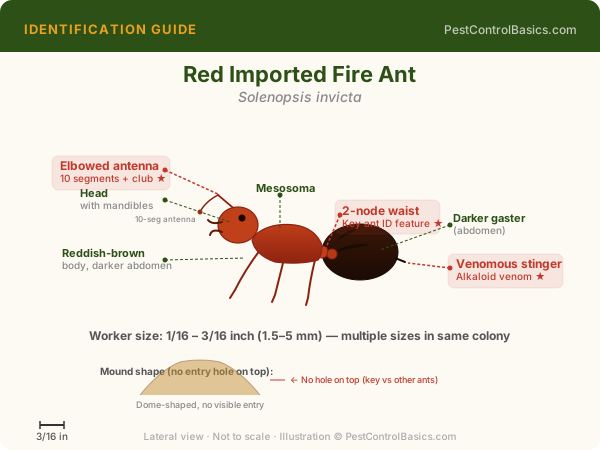
Original illustration by PestControlBasics.com. Use anatomical labels above to confirm your identification. For photo references, see the identification section below.
Identification
Pavement ants are tiny (1/8 inch), dark brown to black, and move in distinctive trails along pavement edges, sidewalk cracks, and foundation perimeters. The key identifier is their nesting location — small craters of sandy soil pushed up through cracks in pavement or at the base of foundations. During spring and early summer, rival colonies engage in massive territorial battles on driveways and sidewalks — hundreds of ants fighting in piles. Alarming looking but completely harmless.
They enter homes through foundation cracks, expansion joints, and utility penetrations — typically foraging at night along baseboards, under kitchen appliances, and around pet food.
Unlike fire ants or carpenter ants, pavement ants are extremely predictable foragers that trail reliably. Drop Terro liquid bait along their trail and they'll find it within minutes. A single well-placed bait station eliminates most pavement ant infestations within 1–2 weeks. This is one of the simplest DIY ant control situations there is.
Control Protocol
Outdoor mound treatment: Drench the sidewalk crack mounds with diluted bifenthrin solution (1 oz per gallon water) for immediate knockdown. Follow with bait stations placed along entry trails to prevent satellite colonies from reestablishing inside.
If you see hundreds of pavement ants fighting on your driveway in spring, this is normal territorial warfare between neighboring colonies — not an invasion. They'll disperse on their own within hours. No treatment needed for the outdoor battle itself.
Identification — The Coconut Smell Test
Odorous house ants are tiny (1/16 to 1/8 inch), dark brown to black, and move in fast, erratic trails — they don't march in a straight line the way pavement ants do. The definitive identification: crush one between your fingers. The rotten coconut or blue cheese odor is unmistakable and instant. No other common household ant smells this way.
They nest in an enormous variety of locations: wall voids behind baseboards, under bathroom tiles, in rotting wood, under mulch adjacent to the foundation, even inside potted plants. Multi-queen colonies can have dozens of reproductive queens, which allows them to quickly rebuild after partial disruption.
Odorous house ants with multiple queens respond to repellent spray by budding — the colony splits, queens move to new satellite locations, and you end up with several infestations instead of one. This is why every time someone sprays their kitchen and the ants "come back worse," it's because they actually caused colony fission. Bait is the only indoor treatment that works.
Control Protocol
Timeline expectation: Multi-queen colonies take longer to eliminate than single-queen species. Expect 2–4 weeks of active baiting before numbers drop significantly. Resist the urge to spray — patience with bait always outperforms the spray-and-wait cycle.
Why Argentine Ants Are Different From Every Other Ant
Most ant species are territorial — colonies of the same species fight each other. Argentine ants don't. Colonies recognize each other as family and cooperate, forming massive supercolonies that share workers, queens, and food sources across enormous areas. In California, the "California Large" supercolony is one of the largest cooperative animal societies ever documented. If you're in California, Southern Arizona, the Gulf Coast, or the Southeast and you have a serious ant problem, it's probably Argentine ants.
They enter homes through the tiniest gaps — expansion joints, weep holes, around electrical conduit — driven by temperature and moisture. In hot dry summers they flood into structures seeking water. In winter they seek warmth. This means they can be a year-round problem in mild climates.
A supercolony with hundreds of queens cannot be eliminated by killing workers. Spray kills today's foragers while the colony rapidly replaces them from satellite nests. Worse, repellent sprays around the perimeter push the colony to find new entry points deeper into the structure. Argentine ant control requires bait that travels back to and kills queens — not contact kill of workers.
The Only Effective Control Strategy
Realistic expectations: You cannot eliminate Argentine ants from your property — the supercolony extends far beyond your lot. The goal is management: keeping them out of the structure and reducing population pressure near the home. With consistent baiting and exclusion, indoor infestations are controllable. Outdoor populations will always be present in affected regions.
Argentine ant food preferences shift seasonally — sweet in spring, protein in summer. Rotate between Terro (boric acid/sweet) and Advance 375A (protein) every 4–6 weeks, or use both simultaneously. If ants stop taking bait, switch formulations rather than adding more of the same type.
Identification
Little black ants are one of the smallest common U.S. ant species — at 1/16 inch, they're barely visible individually but highly visible in trails. Jet black coloring distinguishes them from the dark brown odorous house ant (which they're often confused with). The quick smell test helps: crush a little black ant and there's no odor. Crush an odorous house ant and the coconut smell is immediate.
They nest outdoors in soil, woodwork, rotting logs, and masonry — and send foraging trails into homes through the tiniest gaps. Trails typically follow pipes, electrical conduit, and baseboards into kitchens and bathrooms. They're sweet-feeders almost exclusively, which makes Terro bait extraordinarily effective against them.
Little black ants with 1–2 queens and a strong sweet preference respond faster to Terro bait than almost any other ant species. Place Terro liquid bait stations directly on the trail (don't move or disturb the station once placed) and expect massive bait feeding within hours and significant population reduction within 5–7 days. This is genuinely one of the easiest pest control problems there is.
Control Protocol
Why so many ants suddenly appear around the bait: When you place Terro bait, foragers carry a pheromone trail back to the nest telling others where the food is. The swarm of ants at the bait station looks alarming but is exactly what you want — they're all loading up on boric acid to carry home. Don't spray them. Wait 5–7 days and the colony collapses.
Compare All 4 Common Nuisance Ants
| Species | Size | Key ID | Range | Nest Location | Queens | Best Control | DIY Difficulty |
|---|---|---|---|---|---|---|---|
| Pavement Ant | 1/8" | Sandy mounds in pavement cracks | Northeast, Midwest | Under pavement, foundation edges | 1 | Terro bait stations | Easy |
| Odorous House Ant | 1/16–1/8" | Rotten coconut smell when crushed | All 48 states | Wall voids, mulch, under tiles | Many | Sweet + protein bait both | Moderate |
| Argentine Ant | 1/16" | Light brown, massive wide trails | CA, Gulf South, SE | Supercolony — soil, roots, mulch | Hundreds | Heavy bait + exclusion | Moderate — management only |
| Little Black Ant | 1/16" | Jet black, no smell, tiny | Nationwide | Woodwork, masonry, soil | 1–2 | Terro liquid bait | Very easy — 5–7 days |
These four species are the common nuisance ants. For fire ants (painful sting, dome mounds) see the Red Imported Fire Ant guide. For carpenter ants (large black ants, sawdust piles, structural damage) see the Carpenter Ant guide.