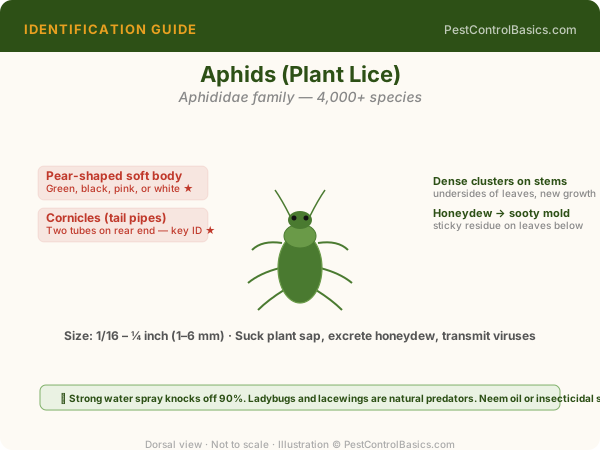
Original illustration by PestControlBasics.com. Use anatomical labels above to confirm your identification. For photo references, see the identification section below.
The explosive reproduction problem
Aphids have one of the most remarkable reproductive strategies in the insect world. In spring and summer, females reproduce by parthenogenesis — giving birth to live female offspring without mating. These offspring are born already pregnant. A single aphid in optimal conditions can produce a colony of thousands within weeks.
Identification by plant location: Aphids cluster on the underside of leaves and on new growth — the youngest, most tender plant tissue with the most accessible phloem. Curling or puckering of new leaf growth, often with a sticky residue on leaves below, is the first visible sign.
Sooty mold: The honeydew aphids excrete as a byproduct of sap feeding falls on lower leaves and surfaces below the infestation, where a black fungus (sooty mold) grows on it. The mold itself doesn't damage plants but blocks sunlight and indicates a significant aphid population above.
Ant farming: Many ant species actively protect aphid colonies from predators in exchange for honeydew — this is why ants are often found on aphid-infested plants. Controlling ants near garden plants (sticky bands around trunks) improves natural predator access to aphids.
Encouraging predators vs. direct treatment
Strong water spray: The simplest and most immediate treatment. A strong stream of water from a garden hose dislodges aphids from stems and leaves. Aphids that fall cannot climb back to the plant. Effective for small to moderate infestations when done every 2–3 days.
Neem oil spray: Mix 1–2 tablespoons neem oil + 1 teaspoon dish soap per gallon of water. Apply to all plant surfaces including undersides of leaves. Neem disrupts aphid development and reproduction. Most effective on nymphs; repeat every 5–7 days.
Insecticidal soap: Directly kills aphids on contact by disrupting their cell membranes. Must contact the pest directly — no residual. Apply in early morning or evening to avoid leaf burn.
Encouraging natural enemies: Plant flowers that attract beneficial insects near the garden — dill, fennel, yarrow, sweet alyssum. Avoid broad-spectrum insecticides that kill ladybugs, lacewings, and parasitic wasps. A single ladybug eats 50–60 aphids per day and 5,000+ in its lifetime. Lacewing larvae are similarly voracious.
Imidacloprid and other systemic insecticides applied as soil drenches are taken up into all plant tissues including pollen and nectar. On flowering plants, this kills pollinators. Use only contact sprays (neem, soap) on flowering plants, and only when bees are not actively foraging.