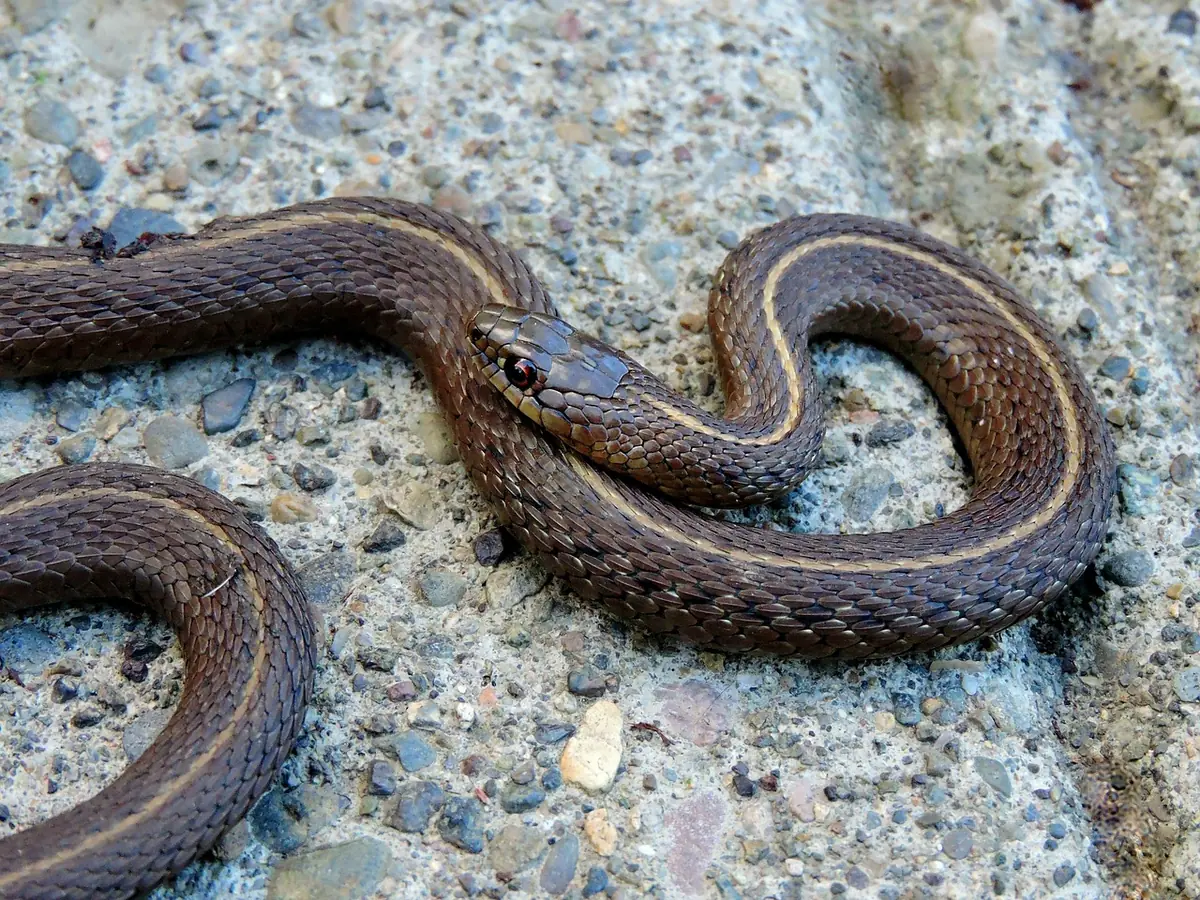
Of the roughly 50 snake species commonly found in U.S. homes, only 4 groups are venomous: copperheads, rattlesnakes, cottonmouths, and coral snakes. The overwhelming majority of snakes found indoors are harmless species — rat snakes, garter snakes, and ring-necked snakes — that entered accidentally and want to leave as badly as you want them out.
According to data compiled by the CDC, approximately 7,000–8,000 venomous snakebites occur in the U.S. annually, and the majority happen outdoors during recreational activities — not from snakes found inside homes. The odds that a snake in your living room is dangerous are low. But the protocol below keeps you safe regardless of species.
Most snake bites in the U.S. happen when people try to handle, kill, or capture snakes. Keep visual contact from a safe distance — at least 6 feet. If you cannot stay in the room, close the door and place a rolled towel along the bottom gap to contain the snake in one room. Note which room and approximately where in the room — this helps the removal professional find it quickly.
Keep children and pets out of the room immediately. If the snake is in a hallway or open-plan area, try to herd it gently toward a room with a closable door using a broom held at full arm's length — but only if the snake is clearly moving away from you. Never corner a snake.
You do not need to get close to make a preliminary identification. From 6+ feet, look for these general characteristics:
Triangular, wide head distinctly broader than the neck. Thick, heavy body relative to length. Vertical (slit) pupils if you can see them from distance. Rattlesnakes have a rattle on the tail. Copperheads have hourglass-pattern copper-brown bands. Cottonmouths are heavy-bodied, dark, and often display a white mouth lining when threatened.
Rounded head not much wider than the body. Slender body. Round pupils. Smooth, uniform coloring or simple stripe patterns. Common harmless species include rat snakes (black, gray, or yellow with blotches), garter snakes (striped, slender), and ring-necked snakes (small, dark back with yellow/orange belly ring).
If you cannot tell: Treat it as venomous. Keep your distance and call a professional. Photographing the snake from a safe distance with your phone's zoom helps the removal operator identify it before arriving — and saves time on site.
| Species | Range | Key Visual Feature | Where Found Indoors |
| Copperhead | Eastern & Central U.S. | Hourglass copper-brown bands; tan body | Basements, garages, crawl spaces |
| Rattlesnake | Nationwide (multiple species) | Rattle on tail; diamond or banded pattern | Garages, utility rooms, basements |
| Cottonmouth | Southeast U.S. | Heavy dark body; white mouth lining | Near water sources; crawl spaces |
| Coral snake | Southeast & Southwest U.S. | Red-yellow-black bands (red touches yellow) | Garages, under debris near foundations |
For coral snakes specifically, the old rhyme "red touches yellow, kill a fellow; red touches black, friend of Jack" is a general guide for North American species, but it does not apply to coral snakes outside the U.S. When in doubt, do not approach — call a professional.
Open an exterior door and gently guide the snake toward it with a broom from a distance. Most will leave on their own if given a clear escape route. Alternatively, call a wildlife removal professional — many handle snake calls for $75–$200.
Call a licensed wildlife removal operator or your local animal control. Do not attempt to handle, kill, or trap the snake. Keep children and pets away from the room. Most wildlife removal companies offer same-day service for snake calls because they understand the urgency.
If someone is bitten by a venomous snake, call 911 immediately. According to the CDC, do not apply a tourniquet, do not attempt to suck out venom, do not apply ice, and do not cut the bite site. Keep the bitten limb at or below heart level and get to an emergency room with antivenom capability as quickly as possible.
Snakes are exceptional hiders. They can fit into gaps as narrow as their body diameter and will seek dark, warm, tight spaces — behind refrigerators, inside wall voids, under water heaters, in closet clutter, and behind washing machines. If the snake disappears before you or a professional can remove it:
Set glue board traps along walls. Snakes travel along edges and baseboards. Place large glue boards (the rodent-sized ones, not small insect monitors) along the walls of the room where the snake was last seen, and in adjacent rooms. Check them daily. A trapped snake can be released by pouring vegetable oil on the glue.
Check warm spots. Snakes are attracted to warmth — behind the refrigerator, near the water heater, around dryer vents, and in sunny windowsills. Inspect these areas carefully.
Reduce clutter. Remove boxes, stacked items, and debris from floors to eliminate hiding spots. The fewer places a snake can hide, the sooner it will be found or will attempt to leave on its own.
Snakes enter homes through openings you might not even notice. According to the Penn State Extension, most snakes can pass through any gap they can fit their head through — which means openings as small as half an inch for many species.
| Entry Point | How to Seal It | DIY Cost |
| Gap under exterior doors | Install door sweep (rubber or brush-style) | $8–$15 |
| Foundation cracks | Fill with hydraulic cement or polyurethane caulk | $10–$25 |
| Crawl space vents | Cover with ¼-inch hardware cloth | $5–$10/vent |
| Pipe and cable penetrations | Seal with expanding foam or caulk | $5–$8 |
| Garage door gaps | Install bottom seal and side weatherstripping | $15–$30 |
| Weep holes in brick veneer | Insert stainless steel mesh weep hole covers | $1–$2/hole |
Snakes enter homes for two reasons: following prey and seeking shelter. Effective prevention addresses both.
Eliminate the rodent population. A snake in your house almost always means you also have a mouse problem you did not know about. Snakes follow mouse scent trails directly to their food source — through the same gaps mice use to enter. Solving the mouse problem removes the primary reason snakes enter homes. Set snap traps and seal entry points.
Seal all gaps larger than ¼ inch at ground level. Walk the exterior perimeter of your home and seal every crack, gap, and opening at or below the foundation line. Pay special attention to where utilities enter the house — cable, water, gas, and electrical penetrations are common entry routes.
Reduce exterior harborage. Snakes shelter under debris, woodpiles, landscape timbers, thick mulch, and dense ground cover near foundations. The Texas A&M AgriLife Extension recommends maintaining a 24-inch clear zone of gravel or bare ground between foundation walls and any landscaping, mulch, or ground cover.
Install door sweeps on all exterior doors. This is the single most common entry point for snakes — especially garage-to-house doors, which often have significant gaps.
No. Commercial snake repellents — naphthalene (mothball-based), sulfur, essential oil blends, and electronic vibrating stakes — have been tested extensively and show no reliable effectiveness. The University of Nebraska Extension, USDA Wildlife Services, and multiple state wildlife agencies have concluded that no chemical repellent consistently prevents snakes from entering an area.
Naphthalene-based products are particularly problematic because they are toxic to children and pets, produce strong fumes, and contaminate soil. The EPA has not approved any snake repellent product with proven efficacy claims.
The only proven prevention method is physical exclusion — sealing entry points, removing harborage, and eliminating the prey that attracts snakes. If a pest control company offers to spray a "snake repellent" around your foundation, they are selling you an ineffective service.
| Service | DIY Cost | Professional Cost |
| Snake removal (single visit) | — | $100–$250 |
| Emergency/after-hours removal | — | $200–$400 |
| Foundation exclusion (sealing entry points) | $50–$150 | $200–$500 |
| Door sweeps (all exterior doors) | $30–$60 | $75–$150 (installed) |
| Crawl space vent screening | $20–$50 | $100–$250 |
| Rodent control (snap traps + exclusion) | $25–$60 | $150–$350 |
No. Attempting to kill a snake is the leading cause of snakebite. Harmless snakes provide valuable pest control by eating mice and insects, and many species are legally protected. Keep your distance, contain the snake in one room, and call a professional.
Through gaps as small as half an inch — under doors without sweeps, foundation cracks, pipe penetrations, crawl space vents, and garage door gaps. Snakes follow prey (especially mice) or seek shelter from extreme weather. A snake inside often indicates a rodent problem you were not aware of.
From 6+ feet, look for a triangular head wider than the neck, a thick heavy body, and vertical pupils. Rattlesnakes have a rattle; copperheads have hourglass bands. However, some harmless snakes flatten their heads when threatened. If you cannot identify with confidence, treat it as venomous and call a professional.
Professional removal typically costs $100–$250 per visit, with emergency calls running $200–$400. Exclusion work to prevent future entries costs $50–$150 DIY or $200–$500 professionally. The exclusion is more important than the removal.
No. Naphthalene, sulfur, essential oils, and electronic vibrating stakes have all been tested and found ineffective by university extension programs. Naphthalene products are also toxic to pets and children. Physical exclusion — sealing gaps and removing prey — is the only proven method.
Sometimes, if given a clear exit. But if your home has mice, warmth, and hiding spots, the snake may stay indefinitely. If it disappears, set large glue board traps along walls and check daily. Pour vegetable oil on the glue to release a trapped snake.
Pest control content on the internet has grown dramatically in volume but not in average quality, and the signals that distinguish reliable sources from unreliable ones are worth knowing. Reliable content typically cites specific products by active ingredient rather than only by brand, references regional variation in pest pressure and treatment efficacy, acknowledges treatment failures and the conditions under which they occur, and avoids absolute claims about results. Unreliable content tends to make universal claims, recommend specific brand products without identifying alternatives, omit the conditions under which advice applies or fails, and write in a tone optimized for affiliate conversion rather than reader understanding. The other useful signal is whether the source discusses cost-benefit and threshold thinking — at what point does treatment become worth doing — versus only providing how-to instructions with the assumption that treatment is the right answer. Sources that engage with the decision dimension are usually more reliable than sources that skip past it. None of these signals are perfect, but applied consistently they filter out a meaningful portion of the lower-quality content that dominates search results for many pest topics.
Renovation work is one of the highest-value moments for pest intervention, and it's also one of the most consistently missed. When walls are open, when slabs are exposed, when crawlspaces are accessible, when sill plates are visible — these are the windows during which exclusion work, soil treatment, perimeter sealing, and harborage elimination can be done at a fraction of their normal cost and with dramatically better completeness. The same caulk-and-foam exclusion job that takes hours of awkward work after the fact can be done in minutes when the wall cavity is open. A pre-construction termite soil treatment is dramatically more effective than any post-construction equivalent, but it has to happen before the slab is poured. Even non-structural renovations like flooring replacement, kitchen rework, or basement finishing create windows during which the home's pest-relevant geometry can be improved. The cost of pulling in a pest professional during the renovation envelope, even just for an inspection and recommendations, is almost always recovered in reduced future treatment costs and avoided structural damage. The conversation to have with general contractors is whether they're willing to coordinate with a pest specialist during the open-wall phase, and most reputable contractors are, particularly on larger jobs where the small additional scheduling complexity is offset by the value-add for the homeowner.
Most households treat pest control as an emergency expense rather than a line item, and the resulting spend is almost always higher than what a planned program would have cost. A property that allocates a modest annual budget toward inspections, preventive perimeter work, and one or two scheduled treatments at high-pressure times of year typically spends a fraction of what a comparable property spends on crisis response to a single major infestation. The math is straightforward: a moderate cockroach, rodent, or bed bug job typically costs more than a year of preventive service, and the labor and disruption costs to the household are not trivial either. Building a budget also forces the kind of structured thinking that catches problems early — when a homeowner has already decided to allocate funds, they're more willing to call for an inspection at the first ambiguous sign, rather than waiting until the situation is unambiguous and more expensive. The shift from reactive to planned spending is one of the highest-leverage changes a household can make in this category.