The short answer
- Exclusion works best: replace loose screens, and caulk gaps around door and window frames, soffits and siding before the bugs gather.[1]
- Screen soffit and peak vents as well as windows and doors.[3]
- Vacuum bugs that get inside rather than crushing or spraying them; a shop vacuum with a little soapy water kills them and keeps odor out of your household vacuum.[3]
- They come in looking for winter shelter; beyond being annoying, they are not a threat.[1]
Common invaders with full profiles
Western conifer seed bug
- Adults are 3/4 inch, reddish to dark brown, with a thin, jagged white line across the back and yellow-and-black patches along the abdomen edge; they buzz loudly in flight.[1]
- Native to the West, it spread east from the 1950s and is now found across the U.S., most abundant in the Northeast. It feeds on conifer cones and seeds without harming the trees.[1]
- It isn't considered a medical risk: only a single bite has ever been recorded worldwide.[1]
Elm seed bug
- Adults are about 1/3 inch, rusty red and black, with an upside-down black triangle on the back and white dots near the wing tips; when crushed they give off a pungent odor like bitter almonds.[2]
- A European insect first found in the U.S. in Idaho in 2012, now in Utah, Oregon and Washington, it feeds mainly on elm seeds. Unlike the boxelder bug, its nuisance peak is mid-June through August.[2]
- Seal exterior cracks, and make sure windows, screens and door sweeps fit with no gaps; perimeter pyrethroid treatments around foundations, windows, doors and eaves can reduce entry.[2]
Kudzu bug
- Kudzu bugs are almost square, about 1/4 inch, light brown with an olive-green hue, and related to stink bugs; first found in Georgia in 2009, they're now across the Southeast.[3]
- They feed on kudzu, wisteria, soybeans and other beans, then gather on light-colored, especially white, sunlit house walls, window trim and gutters in fall.[3]
- Their secretions smell bad and stain fabrics and walls; handling them can stain skin or even cause blisters in sensitive people. Cutting back nearby kudzu or wisteria before fall helps.[3]
Common questions
- Will these bugs damage my house or bite me?
- No. They overwinter in sheltered spots and are a nuisance; western conifer seed bugs, for example, aren't considered a medical risk.[1]
- Should I spray inside the house?
- Vacuum bugs found indoors instead; most home insecticides kill kudzu bugs, but sprays are best limited to small outdoor areas where they land.[3]
- Why do the bugs come back every year?
- They return to protected overwintering sites each fall; sealing cracks and gaps before they gather is the best long-term fix.[1]
Updated 2026-10-06. Built from sourced records. Spot an error? Tell us.
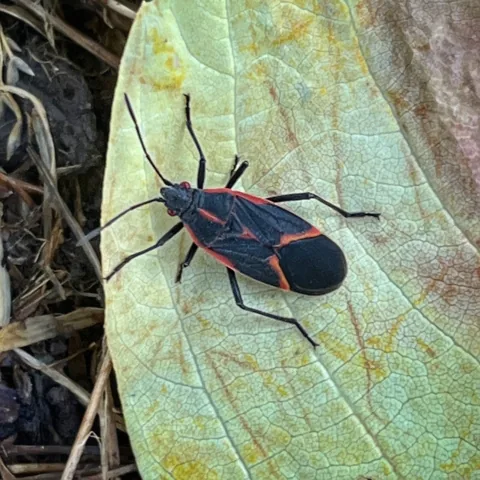 Boxelder Bug
Boisea trivittata
Boxelder bugs feed mainly on the seeds of female boxelder trees and become a nuisance when they gather on homes in fall looking for places to spend the winter; they don't breed indoors.
Sourced profile →
Boxelder Bug
Boisea trivittata
Boxelder bugs feed mainly on the seeds of female boxelder trees and become a nuisance when they gather on homes in fall looking for places to spend the winter; they don't breed indoors.
Sourced profile →
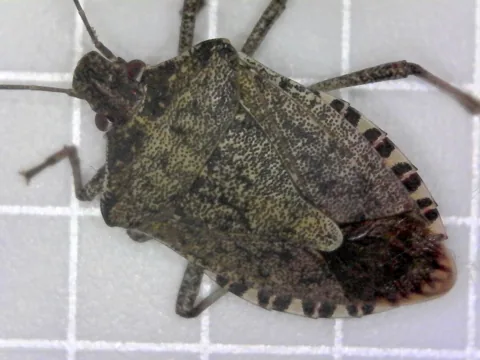 Brown Marmorated Stink Bug
Halyomorpha halys
The brown marmorated stink bug is an invasive insect from east Asia that damages fruit and vegetable crops and invades homes in fall looking for overwintering sites.
Sourced profile →
Brown Marmorated Stink Bug
Halyomorpha halys
The brown marmorated stink bug is an invasive insect from east Asia that damages fruit and vegetable crops and invades homes in fall looking for overwintering sites.
Sourced profile →
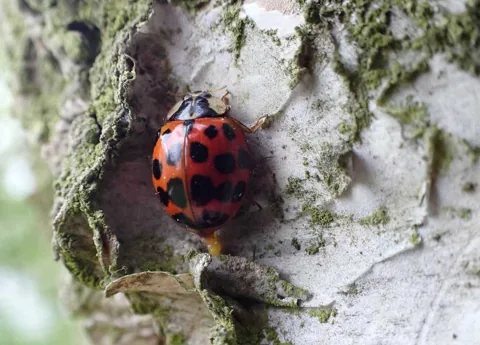 Multicolored Asian Lady Beetle
Harmonia axyridis
The multicolored Asian lady beetle is a beneficial aphid predator outdoors but becomes a nuisance when it flies to buildings in fall to overwinter and ends up indoors.
Sourced profile →
Multicolored Asian Lady Beetle
Harmonia axyridis
The multicolored Asian lady beetle is a beneficial aphid predator outdoors but becomes a nuisance when it flies to buildings in fall to overwinter and ends up indoors.
Sourced profile →