How to identify it
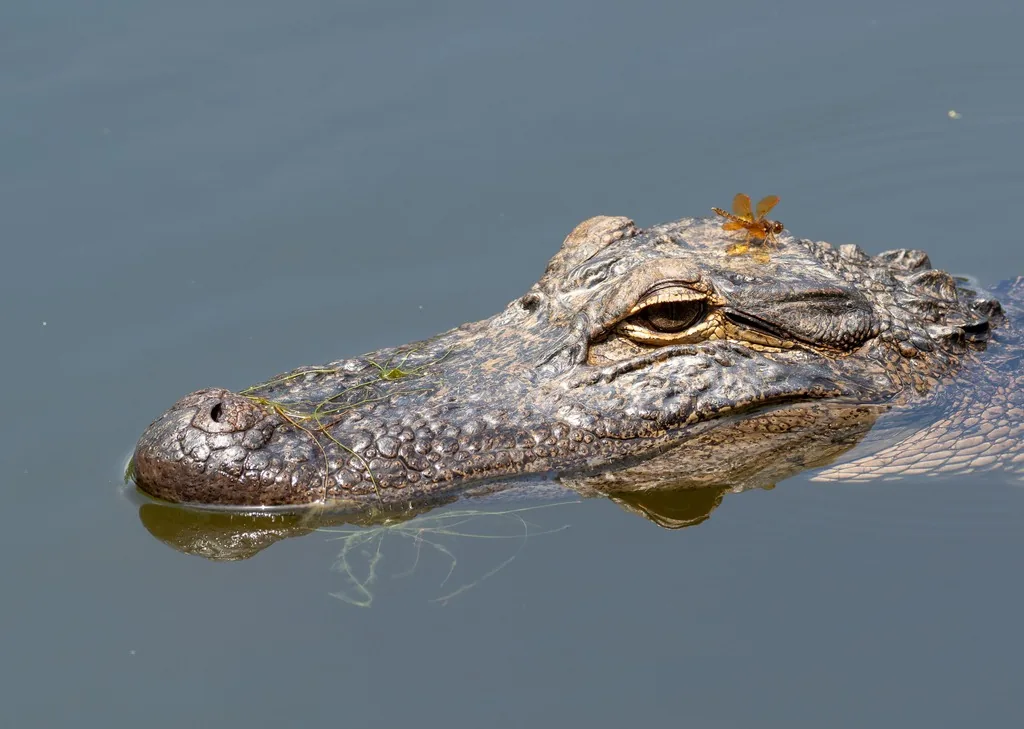
- A large crocodilian with a broad, rounded snout and black and yellow-white coloring.[1]
- Males can grow to more than 14 feet long and about 1,000 pounds; females rarely exceed 10 feet.[1][7]
- Alligators communicate by bellowing and head-slapping, and they hiss as a warning when a person is too close.[1][8]
- Their eyeshine at night is red, from a reflective layer behind the retina.[7]
Look-alikes
| Look-alike | How to tell them apart |
|---|---|
| American crocodile | Olive-brown with a pointed snout; scarce and protected, it lives mainly in south Florida's coastal and brackish waters.[1] |
| Caiman | A smaller, olive-brown crocodilian with a pointed snout, imported from Central and South America and breeding only in south Florida.[1] |
Where it lives
Alligators live from southeast Oklahoma and east Texas to North Carolina and Florida, with viable populations in Texas, Oklahoma, Arkansas, Louisiana, Mississippi, Alabama, Florida, Georgia, South Carolina and North Carolina.[7][1]
Biology and life cycle
Alligators are cold-blooded: most active between about 82 and 92 degrees F, they stop feeding below about 70 degrees and become dormant below 55.[7][2]
Courtship starts in April and mating follows in May or June; females lay about 30 to 50 eggs in a mound nest of plants and soil.[7][2]
Eggs hatch after about 63 to 68 days, from mid-August to early September, and females defend their nests and young.[7][2]
Young alligators eat insects, snails, crustaceans and small fish; adults take fish, turtles, snakes, birds and mammals.[7][2]
Florida alone has about 1.3 million alligators, found in all 67 counties.[5][6]
In spring and summer alligators move around to breed and find new habitat, and most wanderers are smaller ones pushed out by bigger alligators.[8]
Damage and signs
- Alligators readily take dogs and cats, and large ones in rural areas may take calves, goats, hogs and domestic waterfowl.[3]
- Burrowing can damage dikes, levees, impoundments and turf, and breach fences.[3]
- Ponds at golf courses and dense housing become problem sites when alligators get used to living near people.[3]
Health risk
Serious alligator bites are rare; Florida averaged eight unprovoked bites a year needing medical treatment from 2012 to 2022. Every bite needs medical care, because bacteria in an alligator's mouth can cause serious infection.[6][3][5]
Control
Prevention
Never feed alligators. It's illegal and dangerous, because fed alligators learn to link people with food and often have to be removed.[6][8][3]
Keep pets on a leash and away from the water's edge, and swim only in designated areas during daylight, since alligators are most active between dusk and dawn.[6][8]
Keep a safe distance; TPWD suggests at least 30 feet. Supervise children closely near water, and never pick up baby alligators.[6][8]
Build trails at least 15 feet from the water's edge and keep vegetation cut along them.[4]
Keep them out
Bulkheads at least 3 feet above high water exclude alligators along shorelines; fences need outward-angled tops and 4-inch mesh buried 2 feet, since alligators can climb 5-foot chain link.[4]
Sanitation
Don't throw fish scraps into the water or leave them on shore; put them in garbage cans at boat ramps or fish camps.[8]
When to call a professional
Don't kill, harass or try to move an alligator yourself. Report a problem animal to your state wildlife agency; no repellents or toxicants are registered for alligators.[8][4][1]
Is it a nuisance alligator?
Florida generally considers an alligator a nuisance if it is at least 4 feet long and believed to threaten people, pets or property.[5]
Smaller alligators in places like pools, garages or porches also need removal, but you should never handle one yourself.[5]
A basking alligator, even with its mouth open, is usually just regulating its temperature, not hunting.[8]
An alligator that comes straight toward people, especially out of the water, or that keeps following boats is a nuisance and should be reported.[8]
If one is just passing through, Texas advises waiting a few days to a week if possible, since many wanderers move on.[8]
Who to call
In Florida, call the FWC Nuisance Alligator Hotline at 866-FWC-GATOR (866-392-4286); a contracted nuisance alligator trapper is sent if the complaint qualifies.[5][6]
In Texas, report a nuisance alligator to the TPWD law enforcement communications center at 512-389-4848.[8]
In Louisiana, complaints go to LDWF offices, which forward them to licensed nuisance alligator hunters in the area.[9]
FWC doesn't relocate nuisance alligators, because they often try to return and can cause fights or new problems where they are released.[5]
Legal status
Federal law lists the alligator as threatened due to similarity of appearance to other crocodilians, which protects it while allowing state management programs.[1][7]
Only people with proper licenses or permits may take alligators.[1][7]
In Texas it is illegal to feed, kill, harass or remove alligators from the wild or keep one as a pet.[8]
Common questions
- Will an alligator chase me on land?
- It is extremely rare. Alligators usually retreat from people, but they are fast over short distances, so back away slowly if one is close.[8]
- Can the state just relocate the alligator in my pond?
- Florida doesn't relocate nuisance alligators; they tend to come back and can cause problems along the way or at the release site.[5]
- Is my dog at risk near the water?
- Yes. Pets resemble natural alligator prey, so keep dogs leashed and away from the water's edge.[6][3]
Sources
- Internet Center for Wildlife Damage Management, “Alligators: Identification and Legal Status.” icwdm.org/species/reptiles/alligators/ (accessed 2026-10-06). Run by university wildlife damage specialists (maintained at the University of Wisconsin-Stevens Point); species modules are based on Prevention and Control of Wildlife Damage (University of Nebraska Cooperative Extension, 1994).
- Internet Center for Wildlife Damage Management, “Alligator Biology.” icwdm.org/species/reptiles/alligators/alligator-biology/ (accessed 2026-10-06). Run by university wildlife damage specialists (maintained at the University of Wisconsin-Stevens Point); species modules are based on Prevention and Control of Wildlife Damage (University of Nebraska Cooperative Extension, 1994).
- Internet Center for Wildlife Damage Management, “Alligator Damage Identification.” icwdm.org/species/reptiles/alligators/alligator-damage-identification/ (accessed 2026-10-06). Run by university wildlife damage specialists (maintained at the University of Wisconsin-Stevens Point); species modules are based on Prevention and Control of Wildlife Damage (University of Nebraska Cooperative Extension, 1994).
- Internet Center for Wildlife Damage Management, “Alligator Damage Prevention and Control Methods.” icwdm.org/species/reptiles/alligators/alligator-damage-prevention-and-control-methods/ (accessed 2026-10-06). Run by university wildlife damage specialists (maintained at the University of Wisconsin-Stevens Point); species modules are based on Prevention and Control of Wildlife Damage (University of Nebraska Cooperative Extension, 1994).
- Florida Fish and Wildlife Conservation Commission, “Statewide Nuisance Alligator Program (SNAP).” myfwc.com/wildlifehabitats/wildlife/alligator/snap/ (accessed 2026-10-06)
- Florida Fish and Wildlife Conservation Commission, “A Guide to Living with Alligators (brochure, April 2024).” myfwc.com/media/dmwbfdw4/alligator-brochure.pdf (accessed 2026-10-06)
- Florida Fish and Wildlife Conservation Commission, “Alligator Facts.” myfwc.com/wildlifehabitats/wildlife/alligator/facts/ (accessed 2026-10-06)
- Texas Parks and Wildlife Department, “If You See an Alligator.” tpwd.texas.gov/huntwild/wild/species/alligator/safety/index.phtml (accessed 2026-10-06)
- Louisiana Department of Wildlife and Fisheries, “Alligator Management Program 2024-2025 Annual Report.” www.wlf.louisiana.gov/assets/Resources/Publications/Alligator/2024-2025-Alligator-Program-Annual-Report_FINAL.pdf (accessed 2026-10-06)
- iNaturalist, “Alligator mississippiensis taxon page (order and family).” www.inaturalist.org/taxa/26159 (accessed 2026-10-06)