Pest profile

American Grasshopper

Schistocerca americana · Orthoptera: Acrididae[2]

American grasshoppers can strip young citrus and eat young vegetable plants to the ground, mostly as older nymphs.[1]

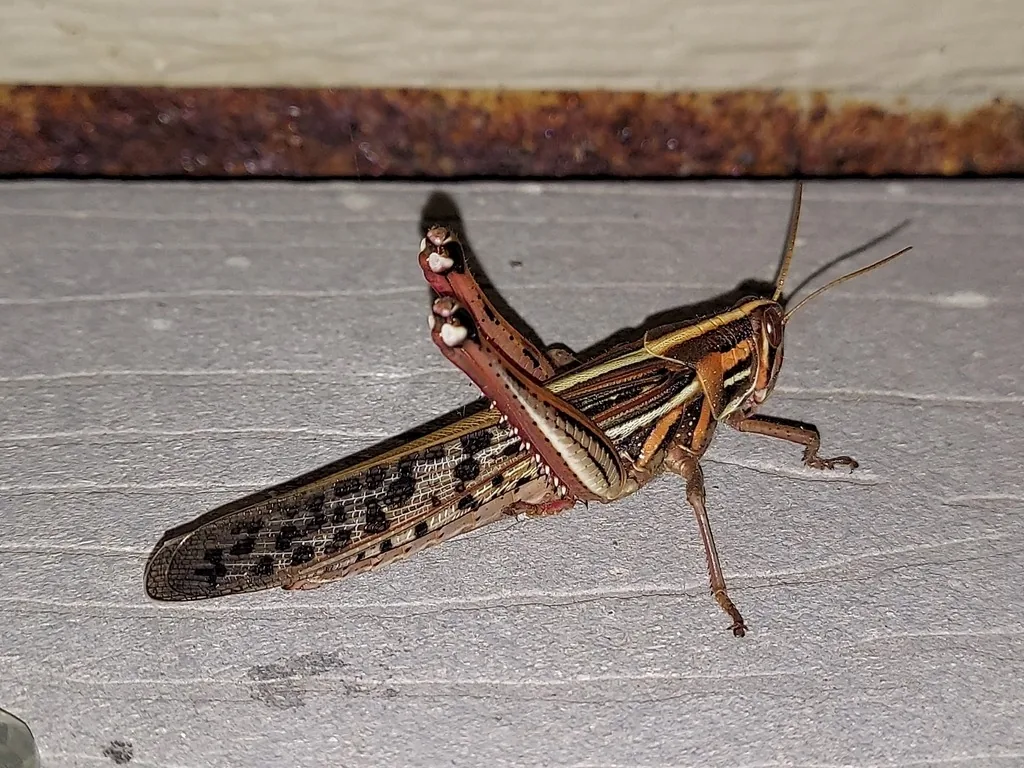
American grasshopper adult, reddish-brown with dark-spotted wings, on a wooden ledge
American grasshopper adult, reddish-brown with dark-spotted wings, on a wooden ledge. (c) florawhite, some rights reserved (CC BY) — via iNaturalist, CC BY 4.0

How to identify it

  • Adults are 1 1/2 to 2 1/8 inches long with large dark brown spots on the wings, turning from reddish-brown to yellowish-brown as they mature.[1]
  • Nymphs are green when few, but yellow, orange and black when crowded.[1]

Where it lives

It's found east of the Great Plains through the Southeast, north to near Iowa and Pennsylvania, and throughout Florida.[1]

US map: public records from 23 states since 1990 (GBIF).

Biology and life cycle

Females bury pods of 60 to 80 eggs in soil; nymphs hatch three to four weeks later and pass through five or six stages.[1]

Adults often roost at night in nearby trees and shrubs.[1]

Damage and signs

  • It damages citrus, corn, peanuts, vegetables and ornamentals, and is notable in Florida for defoliating young citrus.[1]
  • The third through fifth nymph stages do most of the feeding.[1]

Health risk

It feeds on plants; UF/IFAS mentions no risk to people.[1]

Control

Prevention

Control weeds by mowing or tilling, which can also destroy eggs and small nymphs; watch the timing so hoppers aren't driven onto crops.[1]

Biological control

Birds such as cattle egrets eat many, and the fungus Entomophaga grylli can be effective locally.[1]

Pesticides

Treat nymphs before they become adults; local UF/IFAS Extension offices give insecticide recommendations.[1]

Common questions

How many grasshoppers is too many?
When late nymphs or adults top about 15 per square yard, damage is possible.[1]
When should grasshoppers be treated?
While they're nymphs, which are easier to kill than adults.[1]

Sources

  1. University of Florida IFAS Extension (Featured Creatures), “American Grasshopper, Schistocerca americana (EENY-004).” edis.ifas.ufl.edu/publication/IN130 (accessed 2026-10-06)
  2. iNaturalist, “Schistocerca americana taxon page (order and family).” www.inaturalist.org/taxa/1373635 (accessed 2026-10-06)

Updated 2026-10-14. Built from sourced records. Spot an error? Tell us.