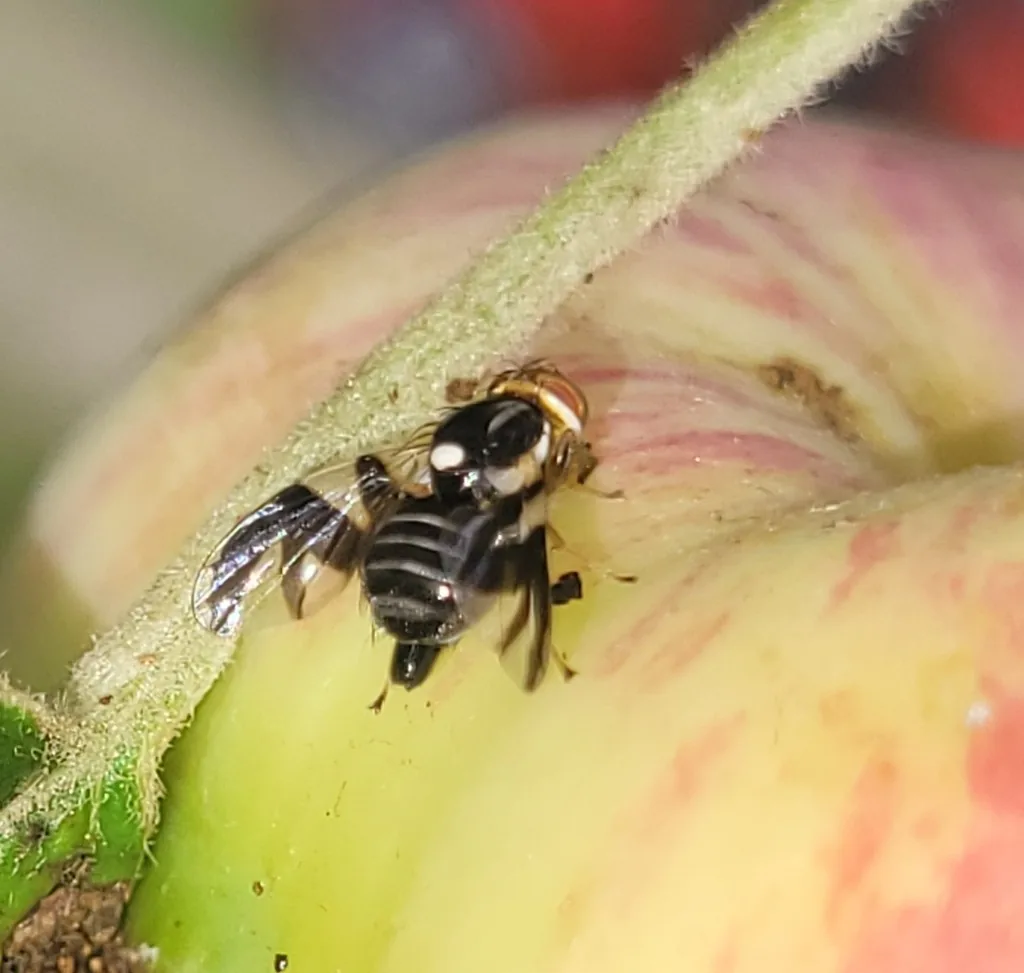
How to identify it
Look-alikes
| Look-alike | How to tell them apart |
|---|---|
| Vinegar flies | Small drosophilid flies are also called fruit flies but are much smaller than apple maggot flies.[1] |
| Codling moth larvae | Codling moth larvae are much larger than the rarely seen apple maggot larvae.[2] |
Where it lives
It attacks apple, hawthorn and occasionally other Rosaceae. In California it's found from Sonoma County north, and moving home-grown apples into several southern counties is illegal.[1]
Biology and life cycle
Pupae overwinter in the soil, and adults emerge from late June through August, peaking in July.[1][2]
Newly emerged flies must feed on honeydew before they mate.[1]
A female lays about 300 eggs under apple skins over a 30-day life and marks each fruit to deter other females.[1]
Larvae feed three to four weeks, leave the fruit and pupate in soil; there's usually one generation a year.[1][2]
Damage and signs
Health risk
It damages fruit only; neither source mentions any risk to people.[1][2]
Control
Keep them out
Bag each apple in a sandwich bag with snipped corners after thinning, in early to mid-June.[2]
Sanitation
Pick up fallen apples often during the season and after harvest, and send them away in sealed bags rather than composting them at home.[2][1]
Traps and physical control
Hang bright red sticky spheres at least 3 inches across on the outer canopy to catch egg-laying females; mind birds, which can get stuck.[2][1]
Pesticides
Where it's been a problem, UC IPM suggests spinosad, ideally premixed with a fruit fly bait, once yellow sticky traps catch the first flies.[1]
Common questions
- Why are my apples full of brown trails?
- Apple maggot larvae tunnel through the flesh and leave brown, rotting trails.[1][2]
- Does bagging apples really work?
- Yes. Bagging each apple in early to mid-June protects it from apple maggot for the rest of the season.[2]
- I found it in Southern California. What now?
- Report suspected apple maggots in Central or Southern California to the County Agricultural Commissioner.[1]
Sources
- University of California Statewide IPM Program, “Apple Maggot (Pests in Gardens and Landscapes).” ipm.ucanr.edu/PMG/GARDEN/FRUIT/PESTS/applemaggot.html (accessed 2026-10-06)
- University of Minnesota Extension, “Apple maggot (Yard and garden insects).” extension.umn.edu/yard-and-garden-insects/apple-maggot (accessed 2026-10-06)
- iNaturalist, “Rhagoletis pomonella taxon page (order and family).” www.inaturalist.org/taxa/366909 (accessed 2026-10-06)