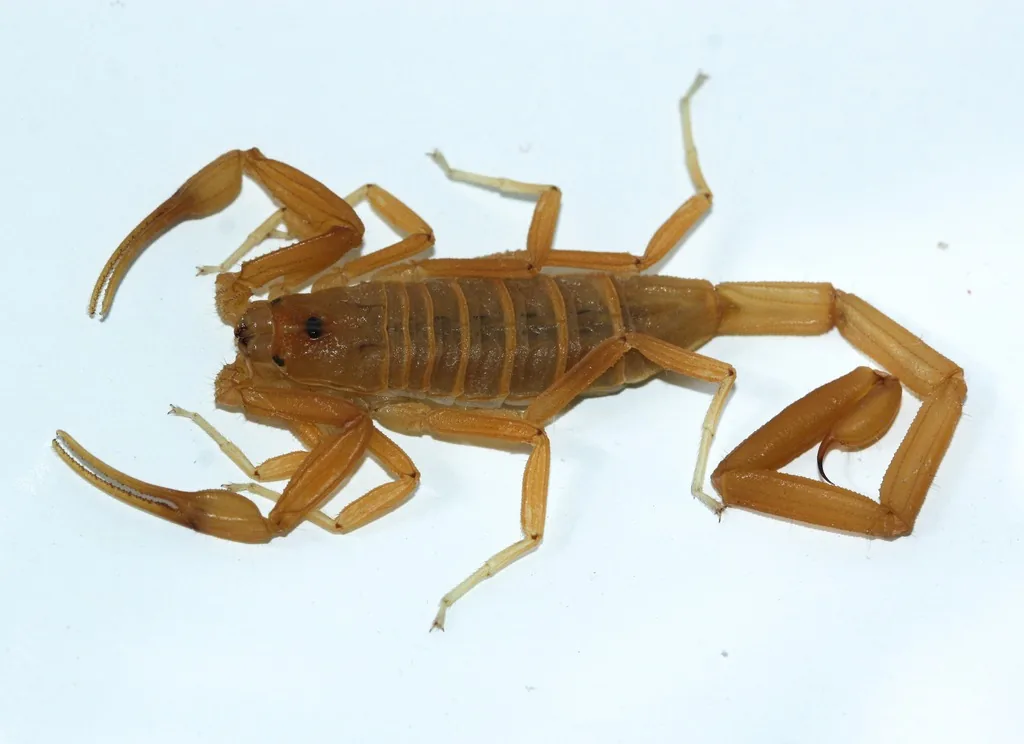
How to identify it
- Adults are usually 2 to 3 inches long, with slender legs and pincers and a long, thin tail ending in a stinger.[1][4]
- Color varies: some are pale yellowish, while others are darker with stripes or a checkered pattern.[1]
- Compared with other Arizona scorpions, its pincers and tail segments are noticeably more slender.[3][1]
- It is a strong climber that can cross textured walls and even ceilings, and it does not dig burrows.[1][2]
- Like other scorpions, it glows brightly under an ultraviolet (black) light, which makes it easier to spot at night.[1][2]
Look-alikes
| Look-alike | How to tell them apart |
|---|---|
| Stripe-tailed and yellow ground scorpions | These burrowing desert scorpions are often mistaken for bark scorpions, but the stripe-tailed scorpion has bulkier pincers and tail, and the yellow ground scorpion has a much wider tail.[1] |
| Arizona giant hairy scorpion | This is the largest U.S. scorpion, often over 5 inches long and heavy bodied; its venom is mild, and it even eats bark scorpions.[1][4] |
Where it lives
Found throughout Arizona and in small parts of California, Nevada, New Mexico, Utah, Colorado and Texas, plus northwestern Mexico; it is common around buildings in low desert areas.[1][4]
Biology and life cycle
By day bark scorpions hide in crevices: in walls, under rocks, logs and bark, in animal burrows, and inside wall voids of buildings.[1][4]
In studies of where they shelter around homes, about 95 percent chose hollow block walls over other options.[1]
They hunt at night, feeding on crickets, cockroaches and other insects, and they will drink from small pools of standing water.[1][2]
Unlike most desert scorpions, bark scorpions are not territorial and often live close together, sometimes in dense groups.[1]
Most movement happens from about 7 to 11 p.m. and from 3 a.m. to sunrise, and nights above 70 degrees F suit them best.[1]
In the coolest months they are less active and cluster in protected spots to overwinter.[1]
Females give birth to live young that ride on the mother's back; adults can live 5 to 7 years.[1][2]
Damage and signs
- Bark scorpions enter homes through gaps around doors, weep holes, pipes and wall openings; UC IPM notes a crack 1/16 inch wide is enough.[1][4]
- Once inside wall voids they can reach rooms around electrical faceplates and pipe collars, and they may drop from ceilings into beds, sinks and tubs.[1]
- A home with a cricket or cockroach problem can see more scorpions indoors because of the ready food supply.[2]
- Most U.S. scorpion exposures reported to poison centers, about 98 percent, happen in or around homes.[1]
Health risk
Stings cause immediate pain, numbness and tingling, and in young children can bring twitching, flailing limbs, abnormal eye movements, drooling and trouble breathing. Death is extremely rare, but small children need immediate medical care.[1][3]
Control
Prevention
Shake out shoes, clothes and towels, keep shoes off the floor, wear shoes or slippers at night, and teach children not to touch scorpions.[1][2]
Keep them out
Install tight weatherstripping and door sweeps, keep window screens snug, and caulk around eaves, pipes and other wall openings.[1][2]
Screen weep holes with coarse steel mesh rather than sealing them, and stucco and cap hollow block walls so they shelter fewer scorpions.[1]
Sanitation
Clear wood, rocks, bricks, trash and clutter away from the house, and bring in firewood only to burn it right away.[1][2][3]
Keep grass short near the home, limit low ground cover, and prune shrubs and branches that touch the walls or roof.[1][2]
Traps and physical control
Search with a UV flashlight at night, wearing boots, and pick scorpions up with long tongs into a sealed jar; never look directly into the UV light.[1][2]
When to call a professional
If you regularly find scorpions indoors, call a pest management professional experienced with scorpions; pesticides alone will not solve the problem.[1][2]
If someone is stung
Call the Poison Help line at 1-800-222-1222 right away; specialists can advise home care or tell you to go to the emergency room.[1][3]
If a child age 9 or under, or weighing under 70 pounds, is stung, call 911 or Poison Help, or go to the nearest hospital immediately.[1]
First aid from the poison center: wash the site with soap and water and apply a cool compress for ten minutes on, ten minutes off.[1][3]
Rest a stung arm or leg in a comfortable, supported position; over-the-counter medicine can ease minor discomfort.[1][3]
An infant who cries and cannot be comforted may have been stung, especially with twitching, flailing or roving eye movements.[1]
Symptoms usually appear within 20 minutes and can worsen over the first 4 hours; most healthy adults recover in a day or two.[1]
Antivenom is available in some hospitals for severe cases.[1][4]
Why sprays alone fail
Bark scorpions hide deep in crevices by day and adults are hard to kill, so pesticides alone do not control them.[1][2][4]
Pest-proofing the building is by far the most effective way to reduce scorpion contact and stings.[1]
Removing crickets and other prey insects helps, but will not by itself eliminate scorpions around a home.[1]
Common questions
- Is the Arizona bark scorpion the only dangerous scorpion in the U.S.?
- Yes. All native scorpions can sting, but University of Arizona Extension says only bark scorpion stings are a hazard to human health.[1][3]
- Can a scorpion in the pool still sting?
- Yes. Bark scorpions can survive underwater in chlorinated pools for a surprisingly long time and may sting if fished out by hand.[1]
- Do I need to go to the hospital after a sting?
- Most stings in healthy adults can be managed at home, but call Poison Help at 1-800-222-1222 for advice, and get immediate care for young children.[3][1]
Sources
- University of Arizona Cooperative Extension, “Scorpions of the Desert Southwest United States, AZ1768 (May 2018).” extension.arizona.edu/sites/extension.arizona.edu/files/pubs/az1768-2018.pdf (accessed 2026-10-06)
- University of Arizona Cooperative Extension, Yavapai County, “Backyard Gardener #184: Scorpions (June 13, 2024).” www.extension.arizona.edu/sites/extension.arizona.edu/files/attachment/Scorpions.pdf (accessed 2026-10-06)
- Arizona Poison and Drug Information Center (University of Arizona), “Scorpions.” azpoison.com/venom/scorpions (accessed 2026-10-06)
- University of California Statewide IPM Program, “Pest Notes: Scorpions, Publication 74110 (December 2011).” ipm.ucanr.edu/legacy_assets/PDF/PESTNOTES/pnscorpions.pdf (accessed 2026-10-06)
- iNaturalist, “Centruroides sculpturatus taxon page (order and family).” www.inaturalist.org/taxa/143985 (accessed 2026-10-06)