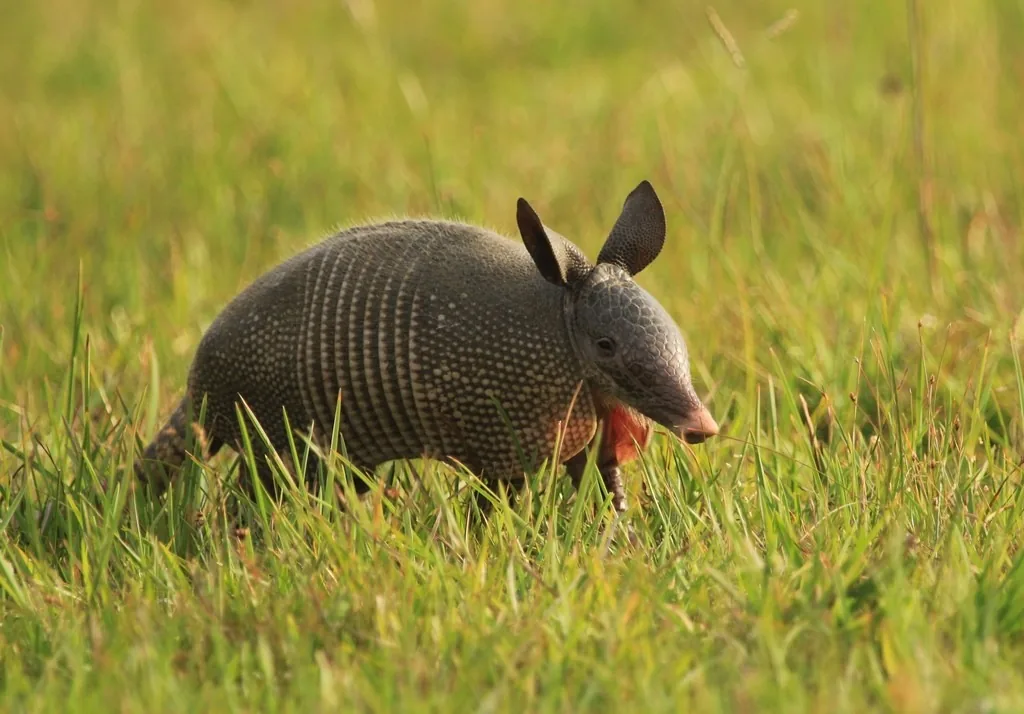
How to identify it
- A shell of bony, horn-covered armor over the head, body and tail, with nine flexible bands between the shoulder and hip shields.[2][1]
- Adults weigh about 8 to 17 pounds, roughly opossum size, with a small head, a long, narrow pig-like snout and a long tapering tail ringed with armor.[2][1]
- Only the ears and belly lack armor, and the animal has simple peg-like teeth with no front teeth.[1][2]
- Feeding leaves holes about 1 to 3 inches deep and 3 to 5 inches wide; burrow openings are about 7 to 8 inches across.[4][1][3]
- Tracks usually show three forward toes with sharp claw marks.[2]
Look-alikes
| Look-alike | How to tell them apart |
|---|---|
| Raccoon digging | Armadillo damage to turf can be extensive and hard to tell apart from raccoon digging; numerous shallow holes 3 to 5 inches wide and nearby burrows point to armadillos.[4][1] |
| White grubs (what armadillos hunt) | Armadillos dig mainly to reach insect larvae and earthworms in moist soil, so grub-rich, well-watered lawns attract more digging.[3][1] |
Where it lives
Found from Texas east through the South, including Oklahoma, Arkansas, Mississippi, Alabama, Georgia and Florida, and still spreading north; cold weather limits its northern edge.[2][1]
Biology and life cycle
Females raise one litter a year, born in late winter or early spring, and the litter is always four identical young of the same sex.[1][3]
They rest in burrows up to 15 feet long under brush piles, stumps, rock piles or concrete patios, and often keep several burrows in one area.[1][3]
Armadillos feed mostly from evening through early morning in summer and during the warmest part of the day in winter.[3][1]
More than 90 percent of the diet is insects and their larvae, plus earthworms, spiders, scorpions and some fruit and small animals.[3][1]
They have poor eyesight but a keen sense of smell, run well, and are good swimmers.[1]
Damage and signs
- Numerous shallow feeding holes in lawns, golf courses, flower beds and gardens, with ornamental plants uprooted.[4][1]
- Burrows under driveways, sidewalks, slabs, patios and pools can cause structural damage.[4][1]
- They occasionally eat poultry eggs, and burrows in pastures can be a hazard to livestock.[4][1]
Health risk
Some wild armadillos in the southern United States carry the bacteria that cause leprosy (Hansen's disease), and CDC says the risk is very low and most people who touch armadillos are unlikely to get it; avoid handling them with bare hands.[7][4]
Control
Prevention
Cut back on lawn watering and fertilizing; moist, lush turf favors the earthworms and insect larvae armadillos dig for.[1]
Clear brush and other dense ground cover near the house to discourage armadillos from setting up burrows.[5][1]
Keep them out
Protect valuable beds with a fence 2 to 3 feet high, buried 12 to 18 inches deep and slanted outward at about 40 degrees to prevent climbing.[5][1]
Laying chicken wire along a patio, driveway or foundation discourages burrowing next to it.[1]
Traps and physical control
Use raccoon-sized cage traps along fences or near burrow entrances, with board 'wings' to funnel the animal in; set traps late in the afternoon and check them after dark.[1][5]
Shooting, foothold traps, body-gripping traps and cable restraints are regulated differently by state; check state and local laws before using them.[5][1]
Pesticides
Soil insecticides that reduce grubs may cut turf digging, but follow labels carefully to limit harm to other animals.[5]
What doesn't work
No repellents, frightening devices or toxicants are registered or known to work on armadillos, and poison baits are illegal.[5][1]
Legal status and relocation
Armadillos are unprotected in most states, but check state rules before trapping or shooting one.[2][5]
Relocating armadillos is not recommended because it moves the problem and can spread disease; in Florida, where they are not native, transporting and releasing them is illegal.[1][6]
Common questions
- What is digging small holes in my lawn at night?
- In the South, armadillos are a prime suspect: they leave many holes 1 to 3 inches deep while rooting for grubs and earthworms, mostly at night.[4][1][3]
- Can I get leprosy from an armadillo?
- It is possible but unlikely. CDC says some southern armadillos carry the bacteria and may spread it, the risk is very low, and leprosy is curable.[7]
- Will a repellent keep armadillos away?
- No repellent is registered for armadillos. Fencing, trapping and reducing the moist soil that attracts their food are the practical options.[5][1]
Sources
- University of Florida IFAS Extension, “The Nine-Banded Armadillo (Dasypus novemcinctus), EDIS Publication UW082.” edis.ifas.ufl.edu/publication/UW082 (accessed 2026-10-06)
- Internet Center for Wildlife Damage Management, “Armadillos: Identification.” icwdm.org/species/other-mammals/armadillos/ (accessed 2026-10-06). Run by university wildlife damage specialists (maintained at the University of Wisconsin-Stevens Point); species modules are based on Prevention and Control of Wildlife Damage (University of Nebraska Cooperative Extension, 1994).
- Internet Center for Wildlife Damage Management, “Armadillo Biology.” icwdm.org/species/other-mammals/armadillos/armadillo-biology/ (accessed 2026-10-06). Run by university wildlife damage specialists (maintained at the University of Wisconsin-Stevens Point); species modules are based on Prevention and Control of Wildlife Damage (University of Nebraska Cooperative Extension, 1994).
- Internet Center for Wildlife Damage Management, “Armadillo Damage Identification.” icwdm.org/species/other-mammals/armadillos/armadillo-damage-identification/ (accessed 2026-10-06). Run by university wildlife damage specialists (maintained at the University of Wisconsin-Stevens Point); species modules are based on Prevention and Control of Wildlife Damage (University of Nebraska Cooperative Extension, 1994).
- Internet Center for Wildlife Damage Management, “Armadillo Damage Prevention and Control Methods.” icwdm.org/species/other-mammals/armadillos/armadillo-damage-prevention-and-control-methods/ (accessed 2026-10-06). Run by university wildlife damage specialists (maintained at the University of Wisconsin-Stevens Point); species modules are based on Prevention and Control of Wildlife Damage (University of Nebraska Cooperative Extension, 1994).
- Internet Center for Wildlife Damage Management, “Armadillo Handling.” icwdm.org/species/other-mammals/armadillos/armadillo-handling/ (accessed 2026-10-06). Run by university wildlife damage specialists (maintained at the University of Wisconsin-Stevens Point); species modules are based on Prevention and Control of Wildlife Damage (University of Nebraska Cooperative Extension, 1994).
- Centers for Disease Control and Prevention, “About Leprosy (Hansen's Disease) (last reviewed December 5, 2025).” www.cdc.gov/leprosy/about/index.html (accessed 2026-10-06)
- iNaturalist, “Dasypus novemcinctus taxon page (order and family).” www.inaturalist.org/taxa/47075 (accessed 2026-10-06)