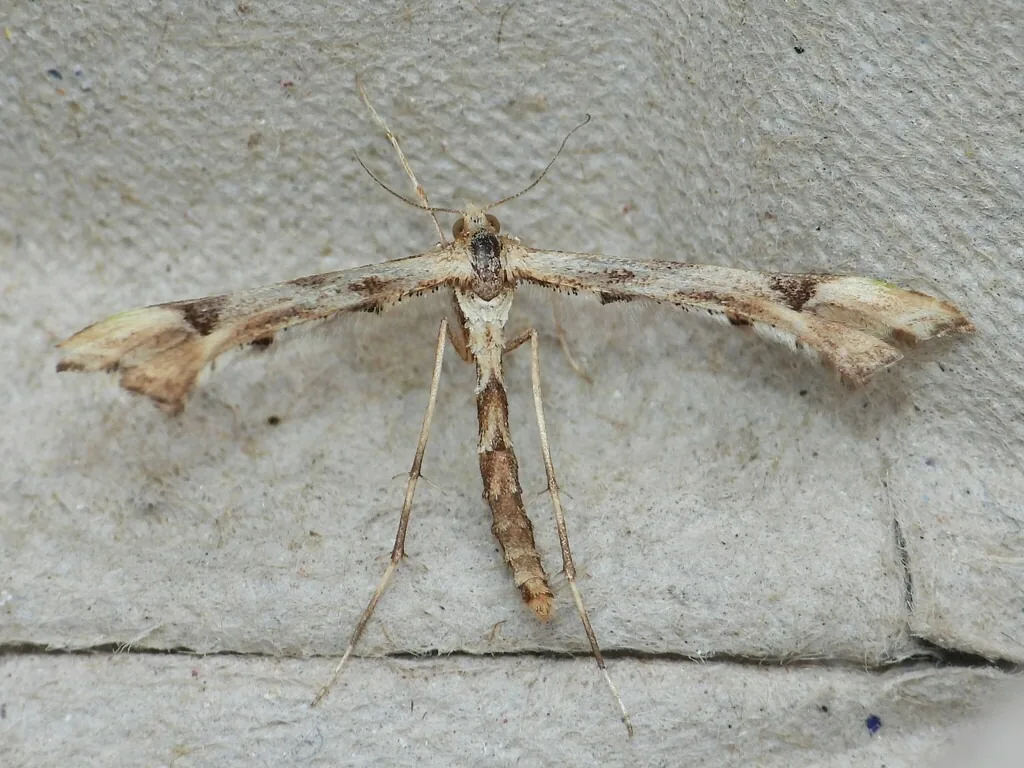
How to identify it
- Adults are buff to brownish buff with a wingspan of 0.75 to 1.25 inches; the wings are split into lobes, and the hind wings are fringed.[1]
- Grown larvae are yellowish to pink and about 0.63 inch long.[1]
- Eggs are tiny and shiny, light greenish yellow at first, turning orange-yellow, and are usually laid singly under leaves.[1]
Where it lives
The PNW Insect Management Handbook covers it on globe artichokes in the Pacific Northwest.[1]
Biology and life cycle
Newly hatched larvae feed outside the plant, then tunnel into the leaf stalk and work toward the center of the bud with each molt.[1]
Mature larvae drop to the ground and pupate in plant debris, often in folds of dried leaves; there are three to four overlapping generations a year.[1]
Damage and signs
- Larvae feed on all parts of the plant, but the real damage comes when they feed in the flower buds.[1]
Health risk
It feeds on plants; the PNW Insect Management Handbook mentions no risk to people.[1]
Control
Sanitation
Cutting plants off at ground level, shredding the tops and working them into the soil can cut infestations by about 95 percent, though moths move in from other fields.[1]
At harvest, pick and dispose of infested buds whatever their stage.[1]
Biological control
Soaking replant stumps in insect-killing nematodes (Steinernema carpocapsae) can sharply reduce infestations.[1]
Pesticides
Home-use options listed include neem (azadirachtin), pyrethrins and esfenvalerate; treat first-instar larvae.[1]
Common questions
Sources
- Pacific Northwest Pest Management Handbooks (OSU, WSU, University of Idaho), “Artichoke (globe artichoke): Artichoke plume moth (Insect Management Handbook).” pnwhandbooks.org/insect/vegetable/vegetable-pests/hosts-pests/artichoke-globe-artichoke-artichoke-plume-moth (accessed 2026-10-06)
- iNaturalist, “Platyptilia carduidactylus taxon page (order and family).” www.inaturalist.org/taxa/319034 (accessed 2026-10-06)