How to identify it
- Adults are about 0.05 inch long, with translucent white wings that may show the yellow body through them.[1]
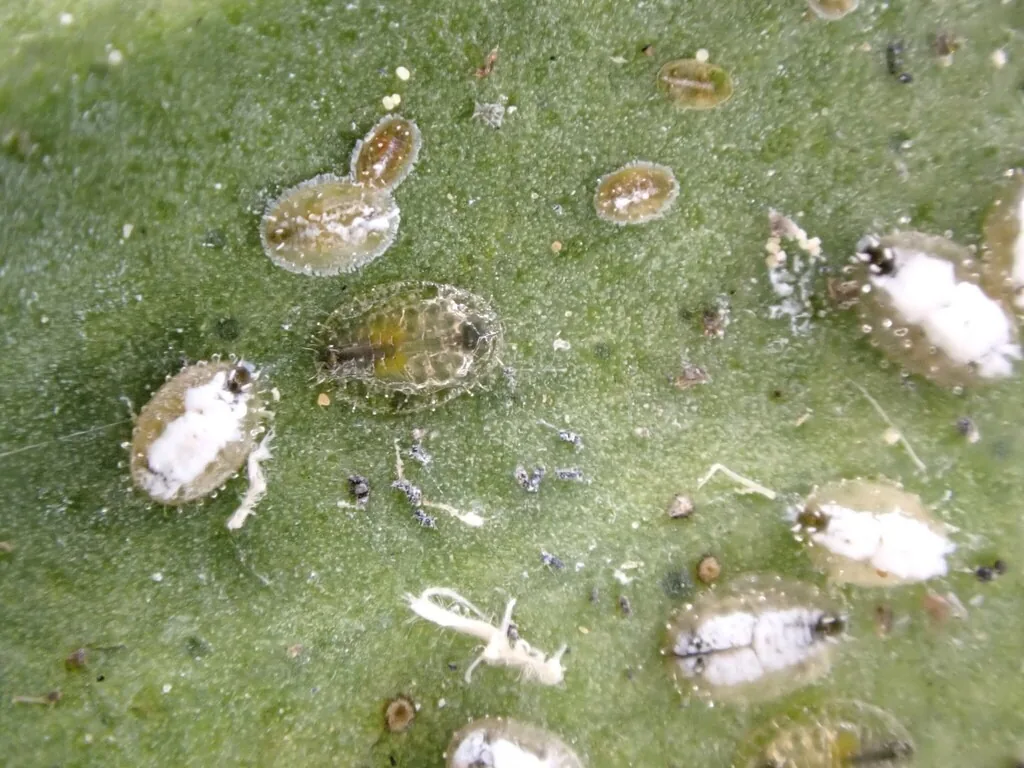
- Nymphs are translucent and covered with tufts of white wax, and the waxy pupal cases ooze sticky honeydew.[1]
- Infested leaves carry a sticky mess of eggs, waxy nymphs, pupal cases and honeydew.[1]
Where it lives
Detected in California in 1988, it was found in Oregon by 2014, and clouds of it appear in the Willamette Valley in late summer and fall.[1]
Biology and life cycle
Females lay eggs under leaves; nymphs settle and feed on sap, then pupate and emerge as winged adults.[1]
Adults live 30 to 60 days, with several generations a year.[1]
Adults leave summer hosts such as ash, pear and hawthorn to overwinter and breed on evergreen hosts.[1]
Damage and signs
- Heavy feeding can defoliate trees, cause early fruit drop and, in severe infestations, kill the host plant.[1]
Health risk
It feeds on plants; the PNW Insect Management Handbook mentions no risk to people.[1]
Control
Prevention
Watch for clouds of tiny whiteflies, or sticky honeydew and sooty mold under infested leaves.[1]
Traps and physical control
Strong streams of water aimed at leaf undersides can dislodge or injure the various stages; sticky traps and screening give some protection.[1]
Biological control
In California the parasitic wasp Encarsia inaron parasitized 80 to 98 percent of ash whitefly nymphs, and pesticides were avoided to let it build up.[1]
Common questions
Sources
- Pacific Northwest Pest Management Handbooks (OSU, WSU, University of Idaho), “Emerging Insect Pests in the Pacific Northwest: Ash whitefly (2015).” pnwhandbooks.org/insect/emerging-insect-pests/emerging-insect/ash-whitefly-2015 (accessed 2026-10-06)
- iNaturalist, “Siphoninus phillyreae taxon page (order and family).” www.inaturalist.org/taxa/397210 (accessed 2026-10-06)