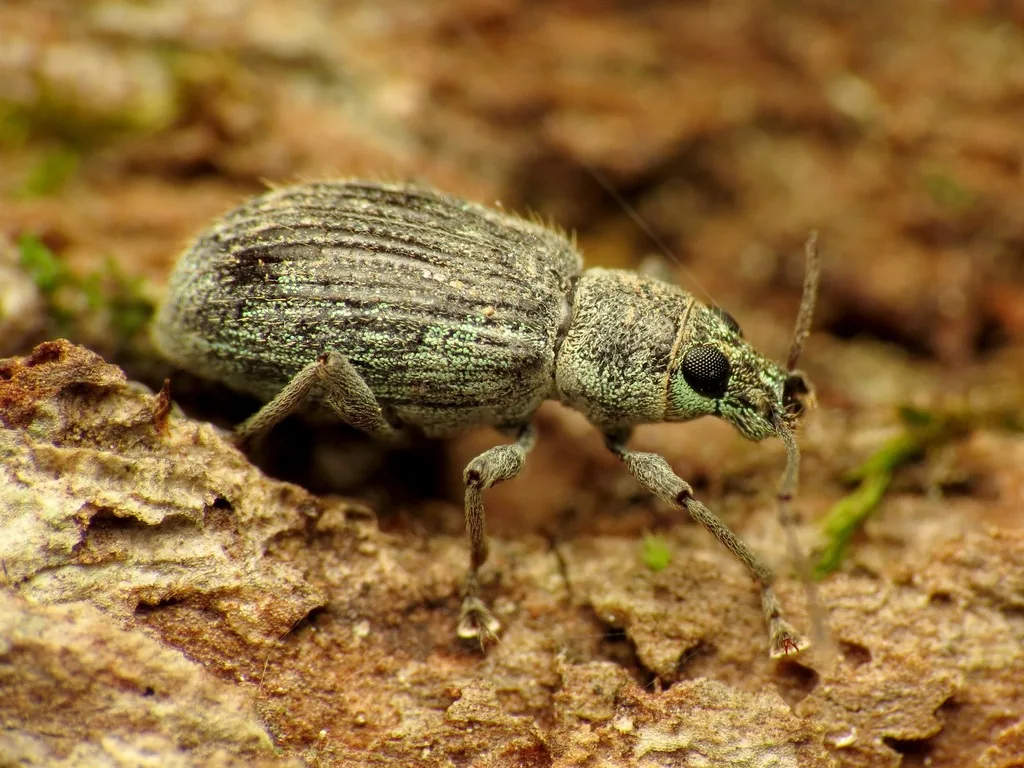
How to identify it
Where it lives
It was first found in New Jersey in 1933 and now occurs through much of the eastern United States; it is native to Japan.[1][2]
Biology and life cycle
Legless grubs live on the roots of hardwood trees through fall, winter and early spring, then pupate.[1]
Adults emerge in May, are most abundant in late June and early July, and lay eggs in the soil from July into fall.[1]
Adults shelter in leaves tied together by caterpillars.[1]
Damage and signs
Health risk
None; it is a nuisance when it comes indoors.[1]
Control
Pesticides
On a small, heavily infested specimen tree, most landscape insecticides should give adequate control.[1]
Common questions
- What are the small gray weevils in my house?
- In oak country they may be Asiatic oak weevils, which sometimes enter houses for the winter.[1]
- Do Asiatic oak weevils hurt oaks?
- Adults chew leaf edges, sometimes eating all but the main veins.[1]
- Where did it come from?
- It is native to Japan and was first found in New Jersey in 1933.[1][2]
Sources
- NC State Extension, “Asiatic Oak Weevil (PDIC Factsheet).” content.ces.ncsu.edu/asiatic-oak-weevil (accessed 2026-10-15)
- UMass Extension Landscape, Nursery and Urban Forestry Program (Landscape Insect & Mite Guide), “Cyrtepistomus castaneus (Asiatic Oak Weevil).” www.umass.edu/agriculture-food-environment/landscape/publications-resources/insect-mite-guide/cyrtepistomus-castaneus-0 (accessed 2026-10-15)
- iNaturalist, “Cyrtepistomus castaneus taxon page (order and family).” www.inaturalist.org/taxa/218048 (accessed 2026-10-06)