How to identify it
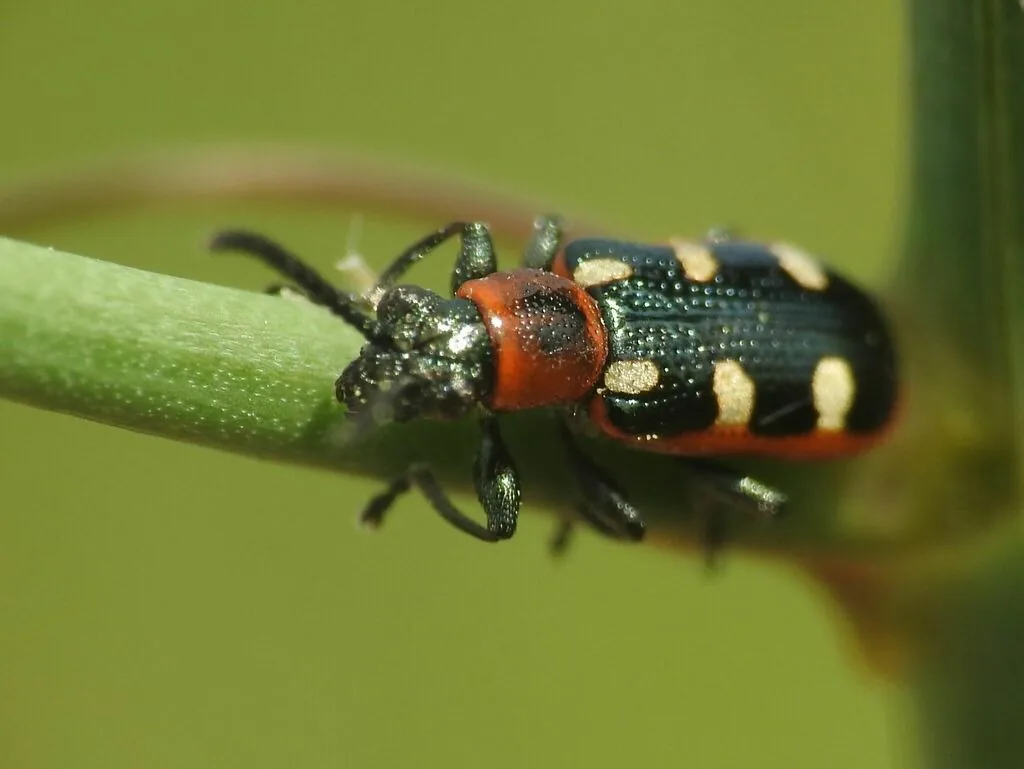
- The common asparagus beetle is about 1/4 inch long, metallic blue-black with cream to white spots and reddish margins on the wing covers.[1][2]
- The spotted asparagus beetle is slightly larger, about 1/3 inch, and reddish orange with 12 black spots.[2][1]
- Larvae are soft and slug-like with dark heads and legs; common asparagus beetle larvae are gray to grayish green, while spotted asparagus beetle larvae are orange.[1][2]
- Eggs are tiny, dark brown to shiny black ovals, about 1 mm long, standing on end in rows on spears, ferns or buds.[2][1]
Look-alikes
Where it lives
Extension services in Minnesota and Maryland both report the common and spotted asparagus beetle in local asparagus plantings, where the adults overwinter.[1][2]
Biology and life cycle
Adults overwinter in plant debris, such as hollow asparagus stems and leaf litter, and appear just as spears come up in spring.[1][2]
Eggs hatch in about a week; larvae feed for about two weeks, drop to the soil to pupate, and new adults emerge one to two weeks later.[1][2]
Maryland has two generations a year, and common asparagus beetles keep feeding on the ferns for the rest of the season.[2][1]
The spotted asparagus beetle shows up later, around mid-May in Minnesota, is gone by late July, and its larvae feed inside the berries.[1]
Beetles are most active on warm, sunny afternoons.[1]
Damage and signs
- Adult feeding scars spears, which turn brown and bend over into a hook.[1]
- Larvae and adults stripping the ferns weaken the plant, reduce food stored for next year's crop and leave it more open to Fusarium disease.[1]
- Eggs on spears don't harm the plant but can make harvested asparagus unappealing.[1][2]
- Spotted asparagus beetle larvae eat only the berries and don't affect plant health.[1]
Health risk
Asparagus beetles are plant feeders; the harm is scarred, unappealing spears and weakened asparagus plants, not any risk to people.[1][2]
Control
Prevention
Harvest spears early and often, so beetles have less time to feed and lay eggs on them.[2]
Sanitation
Remove and dispose of ferns in fall once they are fully brown, or as early as possible in spring if snow came first, to take away overwintering sites.[1][2]
Traps and physical control
Handpick adults and larvae into soapy water and rub off the dark eggs; keep checking, since new adults fly in.[1]
Biological control
A tiny metallic green wasp, Tetrastichus asparagi, can kill up to 70 percent of the eggs, and lady beetles and other predators eat eggs and larvae.[1][2]
Pesticides
Consider an insecticide only at thresholds, such as 10 percent of plants with adults or 20 percent of spears with eggs; it must be labeled for asparagus and observe the harvest interval.[1]
UMN lists pyrethrins, neem, spinosad, malathion, carbaryl and pyrethroids; most are toxic to bees, so avoid spraying while plants are flowering.[1]
Common questions
- Why are my asparagus spears bent into hooks?
- Asparagus beetle adults feeding on spears cause them to turn brown and bend into a hook.[1]
- What are the tiny black specks standing up on my asparagus tips?
- Those are likely asparagus beetle eggs, about 1 mm long and attached by one end; rub them off or harvest promptly.[2][1]
- Should I cut down asparagus ferns in fall?
- Yes. Asparagus beetles overwinter in the patch, so remove the ferns once they are completely brown.[1]
Sources
- University of Minnesota Extension, “Asparagus Beetles.” extension.umn.edu/garden-and-home/yard-and-garden/yard-and-garden-insects/asparagus-beetles (accessed 2026-10-06)
- University of Maryland Extension, “Asparagus Beetles (Vegetable and Fruit News, updated April 16, 2026).” extension.umd.edu/resource/asparagus-beetles (accessed 2026-10-06)
- iNaturalist, “Crioceris asparagi taxon page (order and family).” www.inaturalist.org/taxa/127309 (accessed 2026-10-06)