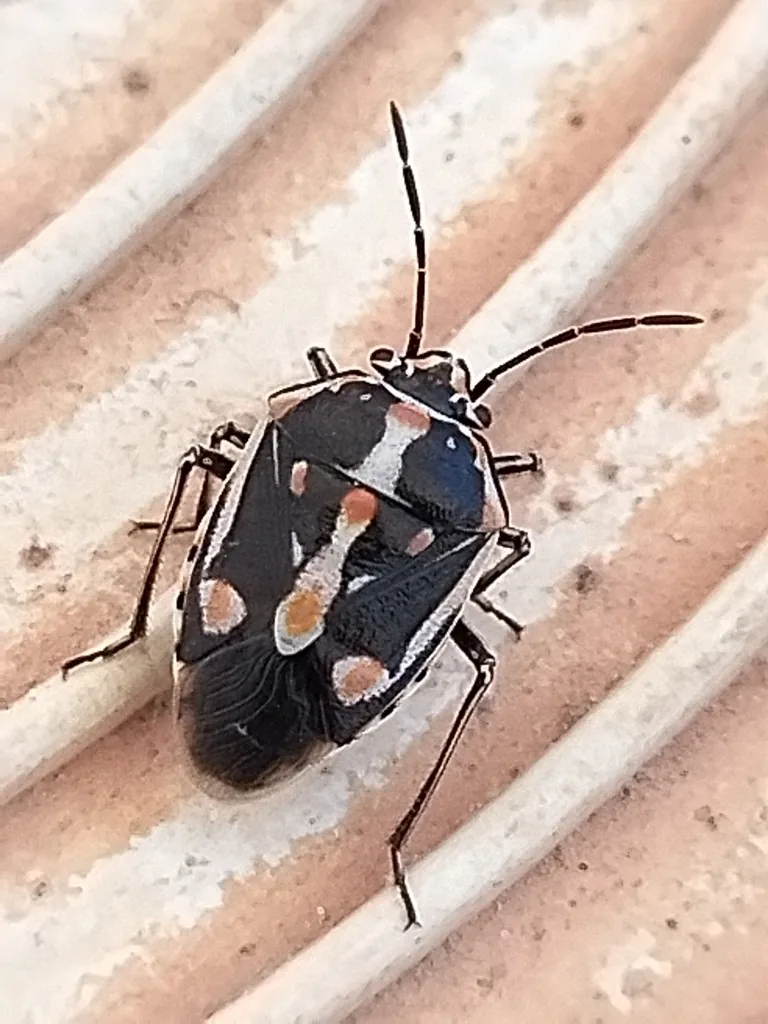
How to identify it
Look-alikes
| Look-alike | How to tell them apart |
|---|---|
| Harlequin bug | The harlequin bug looks similar, but the Bagrada bug is only one-third to one-fifth its size.[1] |
| Lady beetles | Bright nymphs can be mistaken for lady beetles but lack their shiny hard wing covers.[1] |
Where it lives
Native to Africa, it was first found in the U.S. in Los Angeles County in 2008 and has spread through much of California and to Arizona, New Mexico, Nevada, Utah and Texas.[1]
Biology and life cycle
A female can lay up to 150 eggs in two to three weeks, and eggs can hatch in four days.[1]
Southern California has multiple generations a year, peaking late summer and fall; bugs hide in litter or soil in cold weather.[1]
Mustard-family plants are its main hosts, including wild mustards, alyssum, stock and candytuft.[1]
Damage and signs
Health risk
It feeds on plants; UC IPM describes no risk to people.[1]
Control
Prevention
Inspect new plants and containers right after watering, when hiding bugs are flushed out.[1]
Keep them out
Cover plants with fine mesh or row cover raised off the leaves, edges buried, before the bugs arrive.[1]
Sanitation
Remove mustard-family weeds and crop residue; where bugs are dense, replace sweet alyssum with non-mustard plants.[1]
Traps and physical control
Shake plants over a sheet and collect or vacuum the bugs; hand-picking works only when numbers are low.[1]
Common questions
Sources
- University of California Statewide IPM Program, “Pest Notes: Bagrada Bug (Publication 74166).” ipm.ucanr.edu/PMG/PESTNOTES/pn74166.html (accessed 2026-10-06)
- iNaturalist, “Bagrada hilaris taxon page (order and family).” www.inaturalist.org/taxa/152131 (accessed 2026-10-06)