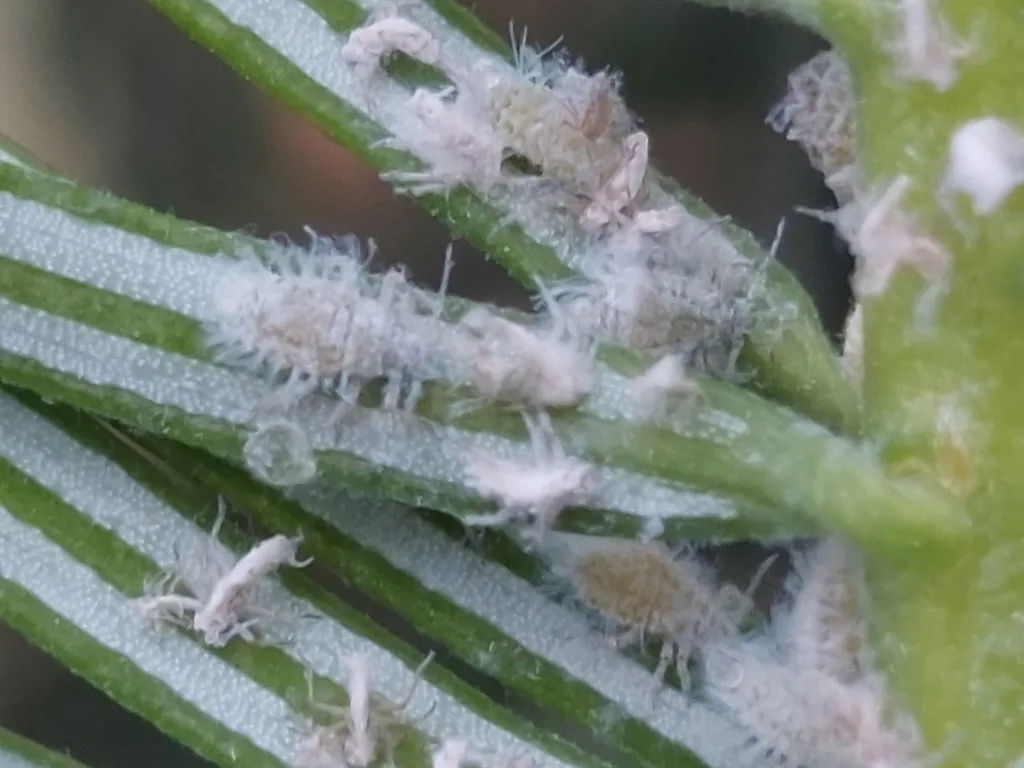
How to identify it
Where it lives
NC State covers it on Fraser fir in North Carolina, and UMass on landscape firs and spruces in New England.[1][2]
Biology and life cycle
Overwintering eggs hatch in April and May into wingless stem mothers that give birth to 20 to 40 young without mating.[1][2]
Their offspring feed on buds and tender needles, so most damage happens early in the season.[1][2]
A winged generation appears from mid June to mid July, mates and lays the eggs that overwinter in bark cracks.[1][2]
Damage and signs
Health risk
Control
Biological control
As the weather warms, lady beetles, syrphid fly maggots, lacewing larvae and other predators help limit populations.[1]
Pesticides
Control is difficult because damage happens in early spring; insecticidal soaps and other landscape insecticides work only if applied early enough.[1]
Common questions
- Why are the new needles on my fir twisted and sticky?
- Balsam twig aphids feeding on new growth in early spring twist needles and leave honeydew.[1][2]
- When do balsam twig aphids do damage?
- In early spring, when stem mothers' young feed on buds and tender needles.[1][2]
- Is it too late to spray once I see the damage?
- Often, yes; by the time damage is noticed the aphids are usually gone.[2]
Sources
- NC State Extension, “Balsam Twig Aphid (PDIC Factsheet).” content.ces.ncsu.edu/balsam-twig-aphid (accessed 2026-10-15)
- UMass Extension Landscape, Nursery and Urban Forestry Program (Landscape Insect & Mite Guide), “Mindarus abietinus (Balsam Twig Aphid).” www.umass.edu/agriculture-food-environment/landscape/publications-resources/insect-mite-guide/mindarus-abietinus (accessed 2026-10-15)
- iNaturalist, “Mindarus abietinus taxon page (order and family).” www.inaturalist.org/taxa/454525 (accessed 2026-10-06)