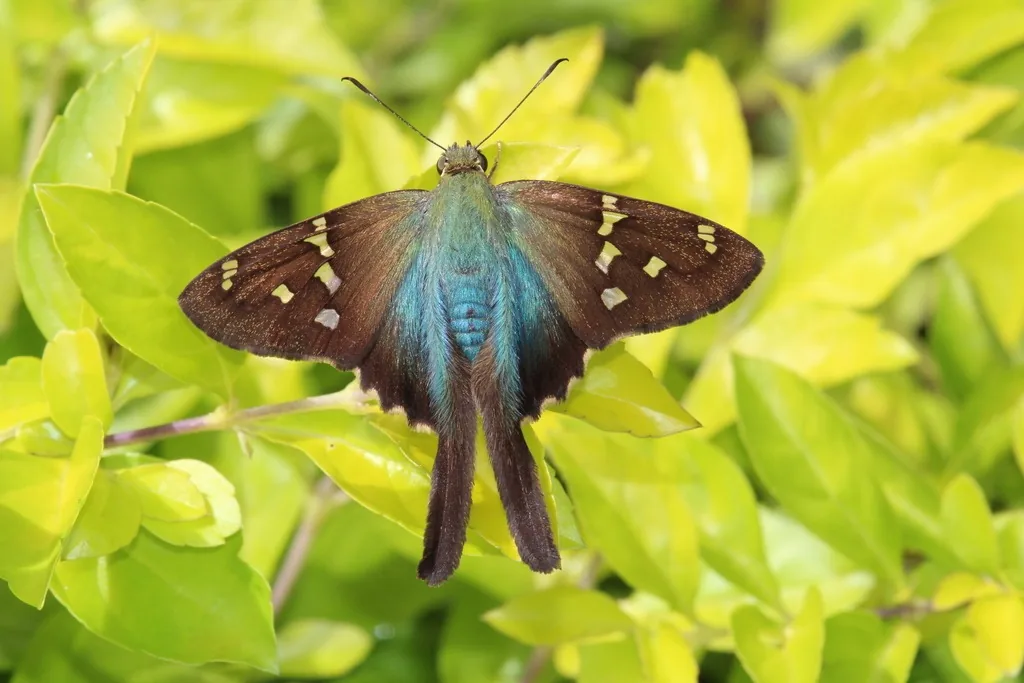
How to identify it
Where it lives
It's found throughout Florida and on the coast from South Carolina to eastern Texas, spreading north each year but not surviving long freezes.[1]
Biology and life cycle
Eggs hatch in three to four days, and caterpillars take 15 to 20 days to mature.[1]
Larvae feed on cowpea, lima bean, pea, snap bean and soybean, plus wisteria and tick trefoil.[1]
Damage and signs
- Larvae cut and fold leaf flaps into silk-lined shelters and leave them to feed.[1]
Health risk
It feeds on plants; UF/IFAS mentions no risk to people.[1]
Control
Prevention
Beans tolerate about 30 percent leaf loss without yield loss, so treatment is rarely needed.[1]
Biological control
A virus can kill 40 to 50 percent of larvae late in the season, and wasps and stink bugs prey on them.[1]
Pesticides
If late-season beans need it, most foliar insecticides are very effective.[1]
Common questions
Sources
- University of Florida IFAS Extension (Featured Creatures), “Bean Leafroller, Urbanus proteus (EENY-001).” edis.ifas.ufl.edu/publication/IN127 (accessed 2026-10-06)
- iNaturalist, “Urbanus proteus taxon page (order and family).” www.inaturalist.org/taxa/67435 (accessed 2026-10-06)