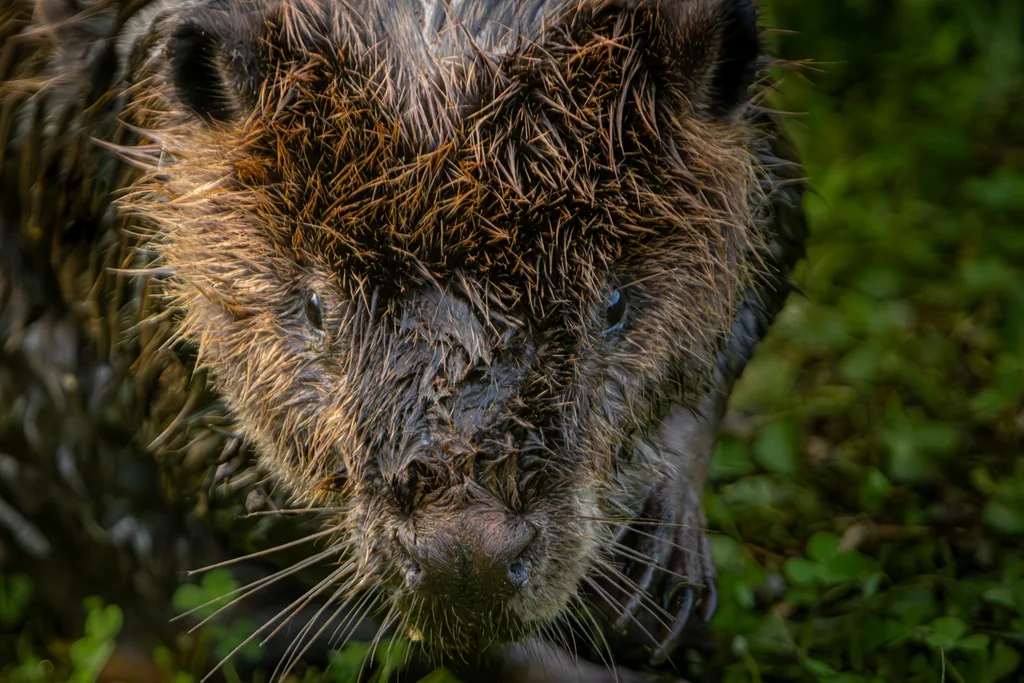
How to identify it
- Adults usually weigh 35 to 50 pounds, and a few top 100 pounds.[1][5]
- The tail is broad, flat, scaly and nearly hairless; beavers use it as a rudder and slap it on the water as a warning.[1][5]
- Large, bright orange front teeth grow throughout life and are kept sharp by gnawing.[1][5]
- Fur is dense and gray underneath with coarse outer hair, most often reddish brown; the webbed hind feet are much larger than the front feet.[1]
- Signs include trees cut down or gnawed near water, dams, lodges, flooding, and caches of branches stored underwater near an active lodge.[1][2][5]
Where it lives
Found across most of North America, except the far arctic tundra, parts of peninsular Florida and deserts without flowing water.[5][1]
Biology and life cycle
Beavers live in family colonies of about 4 to 8 related animals and defend their territory against outsiders.[2]
They pair for life and have one litter a year of 3 or 4 young, born about 105 days after winter mating.[2]
Young leave the colony at about 2 years old and often start new colonies in nearby ponds.[2]
They build lodges in ponds or dig dens into stream banks, and use them for raising young, sleeping, shelter and food storage.[2]
Beavers don't hibernate; they are most active from late afternoon to shortly after daybreak and usually stay in the lodge or den by day.[4]
Poplar and aspen are favorite foods, and willow and birch are also used; tree cutting and dam building increase as winter approaches.[2][6]
Damage and signs
- Dams can flood roads, homes, septic systems, cropland and timber, especially along low-gradient streams with culverts or narrow spots.[3][5]
- They plug ditches, drain pipes and culverts, and burrowing can collapse stream banks, dikes and levees.[3][5]
- Beavers cut or girdle trees, including valuable ornamental trees near ponds and streams, and falling trees can hit buildings, power lines and people.[3][2]
- Their ponds also have benefits, creating wetlands that help wildlife, filter water and slow floodwaters downstream.[6][4]
Health risk
Beavers can spread Giardia, an intestinal parasite, into water and can carry tularemia; rabid beavers are very uncommon but may attack. Avoid splashing pond water in your face, wash hands well, and wear rubber gloves to handle carcasses.[3][5]
Control
Prevention
Flow devices such as pond levelers or fenced pipes let water pass through a dam or culvert, giving longer-term flood relief without killing beavers.[5][6][4]
Flow pipes work best when some tree damage is tolerated, the pond stays at least 4 feet deep for winter, and standing water won't threaten roads or septic systems.[4]
Keep them out
Protect valuable trees near water by circling them with hardware cloth, woven wire or other metal fencing tall enough that beavers can't reach above it.[4][6][5]
Fence culverts and irrigation ditches to keep beavers from plugging them.[4][6]
Traps and physical control
Breaching or removing dams may prompt beavers to move, but they rebuild quickly, removal can cause sudden downstream flooding, and some states require permits.[4][6]
Pesticides
No toxicants or chemical repellents are registered for beavers, and no frightening devices are effective.[4]
When to call a professional
Trapping is often the most effective option but takes skill and specialized traps; check your state wildlife agency's rules first, and leave trapping and relocation to professionals.[4][5]
Legal status varies by state
The legal status of beavers differs from state to state. Some states protect them except during furbearer trapping seasons; others treat them as pests that can be removed when causing damage.[1][5]
Rules also cover dam removal, shooting, relocation and certain trap types, so ask your state wildlife agency and local officials what is allowed before acting.[4][5][6]
Removing beavers from one property often brings only temporary relief, because beavers from nearby land move in unless they are managed too.[4]
Common questions
- How do I stop beavers from cutting down my trees?
- Wrap the trunks of valuable trees near the water with hardware cloth or woven wire fencing, leaving room for growth and making it tall enough that beavers can't reach over.[6][4]
- Can I just tear out a beaver dam?
- Check with your state wildlife agency first, since some states require permits. Beavers often rebuild fast, and sudden removal can flood areas downstream.[4][6]
- Is it legal to trap or relocate beavers?
- It depends on the state. Some allow removal of damaging beavers anytime, others only in furbearer season, and relocation is often regulated.[1][5][6]
Sources
- Internet Center for Wildlife Damage Management, “Beavers: Identification.” icwdm.org/species/rodents/beavers/ (accessed 2026-10-06). Run by university wildlife damage specialists (maintained at the University of Wisconsin-Stevens Point); species modules are based on Prevention and Control of Wildlife Damage (University of Nebraska Cooperative Extension, 1994).
- Internet Center for Wildlife Damage Management, “Beaver Biology.” icwdm.org/species/rodents/beavers/beaver-biology/ (accessed 2026-10-06). Run by university wildlife damage specialists (maintained at the University of Wisconsin-Stevens Point); species modules are based on Prevention and Control of Wildlife Damage (University of Nebraska Cooperative Extension, 1994).
- Internet Center for Wildlife Damage Management, “Beaver Damage Identification.” icwdm.org/species/rodents/beavers/beaver-damage-identification/ (accessed 2026-10-06). Run by university wildlife damage specialists (maintained at the University of Wisconsin-Stevens Point); species modules are based on Prevention and Control of Wildlife Damage (University of Nebraska Cooperative Extension, 1994).
- Internet Center for Wildlife Damage Management, “Beaver Damage Prevention and Control Methods.” icwdm.org/species/rodents/beavers/damage-prevention-and-control-methods/ (accessed 2026-10-06). Run by university wildlife damage specialists (maintained at the University of Wisconsin-Stevens Point); species modules are based on Prevention and Control of Wildlife Damage (University of Nebraska Cooperative Extension, 1994).
- USDA APHIS Wildlife Services, “Beavers, Wildlife Damage Management Technical Series (J. D. Taylor, G. K. Yarrow and J. E. Miller, 2017).” www.aphis.usda.gov/sites/default/files/Beaver-WDM-Technical-Series.pdf (accessed 2026-10-06)
- University of Nebraska-Lincoln Extension, “Beavers (Backyard Farmer resource).” byf.unl.edu/beavers (accessed 2026-10-06)
- iNaturalist, “Castor canadensis taxon page (order and family).” www.inaturalist.org/taxa/43794 (accessed 2026-10-06)