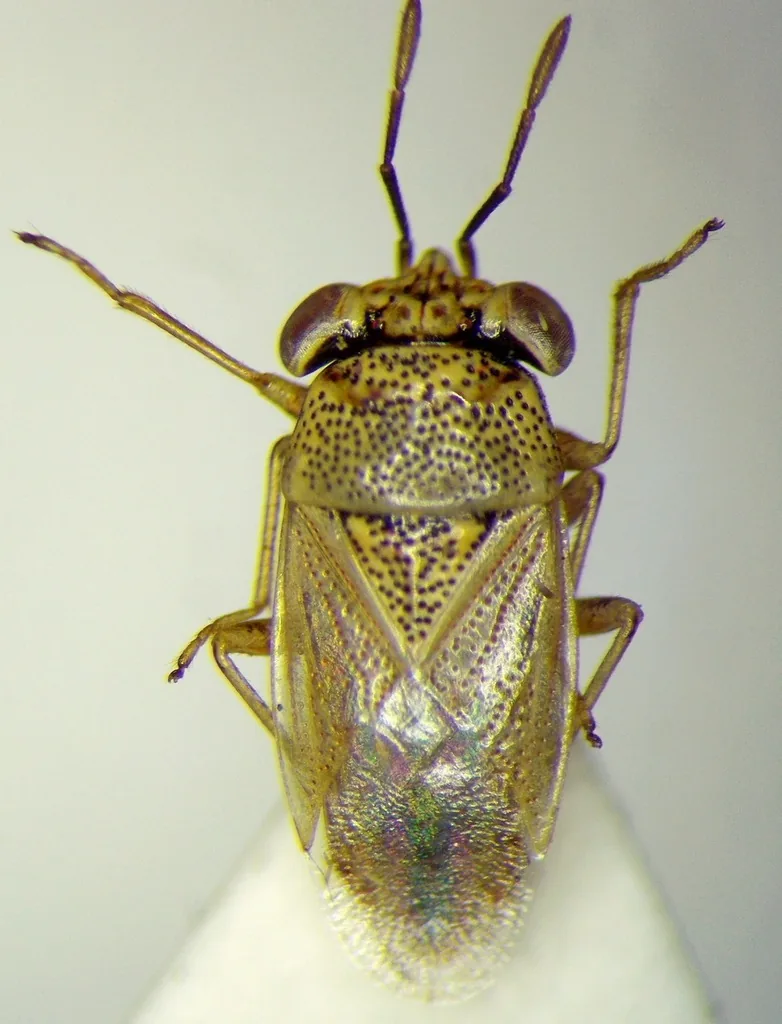
How to identify it
- Adults are oval, about 1/8 to 1/4 inch (3 to 6 mm) long, and black, brownish, gray or reddish.[1]
- The head is wide with large, bulging eyes, their most distinctive feature.[1][2]
- They walk with a distinctive waggle and give off a foul odor when handled.[2]
- Eggs are laid singly on leaves and stems; they're pale, under 1 mm long, and show red spots shortly before hatching.[1][2]
Look-alikes
| Look-alike | How to tell them apart |
|---|---|
| Chinch bugs | Chinch bugs and false chinch bugs have smaller eyes, narrower bodies and a pointed, somewhat triangular head.[1] |
| Plant bugs (Lygus) | Plant bugs have smaller eyes, longer antennae and a narrower head, plus a distinct triangle where the wings attach.[1] |
Where it lives
Common throughout the southern U.S. in most crops; one species is often found in lawns, and others turn up in ornamental plantings and vegetables.[2]
Biology and life cycle
Adults overwinter, and eggs laid in spring and summer hatch in about a week.[2]
Nymphs go through five stages of 4 to 6 days each, and both nymphs and adults hunt.[2]
Adults live about a month, a female can lay up to 300 eggs, and several generations occur each year.[2][1]
They also feed on pollen, seeds and plant juices, so flowering plants and cover crops such as clover and vetch can boost their numbers.[1][2]
Damage and signs
- They feed harmlessly on plants. Prey includes bug nymphs, flea beetles, insect eggs, small caterpillars, and all stages of aphids, mites and whiteflies.[1]
Health risk
Bigeyed bugs prey on small insects and mites; UC IPM and Cornell describe no health concern for people, though they smell unpleasant when handled.[1][2]
Control
Prevention
Check before treating a lawn for chinch bugs; managers sometimes spray when the bug present is actually the beneficial bigeyed bug.[2]
Look for them in leaf litter at the base of plants.[2]
Biological control
Conserve them with integrated pest management and by planting flowering species that feed the adults.[1]
Common questions
Sources
- University of California Statewide IPM Program, “Bigeyed Bugs (Natural Enemies Gallery).” ipm.ucanr.edu/natural-enemies/bigeyed-bugs/ (accessed 2026-10-06)
- Cornell University College of Agriculture and Life Sciences, “Biological Control: A Guide to Natural Enemies in North America: Geocoris species (Bigeyed Bugs).” biocontrol.entomology.cornell.edu/predators/Geocoris.php (accessed 2026-10-06)
- iNaturalist, “Geocoris punctipes taxon page (order and family).” www.inaturalist.org/taxa/261555 (accessed 2026-10-06)