How to identify it
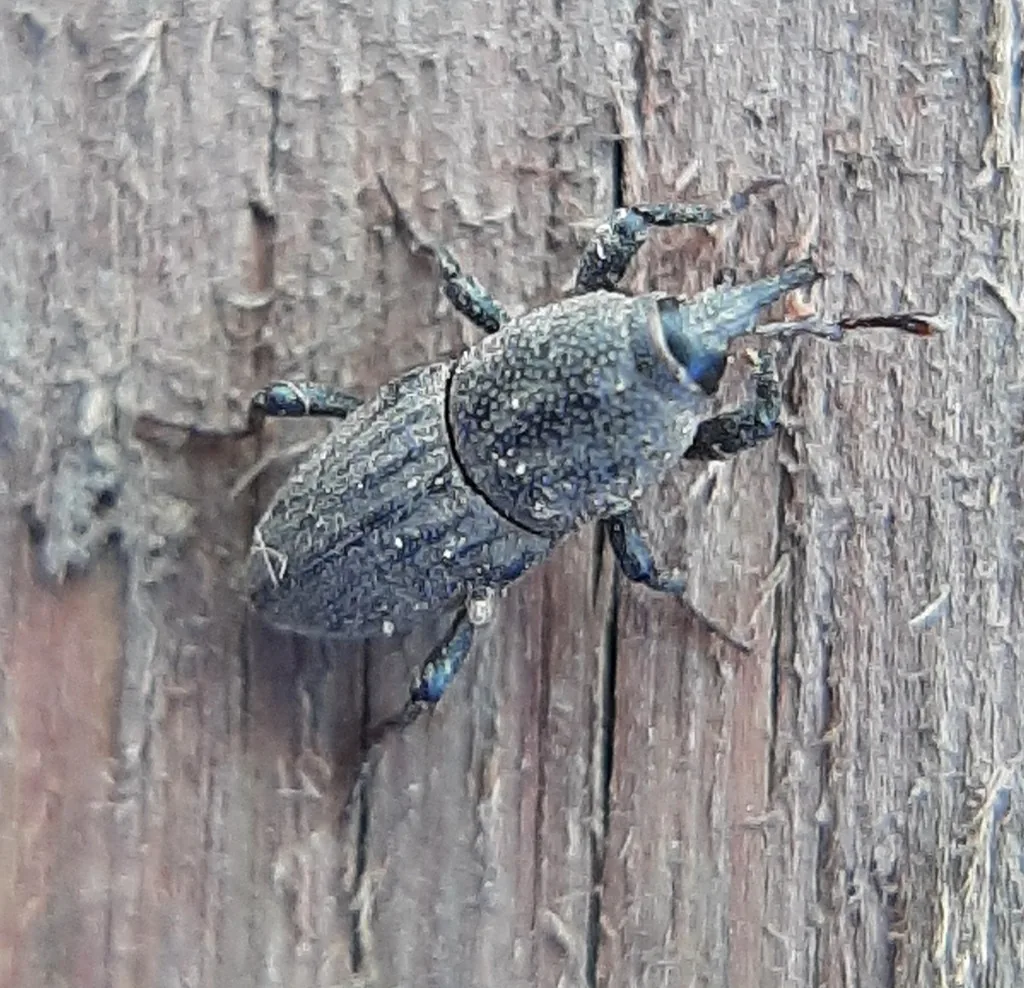
- Adults are hard-bodied weevils about 1/5 to 1/3 inch (5 to 8 mm) long, brown-black, with a long snout, elbowed antennae and rows of pits along the wing covers.[1]
- The name comes from the long snout, or bill, which has small chewing jaws at the tip.[2]
- Larvae are small, legless, cream-colored grubs with a hard yellowish to reddish-brown head, only about 1/4 to 1/3 inch long when grown.[1][3]
- Damaged stems are hollow and packed with sawdust-like frass, and they break off easily at the crown when tugged.[3][1][2]
Look-alikes
| Look-alike | How to tell them apart |
|---|---|
| White grubs | Billbug larvae are tiny, about 1/4 inch long, and legless, unlike annual white grubs, which have legs.[3] |
| Chinch bugs | Billbug damage is easy to confirm with the tug test: affected stems pull out and are hollowed and filled with frass.[3][1] |
Where it lives
More than 64 billbug species occur in the United States. The bluegrass billbug ranges widely across the country and into Canada, while the hunting billbug is a key pest of warm-season lawns in the Southeast.[1][2]
Biology and life cycle
Adults overwinter under leaves, rocks and litter and become active in spring when soil 1 inch deep warms to about 64 to 68 degrees F.[1]
Females chew holes in the base of grass stems and tuck one to three eggs inside; one bluegrass billbug female can lay about 255 eggs over three months.[1]
Young larvae feed inside the stem, then drop into the soil as they grow and feed on roots, rhizomes and crowns.[1][2]
The bluegrass billbug has one or two generations a year in the North; the hunting billbug can have six in Florida, with all stages present year-round in south Georgia.[1][2]
Hunting billbug adults mostly crawl rather than fly and are active at night, but are often seen on sidewalks and driveways early in the morning.[2]
Damage and signs
- Damage starts as small, scattered patches of wilting, yellowish-brown grass that don't green up with watering.[1][2]
- Bluegrass billbugs favor Kentucky bluegrass, while hunting billbugs attack bermudagrass, zoysiagrass and other warm-season turf; zoysia damage can be especially serious.[1][2][3]
- Damage is more common in newly established lawns and shows more when soil moisture and fertility are low.[1]
- Billbugs move to new places in infested bermudagrass and zoysia sod.[2]
Health risk
Billbugs are plant pests: adults and larvae feed on or in the stems of turfgrasses and grass crops such as corn and wheat.[1]
Control
Prevention
Endophyte-infected perennial ryegrass and fescues resist billbugs, and some bluegrass and zoysia cultivars show less damage.[1][2]
Keep turf well watered and fertilized so it tolerates feeding; irrigation can also drown larvae leaving the stems.[1][2]
Traps and physical control
Monitor with buried cup pitfall traps, a flashlight search of the lawn at night, or the tug test for loose, hollow stems.[1][2]
Biological control
Insect-parasitic nematodes such as Steinernema carpocapsae and Heterorhabditis bacteriophora can control billbug larvae, though results vary with soil moisture and temperature.[2]
Pesticides
Use insecticides only after other tools and when monitoring shows the target stage; systemic products hit larvae in stems, while contact sprays target adults before egg laying.[1][2][3]
Timing treatments
In Missouri, the best time to control a known billbug problem may be late April or early May, aimed at overwintered adults before they lay eggs.[3]
UGA lists imidacloprid, clothianidin, chlorantraniliprole and cyantraniliprole as effective on larvae, and bifenthrin on adults.[2]
Follow the product label for every insecticide application.[1]
Common questions
- Why is billbug damage so often misdiagnosed?
- Its spotty dead patches look like drought, disease, chinch bug or white grub damage. Tug on the dead grass: billbug-damaged stems snap off at the crown and are full of frass.[3][1]
- What's the little snouted beetle on my driveway in the morning?
- In the Southeast it may be a hunting billbug, which is active mostly at night and often turns up on sidewalks and driveways early in the morning.[2]
Sources
- University of Florida/IFAS Extension (EDIS), “Bluegrass Billbug, Sphenophorus parvulus (Featured Creatures EENY-652, IN1133).” edis.ifas.ufl.edu/publication/IN1133 (accessed 2026-10-06)
- University of Georgia Cooperative Extension, “Hunting Billbug: Biology and Management in Turfgrass (Circular 1173, reviewed July 2025).” fieldreport.caes.uga.edu/wp-content/uploads/2025/08/C-1173_2.pdf (accessed 2026-10-06)
- University of Missouri Extension, “Integrated Pest Management for Turfgrass Insects (IPM1020): Other subsurface-feeding insects.” extension.missouri.edu/publications/ipm1020/3 (accessed 2026-10-06)
- iNaturalist, “Sphenophorus parvulus taxon page (order and family).” www.inaturalist.org/taxa/231367 (accessed 2026-10-06)