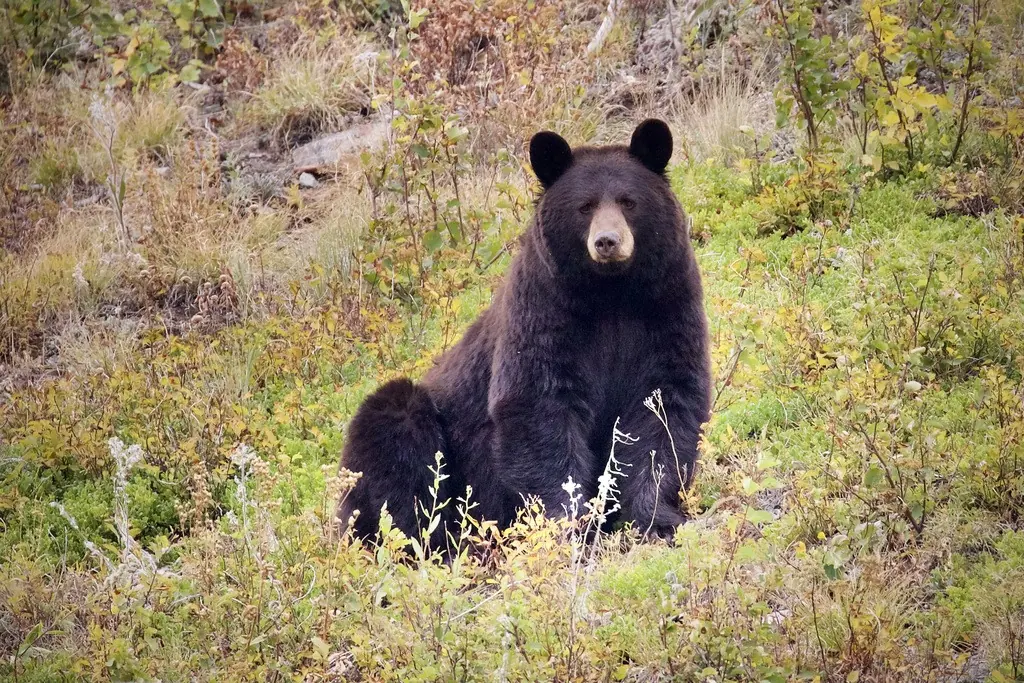
How to identify it
- Adults usually weigh about 100 to 400 pounds and are 4 to 6 feet long; some males top 600 pounds.[1][5]
- Most eastern black bears are black with a tan muzzle and sometimes a white chest mark; in the West, brown, cinnamon and blond bears are common.[1][5]
- The face has a straight profile with small, rounded, upright ears, and the tail is short, only 3 to 6 inches.[1][5]
- Each foot has five curved claws about an inch long; front tracks average about 4.5 by 4 inches and hind tracks about 7 by 3.5 inches.[1]
- Signs include tipped garbage cans, bent or broken bird feeders, smashed beehives with claw and tooth marks, and claw-marked rub trees.[3][5]
Look-alikes
| Look-alike | How to tell them apart |
|---|---|
| Grizzly (brown) bear | Grizzlies have a pronounced shoulder hump, a dished face, silver-tipped fur and long claws, and are usually much larger; the two overlap in the Rockies, western Canada and Alaska.[1] |
Where it lives
Black bears range across much of forested North America, from Mexico to Alaska and Florida to northern Canada, but are largely missing from the Great Plains, Midwest and parts of the southeastern coast.[1][5]
Biology and life cycle
Bears are omnivores with a mostly plant-based diet of grasses, berries, nuts, roots and insects, plus small animals, carrion and garbage.[2][5]
They find food mainly by smell and are most active at dusk and dawn, though they may turn nocturnal to avoid people.[5]
Bears mate in early summer, and cubs are born in the winter den in January; a female usually raises a litter only every other year.[5][2]
In the North, bears den for the winter, often in hollow trees, rock crevices, brush piles or under decks; in the South they may stay active year-round.[2][5]
When berry and nut crops fail, bears roam more widely for food and run-ins with people rise.[2]
Damage and signs
- Bears raid garbage cans, bird feeders, pet food and grills, and may damage homes and vehicles while searching for food.[3][5][6]
- They can tear open doors, rip siding and break windows to reach food stored in cabins and sheds.[4][3]
- Bears destroy beehives, and a bear usually returns along the same path each night until the honey and brood are gone.[3][5]
- A few bears kill livestock such as sheep, pigs, goats and poultry, and they also damage corn fields and fruit trees.[3][5]
Health risk
Deliberate attacks are very rare, but bears may defend themselves when surprised, cornered or protecting cubs or food. Bears used to human food can become dangerous, and they can carry parasites that cause trichinellosis.[7][4][3]
Control
Prevention
Take down bird feeders while bears are active; birdseed is high in calories and draws bears. Feed birds only in winter when bears are denning.[6][4]
Never feed bears on purpose; some states, including Pennsylvania, ban placing food that draws bears.[6][5][4]
Keep them out
Protect beehives and livestock pens with electric fencing, and keep pens and hives away from wooded cover.[4][5]
Sanitation
Store garbage, recycling and food waste where bears can't reach or smell it, ideally in bear-resistant containers, and have garbage picked up regularly.[6][4][5]
Feed pets indoors, and clean grease and food scraps off grills and smokers after each use, storing them where bears can't get in.[6]
Traps and physical control
If a bear is in your yard, make loud noise from a safe distance, then remove or secure whatever attracted it; check for bears before letting dogs out.[7]
When to call a professional
For a bear that keeps returning or acts bold, contact your state wildlife agency; trapping, relocating or killing bears requires permits and trained staff.[4][8]
If you meet a bear
If a bear is near a building or dumpster, back away and give it a clear escape route; leave doors open so it isn't trapped inside.[7]
If you see a bear that hasn't noticed you, don't approach; move away quietly. If it huffs, clacks its jaws or swats the ground, don't run; stand your ground, talk firmly and slowly wave your arms.[7]
Use bear spray if a bear keeps approaching or charges within about 30 feet. Spray doesn't work as a repellent sprayed on objects and may even attract bears.[7][4]
Legal status varies by state
Black bears are protected by federal and state laws throughout their range; Pennsylvania, for example, manages its bears with regulated hunting seasons.[1][5]
Permits are required in most states to shoot a problem bear, and baiting bears is illegal in many states.[4]
A bear that keeps getting food around homes faces a higher risk of being hit by a car, shot illegally or removed by wildlife officers, which is why Florida's wildlife agency says a fed bear is a dead bear.[8]
Common questions
- Why is a bear coming into my yard?
- Usually for food. Bird feeders, garbage, pet food and grills all draw bears, and removing those attractants typically stops the visits.[5][6]
- When can I put my bird feeders back up?
- Wildlife agencies advise removing feeders while bears are active and feeding birds only in winter, when bears are in their dens.[6][4]
- Will wildlife officers move a nuisance bear?
- Sometimes, but bears are protected and rules vary by state. Relocated bears that learned to eat human food sometimes repeat the problem.[1][4]
Sources
- Internet Center for Wildlife Damage Management, “Black Bears: Identification.” icwdm.org/species/carnivores/black-bears/ (accessed 2026-10-06). Run by university wildlife damage specialists; species modules are based on Prevention and Control of Wildlife Damage (University of Nebraska Cooperative Extension, 1994).
- Internet Center for Wildlife Damage Management, “Black Bear Biology.” icwdm.org/species/carnivores/black-bears/black-bear-biology/ (accessed 2026-10-06). Run by university wildlife damage specialists; species modules are based on Prevention and Control of Wildlife Damage (University of Nebraska Cooperative Extension, 1994).
- Internet Center for Wildlife Damage Management, “Black Bear Damage Identification.” icwdm.org/species/carnivores/black-bears/black-bear-damage-identification/ (accessed 2026-10-06). Run by university wildlife damage specialists; species modules are based on Prevention and Control of Wildlife Damage (University of Nebraska Cooperative Extension, 1994).
- Internet Center for Wildlife Damage Management, “Black Bear Damage Prevention and Control Methods.” icwdm.org/species/carnivores/black-bears/black-bear-damage-prevention-and-control-methods/ (accessed 2026-10-06). Run by university wildlife damage specialists; species modules are based on Prevention and Control of Wildlife Damage (University of Nebraska Cooperative Extension, 1994).
- Pennsylvania Game Commission, “Black Bear (species profile, feeding ban and preventing human-bear conflict).” www.pa.gov/agencies/pgc/wildlife/discover-pa-wildlife/black-bear (accessed 2026-10-06)
- Connecticut Department of Energy and Environmental Protection, “Be BearWise at Home: Six At-Home BearWise Basics.” portal.ct.gov/-/media/deep/wildlife/pdf_files/outreach/ct-six-at-home-bearwise-basics.pdf (accessed 2026-10-06)
- BearWise (Association of Fish and Wildlife Agencies), “How to React If You See a Bear.” bearwise.org/bear-safety-tips/bear-encounters/ (accessed 2026-10-06). Education program founded, supported and funded by state wildlife agencies.
- Florida Fish and Wildlife Conservation Commission, “BearWise.” myfwc.com/wildlifehabitats/wildlife/bear/wise/ (accessed 2026-10-06)
- iNaturalist, “Ursus americanus taxon page (order and family).” www.inaturalist.org/taxa/41638 (accessed 2026-10-06)