How to identify it
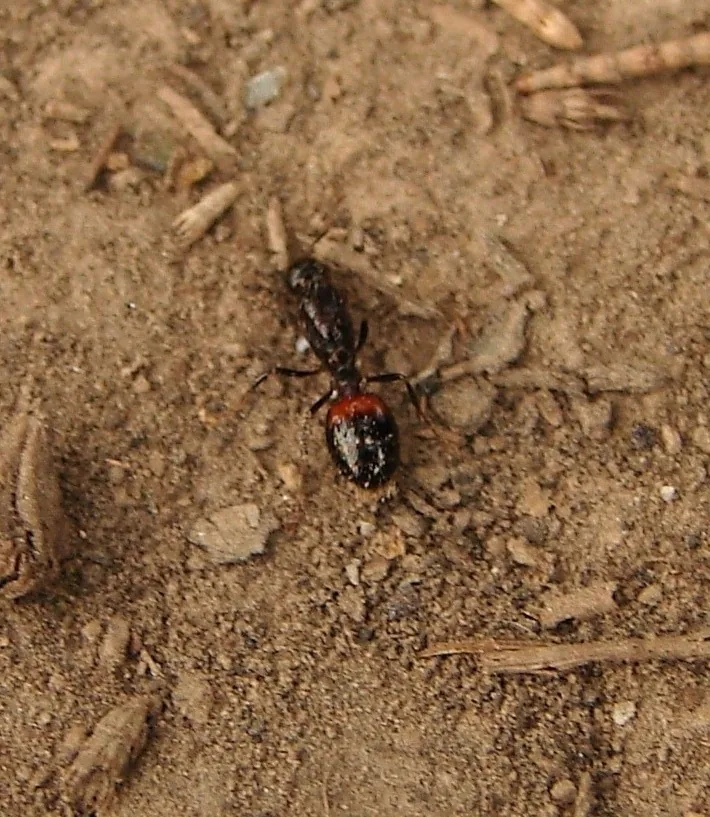
- Workers come in many sizes, from about 1 to 4 mm long, and are brownish black with a reddish-orange spot on the first segment of the abdomen.[1]
- Seen from above, the black fire ant shows a golden patch at the top of the abdomen with distinct dark outlines; on the hybrid those outlines look hazy.[3]
- Like other fire ants, it has 10-segmented antennae ending in a two-segmented club, a two-segmented waist, no spines on the thorax and a prominent stinger.[1][3]
- Color alone can't reliably separate it from the hybrid; labs confirm identity with cuticular hydrocarbon tests or molecular methods.[3][1]
Look-alikes
| Look-alike | How to tell them apart |
|---|---|
| Red imported fire ant | The red imported fire ant is generally redder overall, lacks black antennal bases and has a less pronounced shoulder area on the thorax.[1] |
| Hybrid imported fire ant | The hybrid of the red and black imported fire ants mixes traits of both parents and is reddish to brownish, so lab testing is the most reliable way to tell it apart.[2] |
Where it lives
Native from northern Argentina through Uruguay to southern Brazil. In the U.S. it holds northeastern Mississippi, northwestern Alabama and southern Tennessee, with the hybrid spread through much of Tennessee, northwestern Georgia, northern Alabama and northern Mississippi.[1][4]
Biology and life cycle
It was introduced from South America, probably Argentina, around 1918, earlier than the red imported fire ant.[2]
Colonies have a single queen and may hold more than 200,000 ants under a large, cone-shaped dirt mound.[1]
It nests in open, disturbed places such as lawns, fields and roadsides, and workers forage during the day on warm to hot days.[1]
Winged females of the black and hybrid fire ants are black or dark brown; mating flights usually follow a rainy period, most often in spring and fall.[5]
The red and black imported fire ants interbreed, and the hybrid offspring can themselves reproduce; the hybrid zone shifts north as the red fire ant spreads.[2]
Damage and signs
- Nests built under pavement and foundations can cause structural problems, and workers have been reported to short out electrical equipment.[1]
- Fire ants from nearby colonies sometimes forage indoors for food and moisture in hot, dry summers, and whole colonies occasionally nest in wall voids.[7]
- Imported fire ants invade and damage a variety of crops, and their mounds can damage machinery and interfere with harvesting.[1]
Health risk
Its sting is potent, causing burning, itching and a white pustule within a day or two; some people have severe allergic reactions that require emergency care.[1][6]
Control
Prevention
Identify the ant first; if fire ants are absent or few and causing no problems, no treatment is a reasonable option.[7]
Wear protective clothing outdoors, teach children about fire ants, and focus control on the areas people and pets use most.[6]
Traps and physical control
Pouring 2 to 3 gallons of very hot water on a mound kills the colony about 60% of the time, but it also kills the grass it touches.[8]
Pesticides
Texas A&M's Two-Step Method for fire ants pairs a yard-wide bait broadcast, ideally between late August and mid-October, with individual treatment of problem mounds.[8]
Where a colony's exact location can't be found, such as in mulch, compost or pavement cracks, treat the busiest area with a fast-acting bait such as hydramethylnon, indoxacarb, abamectin or spinosad.[7]
Use only products labeled for the site you're treating, and take extra care near ponds, creeks and drainage areas.[7]
Common questions
- Is a black fire ant less dangerous than a red one?
- Not really. Its sting is potent and its effects are very similar to the red imported fire ant's, just on a smaller scale because it is less common in the U.S.[1]
- What is a hybrid fire ant?
- It is the offspring of red and black imported fire ants. Hybrids live in a band between the two parent species' ranges and can be confirmed only with lab tests.[4][3]
Sources
- Mississippi Entomological Museum, Mississippi State University, “Solenopsis richteri Forel 1909, black imported fire ant (BIFA) (last updated August 15, 2016).” mississippientomologicalmuseum.org.msstate.edu/Researchtaxapages/Formicidaepages/genericpages/Solenopsis_richteri.htm (accessed 2026-10-06)
- Mississippi Entomological Museum, Mississippi State University, “Solenopsis invicta X richteri, hybrid imported fire ant (HIFA) (last updated September 15, 2016).” mississippientomologicalmuseum.org.msstate.edu/Researchtaxapages/Formicidaepages/genericpages/Solenopsis_hybrid.htm (accessed 2026-10-06)
- University of Tennessee Institute of Agriculture, Imported Fire Ants in Tennessee, “Imported Fire Ants: Identification.” fireants.tennessee.edu/about-fire-ants/identification/ (accessed 2026-10-06)
- University of Tennessee Institute of Agriculture, Imported Fire Ants in Tennessee, “Imported Fire Ants: History.” fireants.tennessee.edu/about-fire-ants/history/ (accessed 2026-10-06)
- University of Tennessee Institute of Agriculture, Imported Fire Ants in Tennessee, “Imported Fire Ants: Biology.” fireants.tennessee.edu/about-fire-ants/biology/ (accessed 2026-10-06)
- University of Tennessee Institute of Agriculture, Imported Fire Ants in Tennessee, “Imported Fire Ants: Human Medical Impact.” fireants.tennessee.edu/about-fire-ants/human-medical-impact/ (accessed 2026-10-06)
- University of Tennessee Institute of Agriculture, Imported Fire Ants in Tennessee, “Imported Fire Ant Management: Urban Areas.” fireants.tennessee.edu/management/urban-areas/ (accessed 2026-10-06)
- Texas A&M AgriLife Extension Fire Ant Project, “Two-Step Method.” fireant.tamu.edu/controlmethods/twostep/ (accessed 2026-10-06)
- iNaturalist, “Solenopsis richteri taxon page (order and family).” www.inaturalist.org/taxa/231124 (accessed 2026-10-06)