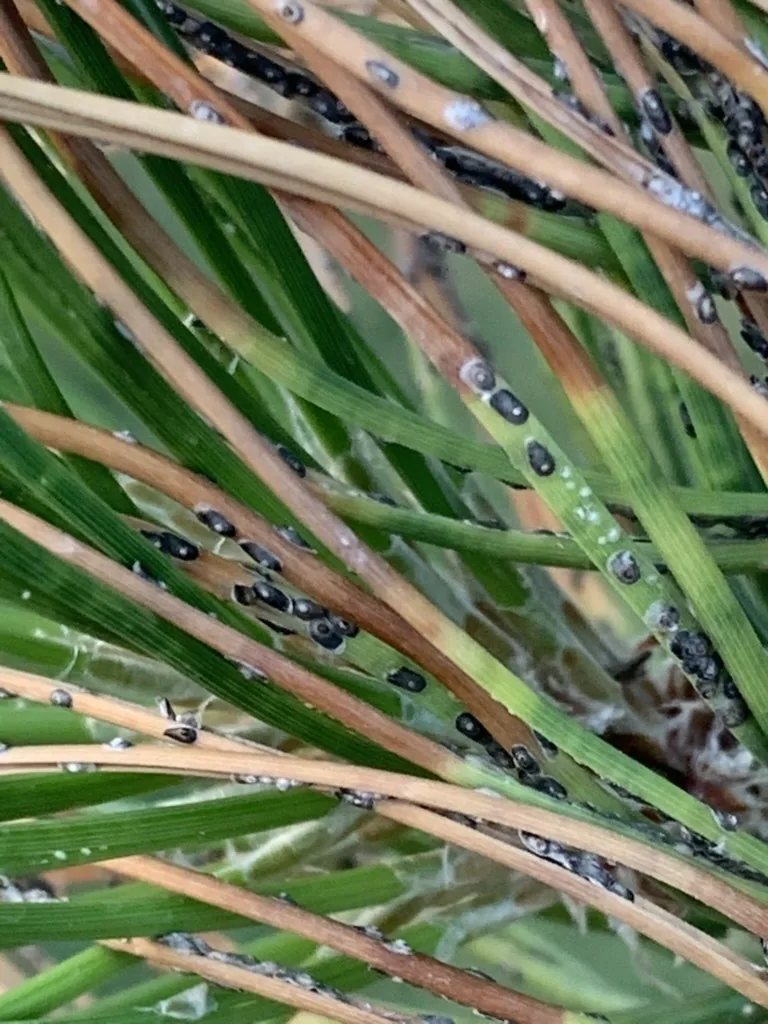
How to identify it
- Adult females are under 1/8 inch, with a round to oval brown-to-black waxy covering and lighter margins.[1][2]
- Crawlers are tiny (about 3/64 inch), yellow-orange and wingless; settled nymphs look like small adults.[1]
- Affected needles become blotchy yellow, and crowns thin as needles yellow and brown.[1]
Where it lives
CSU calls it rare in Colorado, on ponderosa pine and blue spruce; Utah State reports it commonly on Austrian, Scotch and mugo pines and on Douglas-fir.[1][2]
Biology and life cycle
Eggs are laid under the female's shell in late June and early July, and crawlers are out from mid to late July.[1]
Crawlers drift to new spots on the wind, then build a shell and stay put; nymphs and adults do the damage.[1]
Damage and signs
Health risk
Control
Prevention
Keep trees healthy and stress-free.[1][2]
From early to mid July, wrap double-sided tape around twigs to catch crawlers and tell when they are active.[1]
Pesticides
Apply horticultural oil when monitoring shows crawlers are present.[1]
Common questions
- What are the small black shells on my pine needles?
- Possibly black pineleaf scale, an armored scale under 1/8 inch with a dark, light-edged shell.[1][2]
- When should black pineleaf scale be treated?
- When crawlers are active, in mid to late July in Utah; catch them on double-sided tape to time it.[1]
- Can it kill a pine?
- Serious infestations can cause needle drop or tree death, mostly on stressed trees.[1][2]
Sources
- Utah State University Extension, “Black Pineleaf Scale (Ornamental Pest Guide).” extension.usu.edu/planthealth/ipm/ornamental-pest-guide/arthopods/scales/black-pineleaf-scale.php (accessed 2026-10-15)
- Colorado State University Extension, “Scale Insects Affecting Conifers.” extension.colostate.edu/resource/scale-insects-affecting-conifers/ (accessed 2026-10-15)
- iNaturalist, “Dynaspidiotus californicus taxon page (order and family).” www.inaturalist.org/taxa/1037819 (accessed 2026-10-06)