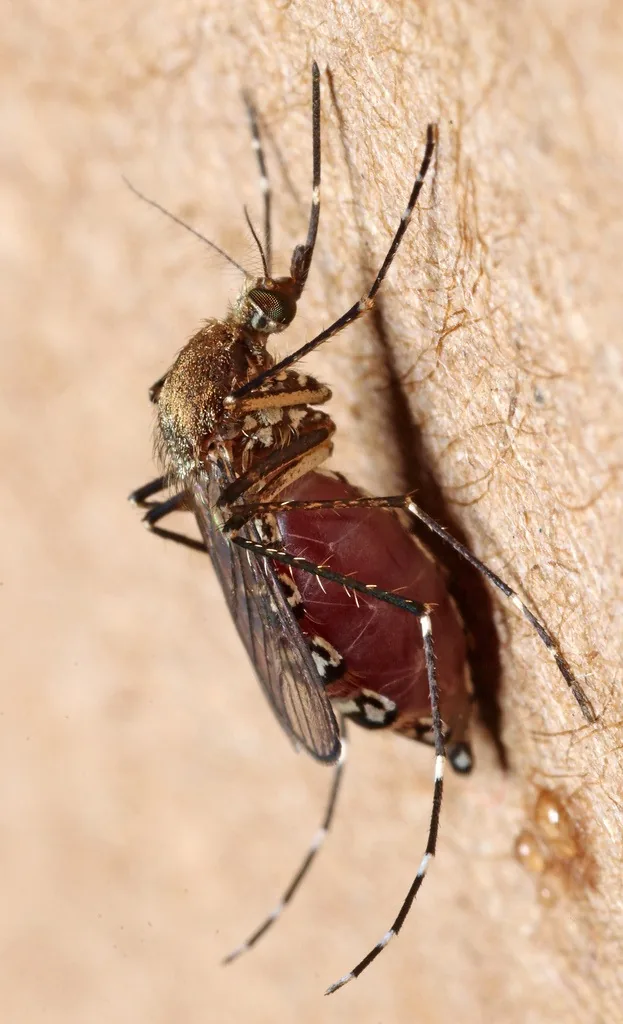
How to identify it
Look-alikes
| Look-alike | How to tell them apart |
|---|---|
| Other mosquitoes | The white ring around the middle of the proboscis helps set this species apart.[1] |
Where it lives
It lives in brackish coastal marshes of the Americas but flies far, and in Florida it can turn up statewide.[1]
Biology and life cycle
Eggs are laid in moist soil above the waterline and hatch when rain or tides flood them.[1]
Larvae take 5 to 15 days and can develop in anything from fresh water to ocean water.[1]
Damage and signs
- Females readily bite people, mostly at night, but will bite by day if their resting spots are disturbed.[1]
Health risk
It can carry eastern equine encephalitis as a bridge vector and transmits dog heartworm.[1]
Control
Prevention
Use repellents with EPA-registered active ingredients and add screened windows and doors.[1]
When to call a professional
Managing salt marsh populations is complex, combining source reduction, surveillance, larviciding and adulticiding.[1]
Common questions
Sources
- University of Florida IFAS Extension (Featured Creatures), “Black Salt Marsh Mosquito, Aedes taeniorhynchus (EENY-591).” edis.ifas.ufl.edu/publication/IN1035 (accessed 2026-10-06)
- iNaturalist, “Aedes taeniorhynchus taxon page (order and family).” www.inaturalist.org/taxa/1112134 (accessed 2026-10-06)