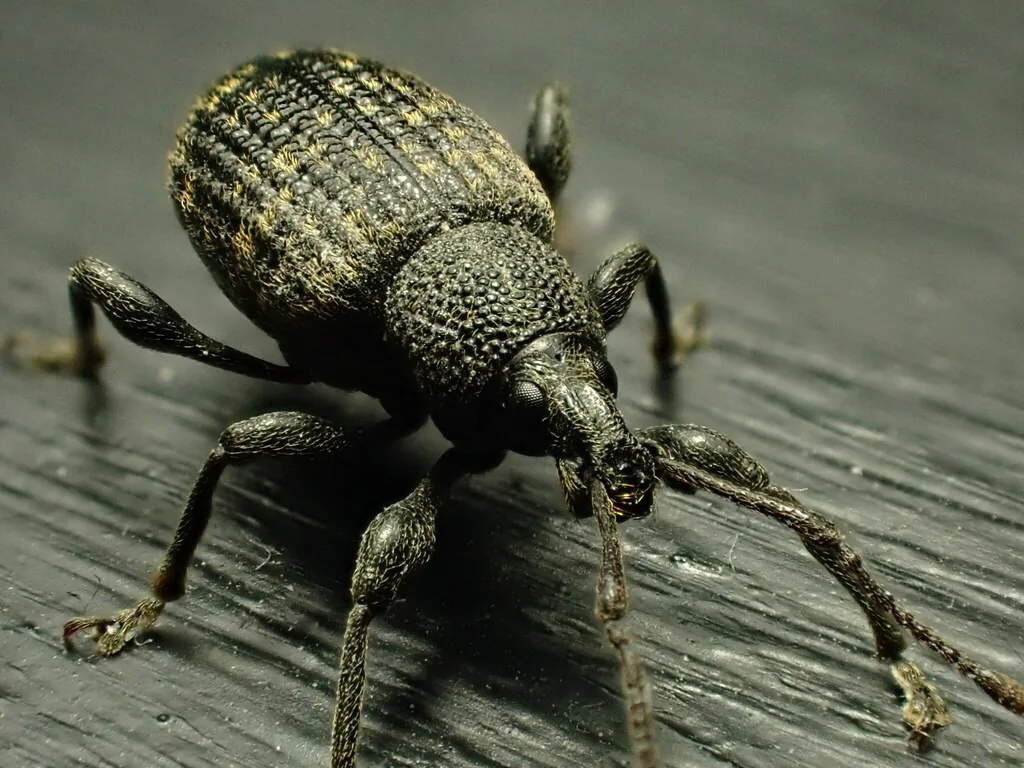
How to identify it
- Adults are hard-bodied, flightless snout beetles about 1/2 inch long, slate gray to black.[1][2]
- The wing covers are pitted with tiny dents and dotted with small patches of short golden or pale hairs.[1][2]
- Adults have a short, broad snout and elbowed, clubbed antennae.[1][2]
- Larvae are legless, C-shaped white grubs with a brown head, reaching about 1/2 inch in the soil.[1][2]
Look-alikes
| Look-alike | How to tell them apart |
|---|---|
| Strawberry root weevil | A close relative with similar habits that is only about half the size of the black vine weevil; it is the root weevil that most often invades homes in hot, dry midsummer weather.[1][3] |
| Other root weevils | Several other common weevils look similar and have similar biology, so leaf notching alone doesn't confirm the species; searching plants at night shows which one is present.[2][3] |
Where it lives
Native to Europe and first reported in Connecticut in 1910, it is now the most destructive and widespread root weevil of its genus and is common in nurseries and landscapes.[1]
Biology and life cycle
Only females are known in North America, and they reproduce without mating.[1][3]
Adults emerge in late spring, feed at night, and hide by day in mulch, leaf litter or dense foliage; disturbed weevils drop to the ground.[1][2][3]
Females feed for three to four weeks before laying eggs, then lay up to 500 eggs in soil near the base of host plants.[1][2]
Larvae feed on roots through summer and fall, overwinter deeper in the soil, and pupate in spring; there is one generation a year.[1][2]
Adults can't fly, so they walk to new plants from nearby infested gardens or unmanaged vegetation.[2]
Damage and signs
- Adults chew notches along leaf edges, which looks bad but seldom hurts plant health even when extensive.[1][2]
- Larvae do the serious damage, chewing roots and sometimes girdling large roots or stems; this can kill or weaken plants, especially azalea and rhododendron.[1][2]
- Infested nursery plants may look healthy in the container but die after planting in the landscape.[1]
- Indoors, root weevils cause no injury to people or furnishings and don't reproduce.[3]
Health risk
Black vine weevils don't bite, sting or damage homes; indoors they are a short-lived nuisance that dies out or goes back outside.[3]
Control
Prevention
Check roots of new plants for grubs before planting, and choose azalea and rhododendron cultivars less susceptible to weevils.[2]
Keep them out
Seal cracks and openings in the building, and consider reducing host plants and watering right around the foundation, since adults seek shade and moisture.[3]
Traps and physical control
Indoors, vacuum up the occasional weevil; insecticides applied inside the house don't help.[3]
After dark, shake plants with notched leaves over a sheet and destroy the weevils; burlap or cardboard trunk wraps checked by day also catch hiding adults.[2][1]
Biological control
Beneficial nematodes, especially Heterorhabditis species, drenched into warm, moist soil from midsummer to fall can reduce the grubs.[2][3][1]
Pesticides
If damage is intolerable, UC IPM lists evening foliar sprays of spinosad timed about a week after leaf chewing starts, or a soil-applied systemic such as imidacloprid; follow the label.[2]
Colorado State suggests pyrethroids such as bifenthrin or permethrin on lower trunks and the plant base, never on blooming plants visited by pollinators.[3]
Common questions
- Why are black vine weevils in my house?
- Adults wander in from foundation plantings, most often in late summer and early fall. They can't breed indoors and soon die or leave.[3]
- Do black vine weevils fly?
- No. Adults are flightless and travel only short distances on foot, so the source is usually host plants close to the house.[2][3]
- What's chewing notches in my rhododendron leaves?
- Night-feeding adult root weevils such as the black vine weevil; check with a flashlight an hour or so after dark to find them.[2][3]
Sources
- Penn State Extension, “Black Vine Weevil (updated June 24, 2026).” extension.psu.edu/black-vine-weevil (accessed 2026-10-06)
- University of California Statewide IPM Program, “Black Vine Weevil (Pest Notes, Home and Landscape).” ipm.ucanr.edu/home-and-landscape/black-vine-weevil/ (accessed 2026-10-06)
- Colorado State University Extension, “Root Weevils, Fact Sheet 5.551.” extension.colostate.edu/resource/root-weevils/ (accessed 2026-10-06)
- iNaturalist, “Otiorhynchus sulcatus taxon page (order and family).” www.inaturalist.org/taxa/226718 (accessed 2026-10-06)