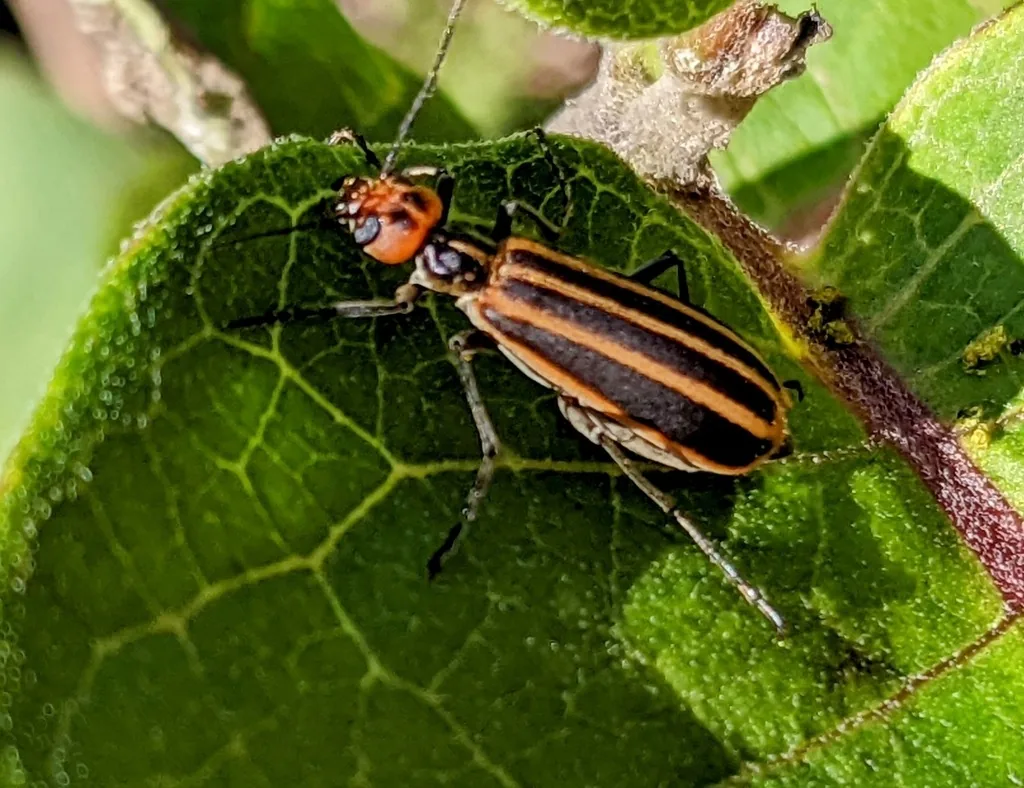
How to identify it
- Long, narrow, soft-looking beetles, about 3/8 to 1 1/4 inches long depending on species, with a broad head and a thorax narrower than the head and abdomen.[1][5][3]
- Unlike most beetles, their wing covers are soft and flexible.[1][5][4]
- Color varies by species: solid black or gray, brown or yellow, sometimes striped, spotted or with pale edges on the wing covers.[4][5]
- The striped blister beetle is 1/3 to 2/3 inch long and yellow and black, with two or three black stripes on each wing cover and two black spots on the head.[2]
- There are about 250 blister beetle species in the United States; the striped blister beetle is a common one in gardens.[4][3]
Look-alikes
| Look-alike | How to tell them apart |
|---|---|
| Other striped Epicauta species | Epicauta occidentalis and E. temexa look nearly identical to the striped blister beetle and are often confused with it; separating them takes a detailed key.[2][5] |
| Black blister beetle | Solid black and usually lower in cantharidin, about 0.5 milligram per beetle versus about 5 milligrams in the striped blister beetle.[1][5] |
Where it lives
The striped blister beetle is native to the eastern United States west to South Dakota, Nebraska, Kansas and Oklahoma, and to Quebec and Ontario. Blister beetles overall are most abundant in dry regions where grasshoppers are plentiful.[2][1]
Biology and life cycle
Females lay clusters of eggs in the soil; striped blister beetles lay masses of 100 to 200 eggs that hatch in 10 to 16 days.[2][1]
The tiny, long-legged larvae search the soil for grasshopper egg pods, then feed there and become legless grubs. A few species develop in solitary bee nests instead.[1][2][5]
Because the larvae eat grasshopper eggs, blister beetle numbers jump after summers with high grasshopper populations.[1][3]
There are one or two generations a year. Adults gather in loose swarms and are most active in the morning and late afternoon.[2][5]
Disturbed beetles drop off the plant and hide or scurry away.[2]
Damage and signs
- Swarms can strip plants quickly. In gardens they feed on peppers, radishes, green beans, potatoes, tomatoes and many other vegetables, plus weeds such as pigweed.[3][2]
- Adults also feed on flowers, including aster, chrysanthemum, dahlia, gladiolus, phlox and zinnia.[4]
- The striped blister beetle is one of the most damaging species to vegetables because it eats foliage, feeds on tomato-family fruit and forms large swarms.[2]
Health risk
Cantharidin in the beetle's blood oozes out when it is pressed, so crushing or even brushing one against skin can cause blisters. Never handle beetles preserved in alcohol, which dissolves the cantharidin.[3][1][5]
Control
Prevention
Managing grasshoppers helps prevent future blister beetle outbreaks, since the larvae feed on grasshopper eggs.[3]
Traps and physical control
Small numbers can be handpicked. Wear gloves, ideally disposable ones, and keep the gloves from touching bare skin.[3][4]
Pesticides
For severe infestations, a garden insecticide dust or spray reduces feeding. Beetles cluster, so check plants and spot-treat infested patches.[3][2]
Blister beetles and horse hay
Living or dead blister beetles can be toxic, sometimes lethal, to horses, sheep and cattle. Animals are poisoned by eating crushed beetles in cured hay, especially alfalfa.[1][2]
Cantharidin is very stable and stays toxic in dead beetles for a long time, and there is no efficient way to inspect baled hay for them.[1]
Signs usually appear within hours: colic, straining and frequent urination, and irritation of the digestive and urinary tracts. Animals can die within 72 hours, so call a veterinarian as soon as poisoning is suspected.[1]
Kentucky Extension advises horse owners to buy first-cutting hay, cut before blister beetles are active there, and to buy from local producers whose practices they know.[1]
Hay producers can cut at late bud or first flower, control flowering weeds, check field edges for clusters from July through early September, and avoid crimping, which crushes beetles into the hay.[1][2]
Common questions
- Are blister beetles ever helpful?
- Yes, in part. The larvae of many species eat grasshopper eggs, so they help suppress grasshopper outbreaks even while adults damage plants.[5][2]
- What should I do if a blister beetle lands on me?
- Don't crush or slap it, since pressure releases the blistering chemical. If you need to pick beetles off plants, wear gloves.[1][3]
- Why does striped blister beetle matter most for hay?
- It carries more cantharidin than common relatives and tends to cluster along field edges, so harmful numbers can end up in a bale.[1]
Sources
- University of Kentucky Entomology, “ENTFACT-102: Blister Beetles (revised March 2026).” entomology.mgcafe.uky.edu/ef102 (accessed 2026-10-06)
- University of Florida/IFAS Extension (EDIS), “Striped Blister Beetle, Epicauta vittata (Fabricius), Featured Creatures IN556.” edis.ifas.ufl.edu/publication/IN556 (accessed 2026-10-06)
- South Dakota State University Extension, “Blister Beetles Causing Problems in Gardens.” extension.sdstate.edu/blister-beetles-causing-problems-gardens (accessed 2026-10-06)
- University of Maryland Extension, “Blister Beetles on Flowers (updated March 7, 2023).” www.extension.umd.edu/resource/blister-beetles-flowers (accessed 2026-10-06)
- Texas A&M AgriLife Extension, “Blister Beetle (Field Guide to Common Texas Insects).” texasinsects.tamu.edu/hemiptera/blister-beetle/ (accessed 2026-10-06)
- iNaturalist, “Epicauta vittata taxon page (order and family).” www.inaturalist.org/taxa/1121206 (accessed 2026-10-06)