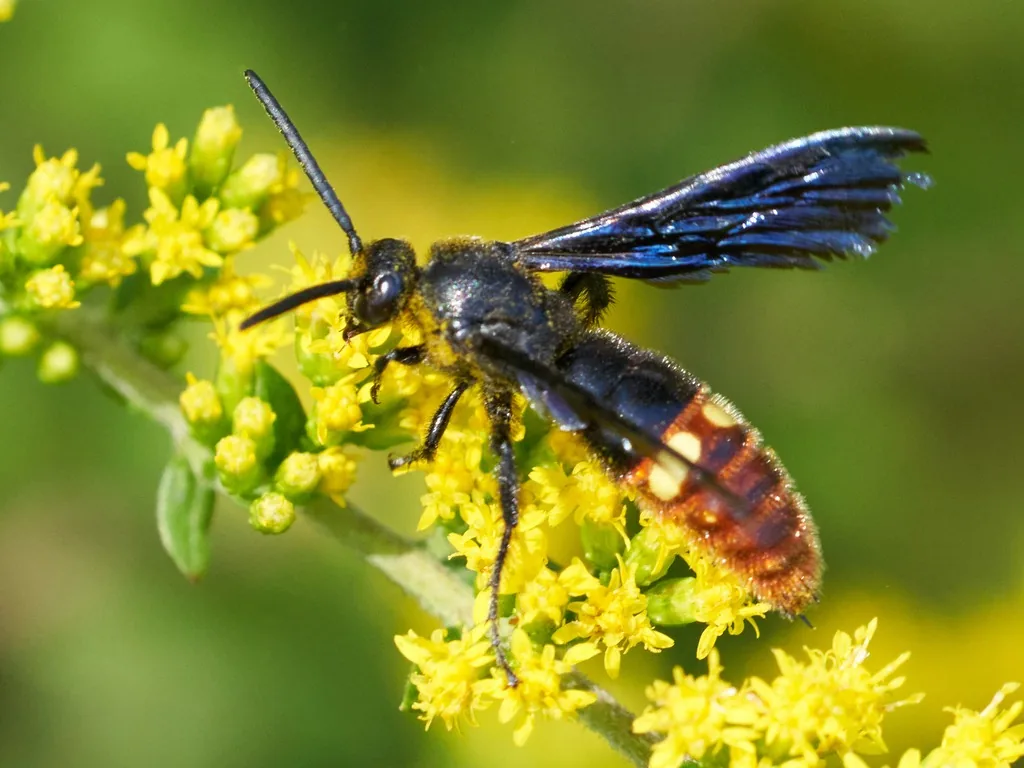
How to identify it
- Adults are over 1/2 inch long (about 5/8 inch) with a shiny black head and thorax, black antennae and blue-black wings.[1][2]
- About midway along the abdomen are two yellow spots, one on each side; in flight they can look like a band.[1][2]
- The rear part of the abdomen is reddish brown and fuzzy.[1][2]
Where it lives
It is the most common scoliid wasp in North Carolina and is seen in Maryland and South Carolina lawns and gardens; adults are active from June to October.[1][2][3]
Biology and life cycle
Adults are present from June to October and are most abundant in August, often flying in large numbers over lawns during the day.[1][2]
A female digs through the soil or follows grub tunnels, stings and paralyzes a grub, and lays an egg on it; the wasp larva eats the grub in about two weeks.[1][3]
The larva spins a cocoon and spends fall and winter in the soil, and a new generation of adults appears the following summer.[1][3]
Adults feed on nectar and are often seen on goldenrod, mountain mint and other flowers in late summer.[1][2][3]
Damage and signs
Health risk
They are not aggressive and generally do not attack people; only females can sting, and they rarely if ever do.[1][2][3]
Control
Prevention
No control is needed or recommended; many wasps over a lawn usually mean it has grubs.[1][2]
Biological control
Their presence is a sign that natural grub control is already at work.[3]
Common questions
- Why are wasps flying low over my lawn?
- In late summer they are often blue-winged scoliid wasps searching for beetle grubs in the soil, or males looking for females.[1][3]
- Do blue-winged wasps sting?
- Rarely, if ever. They are not aggressive, and control isn't recommended.[1][2]
- Should I spray them?
- No. They help control June beetle and Japanese beetle grubs and pollinate flowers.[1][2][3]
Sources
- NC State Extension, “Blue-winged Wasp (PDIC Factsheet).” content.ces.ncsu.edu/blue-winged-wasp (accessed 2026-10-15)
- University of Maryland Extension, “Scoliid Wasp.” extension.umd.edu/resource/scoliid-wasp (accessed 2026-10-15)
- Clemson Cooperative Extension, Home & Garden Information Center, “Two-Spotted Scoliid Wasp: A Gentle and Valuable Garden Visitor.” hgic.clemson.edu/two-spotted-scoliid-wasp-a-gentle-and-valuable-garden-visitor/ (accessed 2026-10-15)
- iNaturalist, “Scolia dubia taxon page (order and family).” www.inaturalist.org/taxa/1129479 (accessed 2026-10-06)