How to identify it
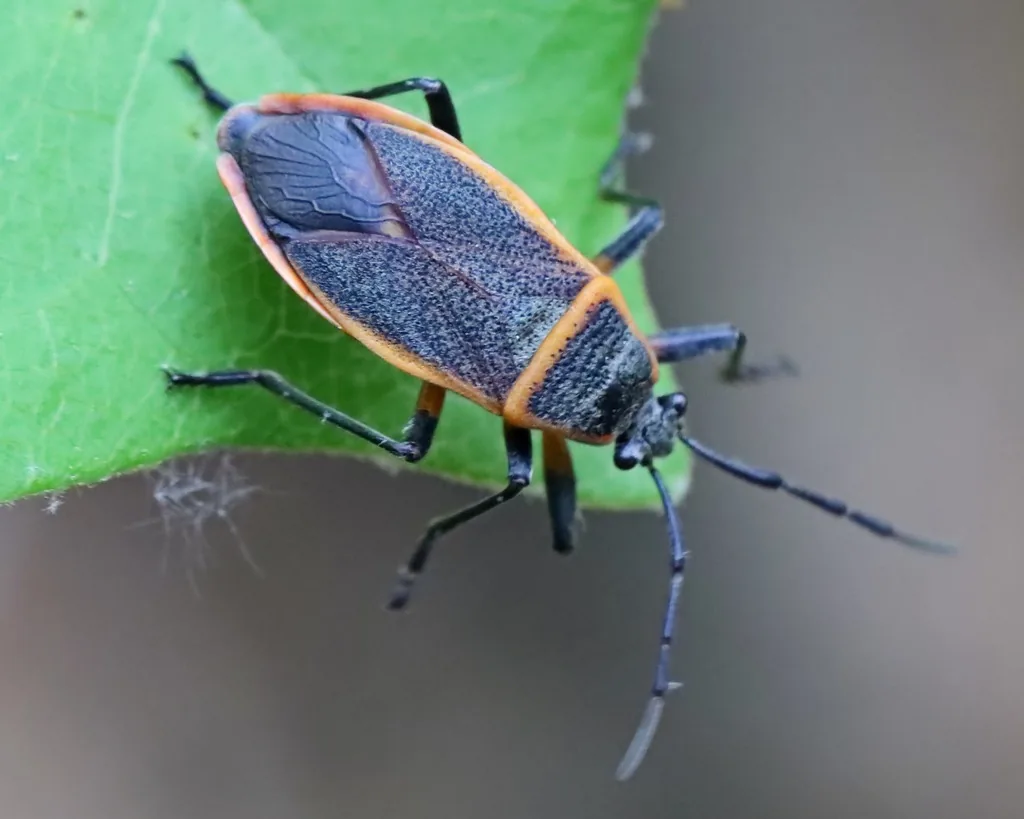
- Adults are about 1/2 to 5/8 inch long, elongated oval and somewhat flattened, matte gray to black or steel blue.[1][2]
- Orange to reddish-yellow borders run around the edges of the wings and the shield behind the head, and the outer edges of that shield are rounded.[1][2]
- Nymphs are shiny black to steel blue; older nymphs usually carry a distinct orange spot in the middle of the back, and they often cluster in large groups.[1]
Look-alikes
| Look-alike | How to tell them apart |
|---|---|
| Assassin bugs | Some adult assassin bugs look much like bordered plant bugs but can give a painful bite, so avoid handling look-alikes.[1] |
| Boxelder bug | Boxelder bugs have diagonal reddish-orange marks across the forewings rather than an orange border around the body.[2] |
| Cotton stainer | Very similar steel-blue bug, but its eyes and the sharp-edged sides of the shield behind the head are bright red; it feeds on cotton.[2] |
Where it lives
Common across the southern United States, including Mississippi and Texas, especially in areas with many pine trees.[1][3][2]
Biology and life cycle
They are general feeders that suck juices from weeds, seeds and the shoots of hardwoods such as oak and wax myrtle, and they also scavenge on animal droppings and dead insects.[1][2]
Large numbers often gather on pine trunks without causing any apparent damage to the pines.[1][3]
In fall, nymphs and adults leave their host plants and wander the ground looking for cracks and crevices to spend the winter in.[2]
Adults and nymphs have an unpleasant odor and taste that helps protect them from predators.[1]
Relatively little is known about their life history, because they have never been considered economically important.[1]
Damage and signs
- They are not serious pests of turf, landscape plants, vegetables or fruit trees, and they rarely cause significant problems as home invaders.[1][3]
- A few may occasionally feed on blueberries, blackberries or other edible plants, but they generally cause little injury to the plants they feed on.[1][2]
Health risk
Medically harmless. Plant-feeding bugs with piercing mouthparts can bite in theory, but they rarely do.[2][1]
Control
Prevention
LSU AgCenter and Mississippi State specialists say no control is needed; these bugs are a curiosity, not a threat to plants or homes.[3][1]
Keep them out
For bugs that gather on buildings in fall, Illinois Extension recommends tight-fitting doors and windows, intact screens, and sealing gaps around the foundation, pipes, wires and chimneys.[4]
Traps and physical control
Vacuum up any bugs that wander indoors and empty them into soapy water; indoor insecticide use against fall invaders is generally not recommended.[4]
Common questions
- Are bordered plant bugs damaging my plants?
- Almost certainly not. Even in large numbers they feed mostly on weeds, seeds and tree shoots and have not been seen harming ornamentals or food plants in any meaningful way.[1][3]
- Do bordered plant bugs bite?
- They are considered medically harmless and rarely bite. Similar-looking assassin bugs can bite painfully, so it is wise not to pick up unfamiliar bugs.[2][1]
- Why are so many of them on my pine trees?
- Bordered plant bugs commonly crowd onto pine trunks, but they don't appear to hurt the trees.[1][3]
Sources
- Mississippi State University Extension, “Bordered Plant Bug (Bug's Eye View, Vol. 2, No. 28, 2016).” extension.msstate.edu/newsletters/bugs-eye-view/2016/bordered-plant-bug-vol-2-no-28 (accessed 2026-10-06)
- Texas A&M AgriLife Extension, “Largus Bug (Field Guide to Common Texas Insects).” texasinsects.tamu.edu/largus-bug/ (accessed 2026-10-06)
- LSU AgCenter, “Bordered Plant Bugs (Southern Garden, June 24, 2015).” www.lsuagcenter.com/portals/blogs/southerngarden/bordered-plant-bugs (accessed 2026-10-06)
- University of Illinois Extension, “Fall house guests (Sept. 23, 2019).” extension.illinois.edu/news-releases/fall-house-guests (accessed 2026-10-06)
- iNaturalist, “Largus succinctus taxon page (order and family).” www.inaturalist.org/taxa/68009 (accessed 2026-10-06)