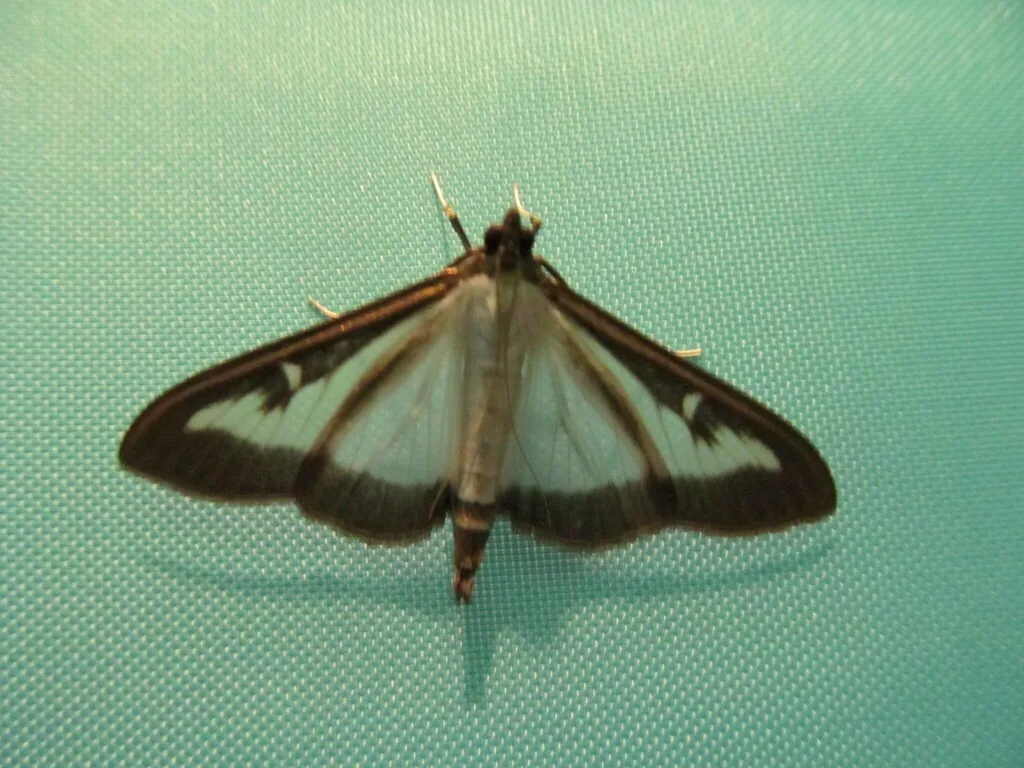
How to identify it
- Caterpillars are lime green with black stripes, white spots, hairs and a shiny black head, and grow to about 1.5 inches.[1][3]
- Most adults have white, slightly iridescent wings with a thick, irregular brown border, a wingspan of roughly 1.5 to 1.8 inches, and a brown head and abdomen.[2][3]
- A dark form also occurs, with mostly brown wings and a small white streak on each forewing; both sexes can have either coloring.[2][3]
- Eggs are pale yellow and laid in flat, scale-like clusters of about 5 to 20 on the undersides of boxwood leaves.[2][3]
Look-alikes
| Look-alike | How to tell them apart |
|---|---|
| Melonworm and pickleworm moths | These related moths lack the white comma-shaped mark on the forewing and are mostly southern species that only occasionally drift north.[3] |
Where it lives
First detected in the United States in New York in 2021, it has since been confirmed in Delaware, Kentucky, Maryland, Massachusetts, Michigan, Ohio, Pennsylvania, Virginia and West Virginia. It also occurs in Ontario, Canada, and in Europe.[1][3]
Biology and life cycle
It overwinters as a young caterpillar inside a silk shelter among the leaves and can survive temperatures as low as -22°F.[2]
Caterpillars resume feeding in spring, tie leaves together with silk webbing, and often feed lowest on the shrub first.[2]
Pupae form in silk cocoons; adults live about two weeks, are mostly active at night, and several overlapping generations can occur each year.[2][1]
New infestations usually start with infested boxwood nursery stock, followed by natural spread from each introduction.[3]
Damage and signs
- Look for leaves with missing sections or eaten down to the midrib, loose silk webbing between twigs, and green-black pellets of frass.[1][2][3]
- Badly infested shrubs look brown or scorched; after the leaves are gone, caterpillars strip bark, which can girdle and kill the plant.[2][3]
- All of the roughly 150 boxwood cultivars sold to homeowners are susceptible.[3]
Health risk
It is a plant pest; the harm described by APHIS and state agencies is defoliation and death of boxwood shrubs.[1][3]
Control
Prevention
Check boxwoods for chewed or skeletonized leaves, webbing and frass, and report suspected box tree moth to your state plant regulatory official or state agriculture department.[1][3]
If you need to replant in an infested area, consider alternatives such as inkberry holly, Japanese holly, bayberry, dwarf hinoki cypress or plum yew.[2]
Sanitation
Double-bag infested clippings in plastic before disposal so you don't spread the moth to new places.[1][2]
Traps and physical control
On small or lightly infested shrubs, hand-pick caterpillars into soapy water, or prune out infested branches; cut very heavily infested shrubs off at the base.[2][1]
Pesticides
UMass lists options including Bacillus thuringiensis, spinosad, chlorantraniliprole and methoxyfenozide; sprays must reach inside the shrub and through the webbing, and should go on after bloom to protect pollinators.[2]
When to call a professional
Your local Cooperative Extension office can advise on treatment, and a licensed applicator may be needed for heavy infestations.[1][2]
Federal quarantine and import rules
In December 2023, APHIS amended its import requirements for box tree moth and for plants for planting shipped from Canada into the United States.[1]
In August 2026, APHIS established a federal box tree moth quarantine in Maryland and Pennsylvania, and it expanded the Maryland quarantine in October 2026.[1]
APHIS publishes a map of the current regulated areas; check it before moving boxwood out of an affected county.[1][3]
Common questions
- How do I report box tree moth?
- Contact your state plant regulatory official, listed through the National Plant Board, or your State Plant Health Director. In Pennsylvania, email badbug@pa.gov with the life stage, any damage and photos.[1][3]
- Will box tree moth kill my boxwood?
- It can. Caterpillars can strip every leaf and then feed on the bark, and repeated defoliation or girdling can kill the shrub.[1][3][2]
- Is box tree moth under quarantine?
- Yes. APHIS has federal quarantine areas in parts of Maryland and Pennsylvania as of 2026 and also regulates boxwood imports from Canada.[1]
Sources
- USDA Animal and Plant Health Inspection Service (APHIS), “Box Tree Moth.” www.aphis.usda.gov/plant-pests-diseases/box-tree-moth (accessed 2026-10-06)
- UMass Extension Landscape, Nursery and Urban Forestry Program, “Cydalima perspectalis (Box Tree Moth), Landscape, Nursery and Urban Forestry Insect and Mite Guide.” www.umass.edu/agriculture-food-environment/landscape/publications-resources/insect-mite-guide/cydalima-perspectalis (accessed 2026-10-06)
- Pennsylvania Department of Agriculture, Bureau of Plant Industry, “Box Tree Moths.” www.pa.gov/agencies/pda/plants-land-water/plant-industry/plant-protection/box-tree-moth.html (accessed 2026-10-06)
- iNaturalist, “Cydalima perspectalis taxon page (order and family).” www.inaturalist.org/taxa/325295 (accessed 2026-10-06)