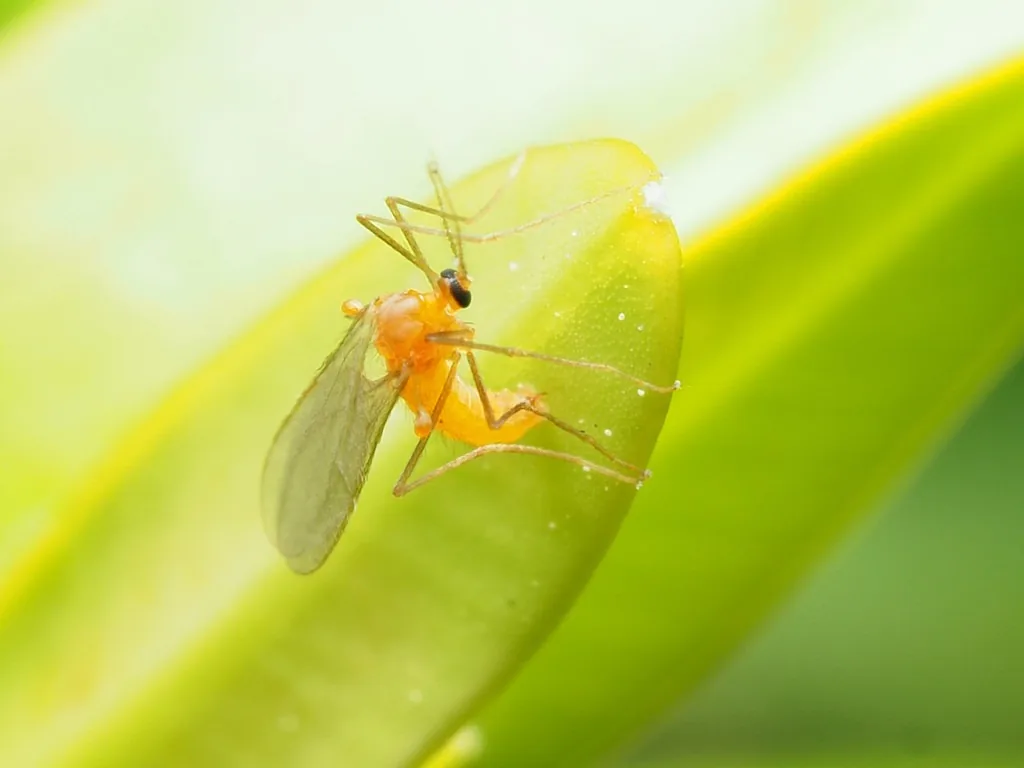
How to identify it
- Adults are delicate, mosquitolike flies about 1/10 inch long with long legs and antennae and a reddish to yellowish orange body.[1]
- Larvae are legless maggots up to 1/8 inch, green, orange, whitish or yellow, hidden inside leaves.[1]
- After emergence, empty whitish pupal skins stick out of small holes under the leaves.[1]
Where it lives
It feeds only on boxwoods (Buxus species).[1]
Biology and life cycle
Adults are present for about two weeks in spring, usually April, and females lay up to about 20 eggs per leaf.[1]
Eggs hatch in two to three weeks, and larvae feed through summer, overwinter and pupate inside the mine.[1]
There is one generation a year.[1]
Damage and signs
Health risk
It damages only boxwood; UC IPM notes nothing about people.[1]
Control
Prevention
Keep boxwoods vigorous with good care, especially adequate soil moisture in the dry season.[1]
Consider resistant boxwoods such as Buxus microphylla var. japonica, 'Green Pillow' or 'Vardar Valley'.[1]
Sanitation
Rake up fallen boxwood leaves in fall and winter, and clip off lightly mined leaves.[1]
Pesticides
For valued plants, UC IPM lists dinotefuran or imidacloprid soil drenches in late winter or spinosad sprays in spring, applied after bloom because all three harm bees.[1]
Common questions
Sources
- University of California Statewide IPM Program, “Boxwood Leafminer (Pests in Gardens and Landscapes).” ipm.ucanr.edu/PMG/GARDEN/PLANTS/INVERT/boxwoodlfmin.html (accessed 2026-10-06)
- iNaturalist, “Monarthropalpus flavus taxon page (order and family).” www.inaturalist.org/taxa/467578 (accessed 2026-10-06)