How to identify it
- Cotesia adults are small, dark wasps that resemble flying ants or tiny flies, with antennae curved upward rather than elbowed.[2]
- The female's abdomen narrows to a downward-curving ovipositor used to lay eggs.[2]
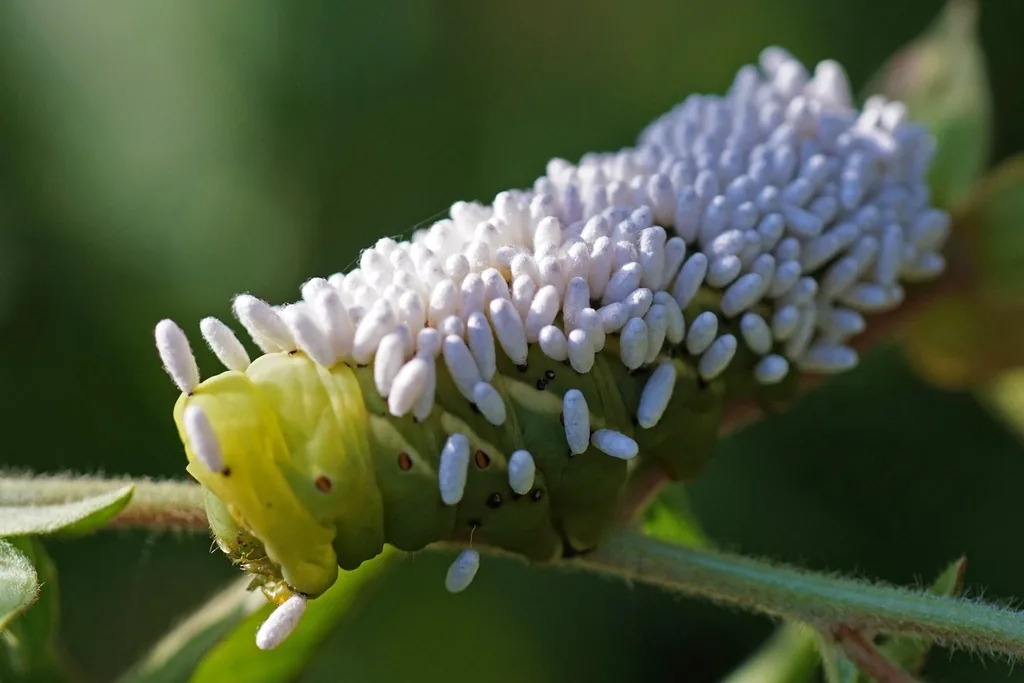
- Cocoons are small silken cases, white to yellowish, attached to the host caterpillar or nearby leaves.[1][2][3]
- On a tomato hornworm the cocoons stick out of the body like grains of white rice.[1]
Where it lives
More than 1,000 braconid species occur in the United States, attacking the larvae of beetles, caterpillars, flies and sawflies.[3]
Biology and life cycle
A female lays eggs inside a young caterpillar; Cotesia glomerata places about 20 to 60 in each imported cabbageworm.[2]
The wasp larvae feed inside the living host, then emerge to spin cocoons on or near it, and the host dies.[1][2]
Egg to adult takes about 22 to 30 days for C. glomerata, and about two weeks in summer for the alfalfa caterpillar Cotesia.[2][3]
Adults feed on honeydew and nectar and live 2 to 3 weeks.[3]
Damage and signs
- They don't feed on plants. By midseason about half of imported cabbageworm larvae may be parasitized by C. glomerata, rising to 60 to 75 percent late in the season.[2]
Health risk
Parasitoid wasps such as braconids do not sting people.[4]
Control
Prevention
If a hornworm carries white cocoons, leave it in the garden so the adult wasps can emerge and parasitize more hornworms.[1]
Biological control
Parasitoid wasps are very sensitive to insecticides, so avoid or limit chemical sprays.[4][1]
Flowering plants supply nectar that nourishes adult parasitic wasps.[3]
Common questions
- What are the white things sticking out of my hornworm?
- They're cocoons of a braconid wasp. Its larvae fed inside the hornworm, which will die when the adult wasps emerge.[1]
- Will these wasps sting me?
- No. Parasitoid wasps are not interested in people and do not sting them.[4]
- Can I buy them?
- Not this one: Cotesia glomerata isn't commercially available, so gardens rely on wild populations.[2]
Sources
- University of Minnesota Extension, “Tomato hornworms.” extension.umn.edu/yard-and-garden-insects/tomato-hornworms (accessed 2026-10-06)
- Cornell University College of Agriculture and Life Sciences, “Biological Control: A Guide to Natural Enemies in North America: Cotesia glomerata.” biocontrol.entomology.cornell.edu/parasitoids/cotesia.php (accessed 2026-10-06)
- University of California Statewide IPM Program, “Alfalfa Caterpillar Cotesia Parasitoid (Natural Enemies Gallery).” ipm.ucanr.edu/natural-enemies/alfalfa-caterpillar-cotesia-parasitoid/ (accessed 2026-10-06)
- University of Maryland Extension, “Parasitoid wasps.” extension.umd.edu/resource/parasitoid-wasps (accessed 2026-10-06)
- iNaturalist, “Cotesia congregata taxon page (order and family).” www.inaturalist.org/taxa/1449989 (accessed 2026-10-06)