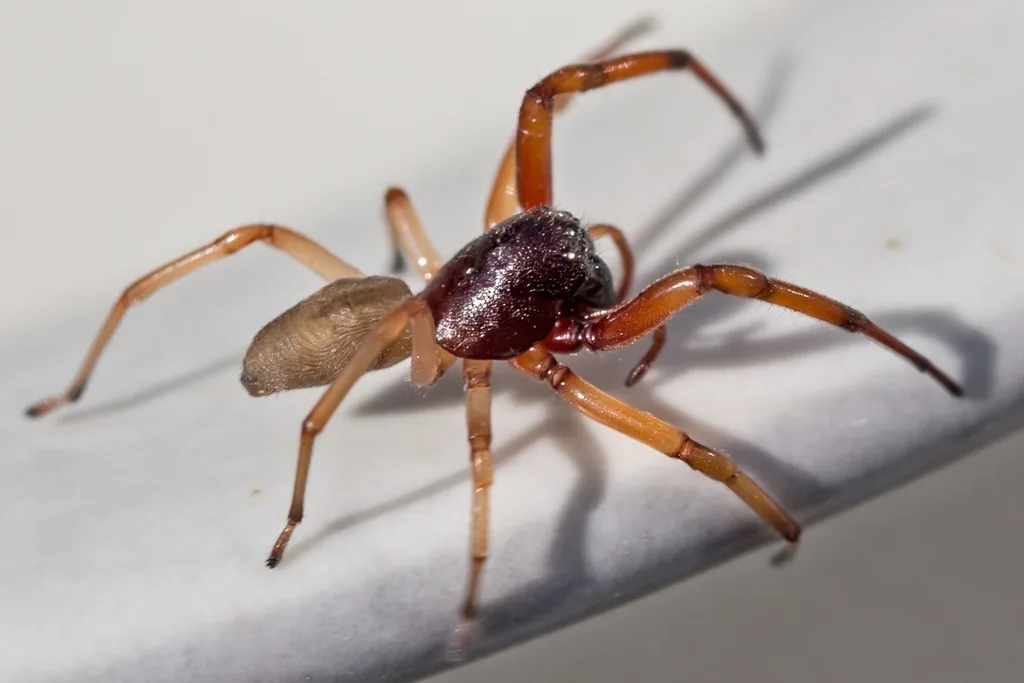
How to identify it
- Females are 7 to 10 mm long and males 5 to 6 mm.[1]
- The front body section and jaws are thick, hard and reddish brown with tiny pits; the abdomen is pale yellow to light gray with a slightly darker stripe.[1]
- The front pair of legs is darker and thicker, and each pair behind it is lighter and thinner.[1]
Where it lives
It ranges from New England and nearby Canada south to Georgia and Alabama and west to Kansas and Minnesota.[1]
Biology and life cycle
Outdoors it walks on foliage and hides by day in silken retreats under leaf litter, stones and boards and under windowsills and siding.[1]
It favors warm, dry spots; males mature and mate in midsummer, and in September or October each female lays a white sac of 30 to 50 eggs, often under loose bark.[1]
It's reported to scavenge dead spiders and insects.[1]
Damage and signs
- Penn State Extension mentions no damage; most indoor sightings come as temperatures fall in autumn, and it doesn't usually set up breeding colonies in homes.[1]
Health risk
Its bite is reported to hurt like a bee or wasp sting, and severe secondary infections followed some bites; people sensitive to venoms may react more strongly.[1]
Control
Keep them out
Seal cracks in the foundation and gaps around windows and doors, and keep screens in good repair.[2]
Sanitation
Keep the foundation clear of leaf litter, trash and heavy vegetation, and keep clutter off floors in basements, garages and storage areas.[2]
Traps and physical control
Vacuum spiders and webs, or trap one under a jar and release it outdoors; wear gloves when clearing clutter.[2]
Common questions
- What is the spider with a shiny reddish-brown front wandering my house in fall?
- It may be a broad-faced sac spider; mature females often wander indoors in autumn.[1]
- Is the broad-faced sac spider dangerous?
- Its bite can hurt like a bee or wasp sting, and severe secondary infections have been recorded after some bites.[1]
Sources
- Penn State Extension, “Broad-Faced Sac Spider.” extension.psu.edu/broad-faced-sac-spider (accessed 2026-10-06)
- University of California Statewide IPM Program, “Spiders (Pest Notes, Home and Landscape).” ipm.ucanr.edu/home-and-landscape/spiders/ (accessed 2026-10-06)
- iNaturalist, “Trachelas tranquillus taxon page (order and family).” www.inaturalist.org/taxa/153871 (accessed 2026-10-06)