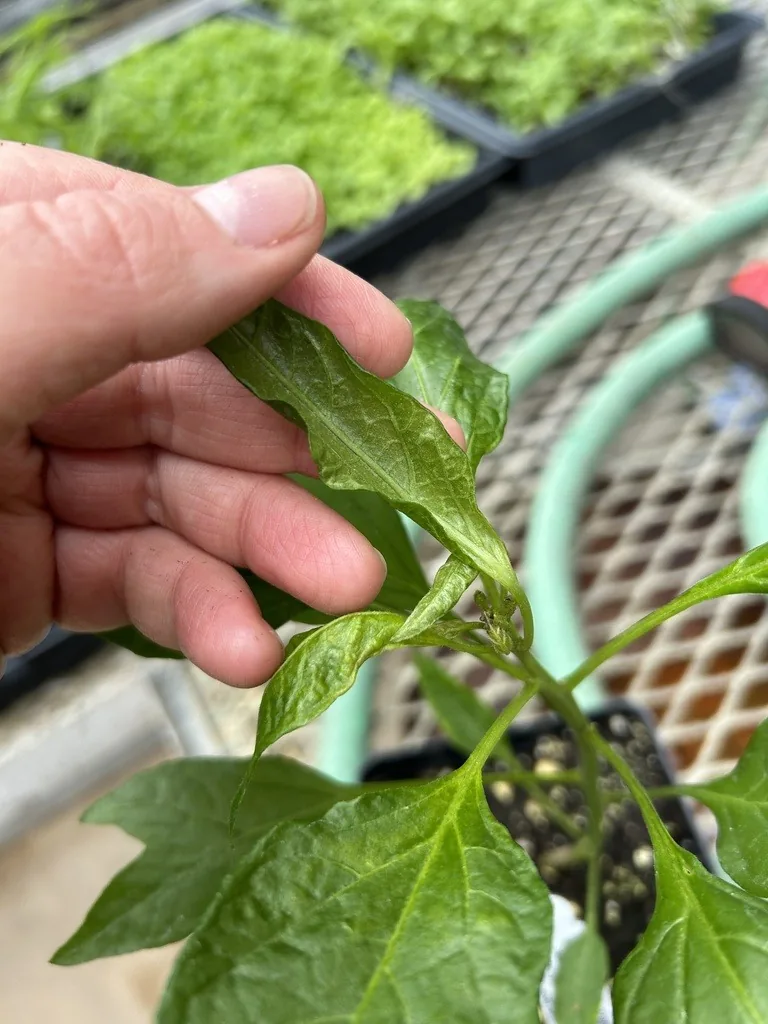
How to identify it
- Females are about 0.2 mm long, oval and light yellow to amber or green; it takes at least a 10x hand lens, ideally 30 to 60x, to see them.[2][1]
- The eggs are distinctive: clear ovals dotted with white tufts on top.[2][1]
- Usually the first sign is twisted, cupped leaves and stunted tips, which can be mistaken for herbicide injury, boron deficiency or fire blight.[2][1]
Where it lives
It occurs worldwide; in temperate areas it's mainly a greenhouse pest, and since 2013 it has damaged primocane blackberries in Pennsylvania and other eastern states.[2][1]
Biology and life cycle
Females lay 30 to 76 eggs over 8 to 13 days on leaf undersides and small fruit, and the eggs hatch in two or three days.[2]
Males carry immature females to new leaves, spreading the colony, and mites can also hitch rides on whiteflies and aphids.[2][1]
Hosts include chili peppers, tomatoes, citrus and mango and ornamentals such as African violet, begonia, impatiens, gerbera and azalea.[2]
Damage and signs
Health risk
It feeds on plants; Penn State Extension and UF/IFAS mention no risk to people.[1][2]
Control
Prevention
Start with clean plants: early blackberry infestations may have come from greenhouse-propagated plants, and mites also travel on tools.[1]
Sanitation
If only a plant or two shows symptoms, remove them along with a couple of plants on each side.[1]
Biological control
Predatory mites are available, especially for greenhouses; avoid broad-spectrum insecticides so natural enemies survive.[2][1]
Pesticides
UF/IFAS notes that insecticidal oils or soaps are usually as effective as miticides and less harmful to the environment.[2]
Common questions
- Why are the new leaves on my pepper plant twisted and cupped?
- Broad mites are one cause; their saliva distorts new growth, though herbicide injury and boron deficiency can look similar.[2]
- Can I see broad mites?
- Not with the naked eye; Penn State says they take 30 to 60x magnification, so ask your Extension office for help.[1]
Sources
- Penn State Extension, “Small Fruit Mite: Broad Mites on Blackberries.” extension.psu.edu/small-fruit-mite-broad-mites-on-blackberries (accessed 2026-10-06)
- University of Florida IFAS Extension (Featured Creatures), “Broad Mite, Polyphagotarsonemus latus (EENY-183).” edis.ifas.ufl.edu/publication/IN340 (accessed 2026-10-06)
- iNaturalist, “Polyphagotarsonemus latus taxon page (order and family).” www.inaturalist.org/taxa/410134 (accessed 2026-10-06)