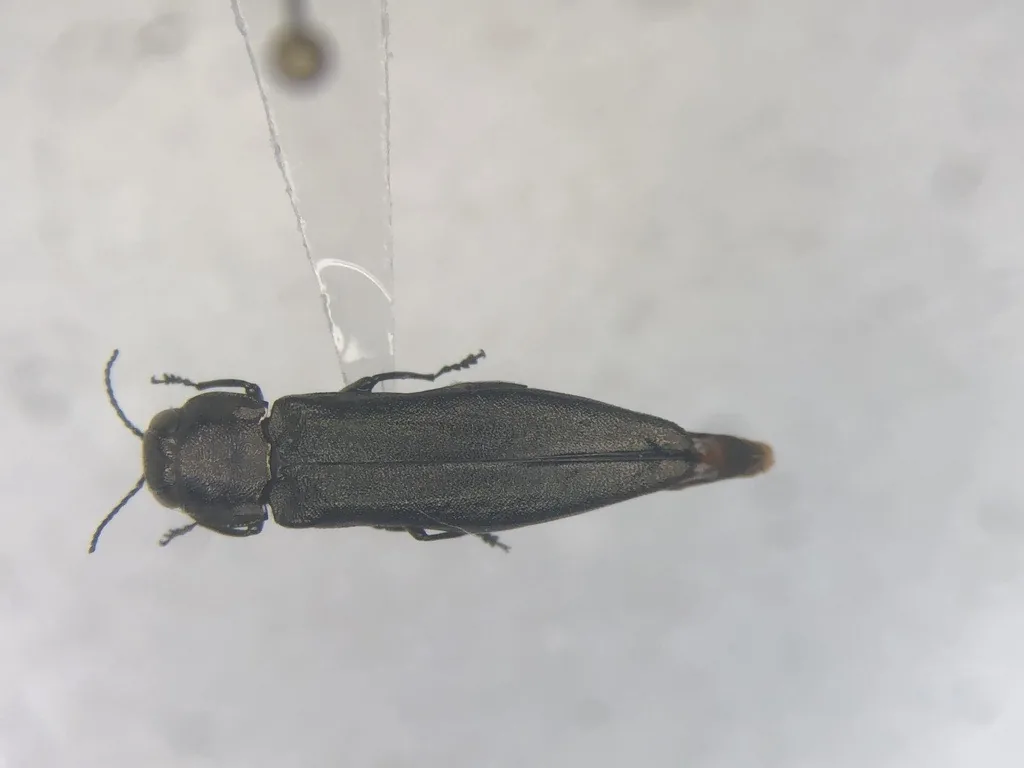
How to identify it
- Adults are slender, dark beetles about 3/8 to 1/2 inch long, olive green to bronze with an iridescent sheen.[2][3][4]
- Larvae are pale, flattened and up to about 1 inch long, with a pair of small pincer-like spines at the tail end.[2][4][1]
- Emerging adults leave small D-shaped exit holes, about 1/8 to 3/16 inch across, in the bark.[2][4]
- Winding, sawdust-packed tunnels under the bark cause raised ridges and bumps on trunks and branches.[3][4][2]
Look-alikes
| Look-alike | How to tell them apart |
|---|---|
| Emerald ash borer | A metallic green beetle from Asia that attacks and kills ash trees, while the bronze birch borer is a native, bronze-colored beetle of birches.[5][1][4] |
| Twolined chestnut borer | A closely related borer that attacks stressed oaks; adults are bluish-black with two parallel yellow stripes down the wing covers.[4] |
Where it lives
Native to North America and found throughout the range of birch in the United States and Canada.[1][2]
Biology and life cycle
Larvae overwinter under the bark, pupate in spring, and adults emerge from late May into July, about when black locust trees bloom.[2][3][4]
Adults feed on leaves for a few weeks, then females lay eggs in bark cracks, usually on sunny parts of the tree.[2][4][3]
Larvae hatch in about two weeks and tunnel into the phloem, the layer that carries sap just under the bark.[2][3]
The life cycle takes one or two years depending on climate and tree condition; in New Hampshire it takes two years.[4][2][1]
Besides birches, it has been recorded on aspens and cottonwoods.[1]
Damage and signs
- Larval tunnels girdle branches and trunks, cutting off sap flow; dieback starts at the top of the crown and works downward.[3][4][2]
- Early signs include yellowing leaves, a thin crown and dying upper branches; untreated trees usually die within a few years of the first dead branches.[3][1]
- European white, Himalayan and other white-barked Asian and European birches are the most susceptible, even when healthy.[1][4]
Health risk
A tree pest only; it feeds on birches and a few other trees and isn't described as a threat to people or pets.[1]
Control
Prevention
Keep birches vigorous: mulch the shallow roots, water deeply during dry spells, protect roots from compaction, and control other birch pests.[4][3][2]
Plant resistant birches, such as river birch and 'Heritage' river birch, instead of highly susceptible European and Asian white-barked types.[3][1][4]
Sanitation
Prune out and destroy dead or infested branches before adults emerge in spring, and avoid routine pruning of birches until late summer.[2][3][1]
Pesticides
Soil-applied systemic insecticides such as imidacloprid or dinotefuran can help, but only for trees in early decline; they aren't effective once 40 to 50 percent of the canopy is dead.[4][3]
Apply systemic products only after birches finish flowering, to reduce exposure to bees.[4]
When to call a professional
Hire a professional tree care company for large trees; they have access to products and methods unavailable to homeowners.[4]
Common questions
- Why is my birch tree dying from the top?
- Top-down dieback in a birch, with thin foliage and bumpy bark, is a classic sign of bronze birch borer tunneling under the bark.[3][4]
- Can a birch with bronze birch borer be saved?
- Sometimes, if caught early; treatments work only while decline is just beginning, not after half the canopy has died.[4]
Sources
- UMass Extension Landscape, Nursery and Urban Forestry Program, “Agrilus anxius (Landscape Insect and Mite Guide).” www.umass.edu/agriculture-food-environment/landscape/publications-resources/insect-mite-guide/agrilus-anxius (accessed 2026-10-06)
- University of New Hampshire Extension, “Bronze Birch Borer [fact sheet].” extension.unh.edu/resource/bronze-birch-borer-fact-sheet (accessed 2026-10-06)
- Purdue University Department of Entomology Extension, “Bronze Birch Borer, E-50-W (November 2017).” www.extension.entm.purdue.edu/publications/E-50/E-50.pdf (accessed 2026-10-06)
- University of Minnesota Extension, “Bronze birch borer and twolined chestnut borer.” extension.umn.edu/garden-and-home/yard-and-garden/yard-and-garden-insects/metallic-wood-boring-beetles (accessed 2026-10-06)
- USDA Animal and Plant Health Inspection Service, “Emerald Ash Borer.” www.aphis.usda.gov/plant-pests-diseases/eab (accessed 2026-10-06)
- iNaturalist, “Agrilus anxius taxon page (order and family).” www.inaturalist.org/taxa/123961 (accessed 2026-10-06)