How to identify it
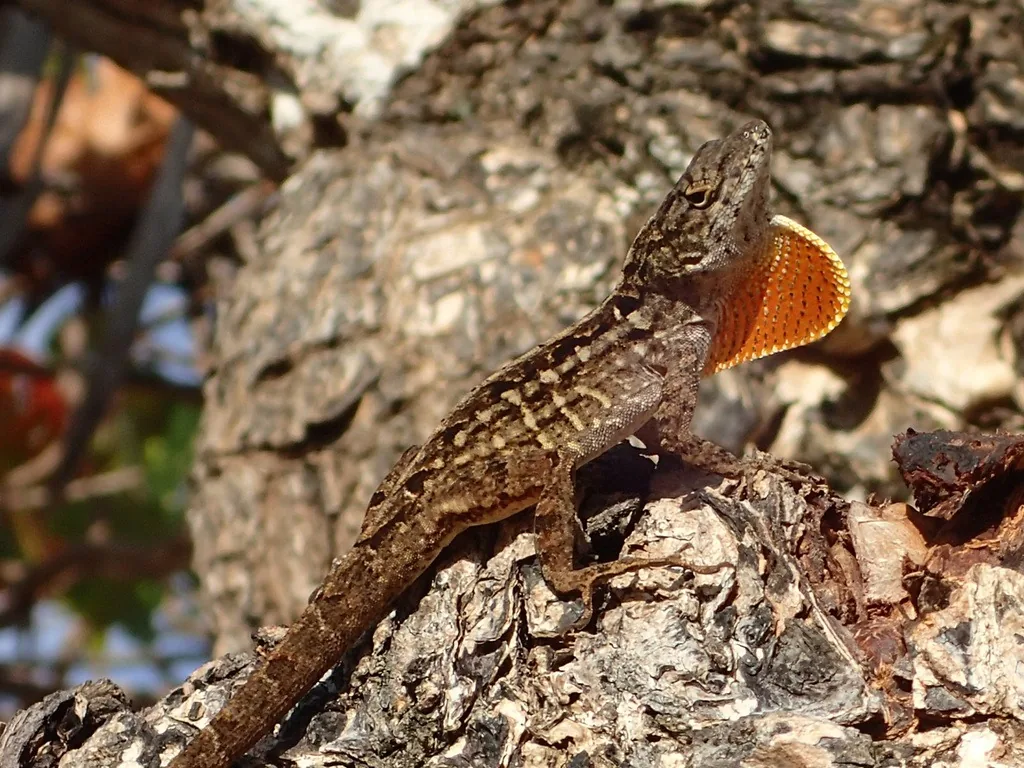
- A small lizard about 5 to 9 inches long from snout to tail tip, with adult females slightly smaller than males.[1][2]
- Usually brown, but it can shift between brown, gray and black, and some have a reddish head; brown anoles are never green.[1]
- Backs and sides often carry stripes, triangles, spots or dashes of lighter and darker color, and females almost always have a pale stripe down the middle of the back.[1]
- Males flash a reddish-orange throat fan bordered in yellow or white and can raise a crest along the neck, back and tail.[1][2]
- Like other anoles, it has widened toe tips with a small claw that make it a strong climber.[1]
Look-alikes
| Look-alike | How to tell them apart |
|---|---|
| Green anole (native) | The native green anole is often green but can turn brown; it has a longer, pointier snout, fewer markings, and males usually have a pink throat fan.[1][2] |
| Crested anole | Crested anoles are introduced lizards found mainly in Miami-Dade County; males have a jagged crest and an orange throat fan with a yellow center.[1] |
| Bark anole | Bark anoles are much smaller introduced anoles of coastal South Florida with mottled light and dark patterns and pale yellow to pale green throat fans in males.[1] |
Where it lives
Native to Cuba, the Bahamas and other West Indies islands. It is established throughout peninsular Florida, along much of the Panhandle coast, and in coastal and southern Georgia, and has been reported in Louisiana, Texas, California and Hawaii.[1][2][3]
Biology and life cycle
Brown anoles live mostly on the ground and low in vegetation, perching on tree trunks, fences and the walls of buildings.[1][2]
They are most common in yards, school grounds, golf courses and landscaped parking lots, and are the most commonly seen lizard in much of Florida.[1]
They eat mostly insects, spiders and other invertebrates, plus some plants and small lizards, including native green anoles and their own kind.[1][2]
Females lay one egg at a time every few days through spring and summer, hiding the eggs under leaf litter, rocks, debris or in moist soil.[1][2]
Eggs hatch in about 30 to 45 days, and wild brown anoles usually live less than two years.[1]
They spread when they hitch rides in ornamental plants, vehicles, kayaks and yard debris, and eggs can travel in potted plants.[1]
Damage and signs
- Brown anoles do not damage homes, but they can get into houses, sheds, garages and screened rooms, where they are hard to catch.[1]
- Where they move in, native green anoles shift higher into trees to avoid them, and brown anoles also eat juvenile green anoles.[1][3]
- Pet cats often catch them and may leave partly eaten lizards indoors.[1]
Health risk
There are no known direct hazards to people, though a handled brown anole may give a noticeable bite. The lizards are not toxic, but a cat that eats one may vomit or get an upset stomach.[1]
Control
Prevention
Check ornamental plants before you move them, and look through storage spaces in canoes, kayaks and boats so you do not carry brown anoles to new areas.[1]
To help native green anoles, keep dense plantings and trees that give them food, hiding places and high perches away from brown anoles.[1]
Keep them out
Keep doors, screened rooms and sheds closed up, since these small climbers can get into houses, garages and porches and are hard to catch once inside.[1]
Traps and physical control
Hand-capture can help keep numbers down around a yard; UF/IFAS describes humane euthanasia by sealing the lizard in a container, refrigerating it for 2 to 3 hours, then freezing it for 24 hours.[1]
Report sightings outside the known range
Because brown anoles are so widespread, UF/IFAS says there is little chance of eradicating them from Florida, but slowing their spread still matters.[1]
If you see one in the Florida Panhandle outside its mapped range, take a photo and report it to EDDMapS or iNaturalist.[1]
The Texas Invasive Species Institute notes that no real management strategies have emerged in affected states, and that limiting pet-store sales could reduce spread.[3]
Common questions
- Is the brown anole the same as a chameleon?
- No. People sometimes call the native green anole a chameleon because it changes color, but true chameleons are a different group, and brown anoles never turn green.[1]
- Are brown anoles dangerous to people or pets?
- No known direct hazard to people. They may bite when handled, and a cat that eats one might have an upset stomach.[1]
- Did brown anoles wipe out green anoles?
- No study has shown brown anoles caused green anoles to vanish locally; green anoles often move higher into trees, where they are harder to see.[1]
Sources
- University of Florida IFAS Extension (EDIS), “Florida's Introduced Reptiles: Brown Anole (Anolis sagrei) (EDIS publication UW486).” edis.ifas.ufl.edu/publication/UW486 (accessed 2026-10-06)
- University of Georgia Savannah River Ecology Laboratory, Herpetology Program, “Brown Anole (Anolis sagrei) - Introduced.” srelherp.uga.edu/lizards/brown-anole/ (accessed 2026-10-06). Species account from the Herpetology Program of the Savannah River Ecology Laboratory, a University of Georgia research unit.
- Texas Invasive Species Institute (Texas State University System), “Brown Anole (Anolis sagrei).” tsusinvasives.org/home/database/anolis-sagrei (accessed 2026-10-06). Invasive species database run by the Texas Invasive Species Institute (Texas State University System).
- iNaturalist, “Anolis sagrei taxon page (order and family).” www.inaturalist.org/taxa/116461 (accessed 2026-10-06)