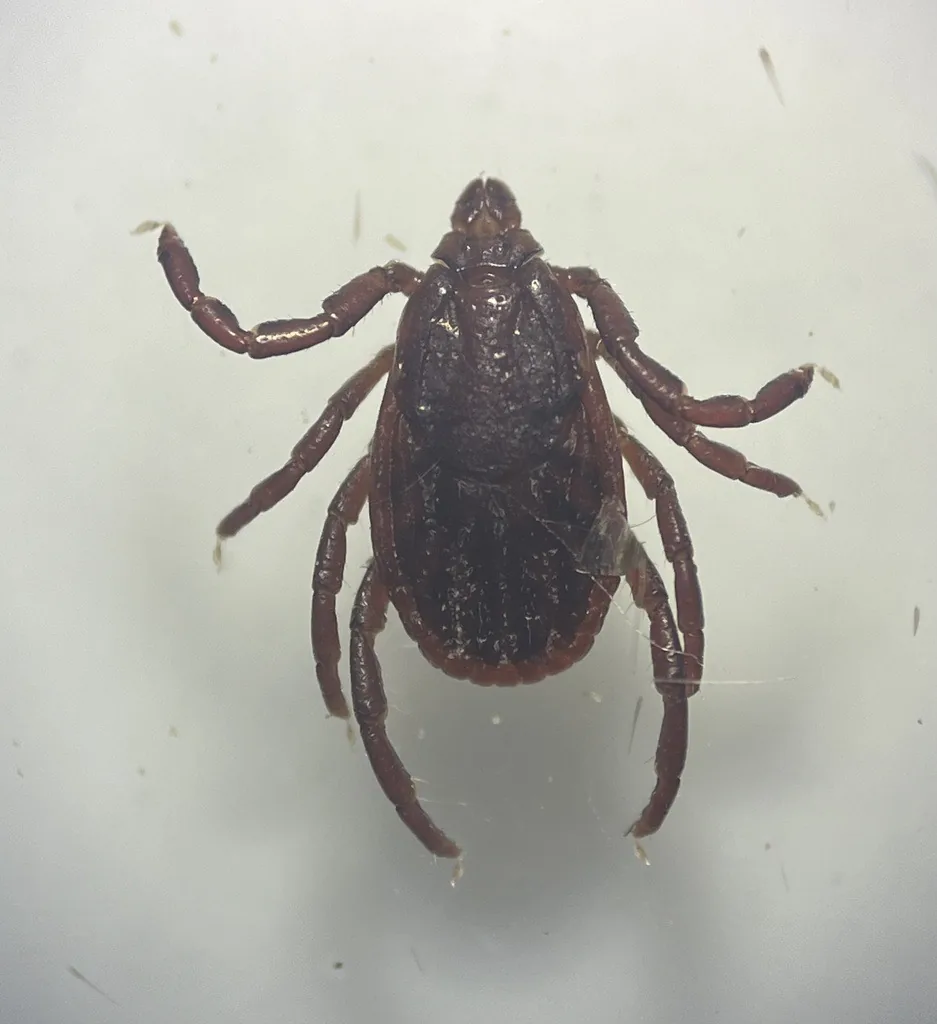
How to identify it
- Adults and nymphs are reddish-brown and elongated, with no markings on the back; unfed adults are only about 1/10 to 1/8 inch long.[1]
- Any tick with white coloring on its back is not a brown dog tick.[1]
- A fully fed female swells about a hundredfold, to roughly the size of a raisin.[1]
- Ticks of very different sizes in one home are usually the same species at different stages: tiny six-legged seed ticks, eight-legged nymphs and larger adults.[1]
Look-alikes
| Look-alike | How to tell them apart |
|---|---|
| American dog tick | The brown dog tick has a plain back with no ornamentation; ticks showing white or pale markings on the back belong to other species.[1] |
Where it lives
Found worldwide and considered the most widespread tick on Earth. It is most common in warm climates but can establish indoors even in colder regions.[1][3]
Biology and life cycle
Dogs are the main host at every life stage in the U.S., but the tick may also bite people and other mammals.[3][1]
Each stage feeds once, then drops off to digest and molt. Fed females hide in cracks and crevices in homes, garages and dog runs to lay eggs.[1]
One fed female can lay more than 7,000 eggs, about 4,000 on average.[1]
Hungry ticks crawl toward dogs, so owners often see them on walls, curtains, furniture, baseboards, carpet and dog bedding.[1]
Ticks can survive three to five months in each stage without feeding, and in warm climates the cycle continues year-round indoors and in kennels.[1]
Because ticks hide while digesting, molting or laying eggs, an infestation can seem to disappear and then come back.[1]
Damage and signs
Health risk
The CDC lists the brown dog tick as a carrier of Rocky Mountain spotted fever in the southwestern U.S. and along the U.S.-Mexico border. The disease can be deadly if not treated early; its most common symptoms are fever, headache and rash.[3][2]
Control
Prevention
Check dogs after visits to kennels, groomers, dog parks and vet clinics, and remove any attached ticks with tweezers, especially fed females.[1]
Ask your veterinarian to choose a tick control product suited to your dog. Some brown dog tick populations in Florida and Texas are highly resistant to permethrin.[1]
Keep them out
Seal cracks and crevices in homes and kennels where ticks hide, and keep grass and weeds short around dog areas.[1]
Sanitation
Wash and dry dog beds and blankets on high heat, and use steam on furniture and other items that can't be washed.[1]
When to call a professional
Once an infestation is established, thorough professional treatment of infested areas is critical, and repeat treatments are often needed.[1]
Common questions
- Can ticks really live inside my house?
- Most ticks can't, but the brown dog tick can complete its whole life cycle indoors, so infestations can develop in homes and kennels.[1]
- Does the brown dog tick spread Lyme disease?
- It has not been shown to transmit the bacterium that causes Lyme disease.[1]
- If I take my dog away, will the ticks die off?
- Not quickly. Without a dog, the ticks may bite other mammals, including people, and each stage can survive months without a meal.[1]
Sources
- University of Florida IFAS Extension, Featured Creatures, “Brown Dog Tick, Rhipicephalus sanguineus Latreille (IN378).” ask.ifas.ufl.edu/publication/IN378 (accessed 2026-10-06)
- U.S. Centers for Disease Control and Prevention, “About Rocky Mountain Spotted Fever (reviewed May 15, 2024).” www.cdc.gov/rocky-mountain-spotted-fever/about/index.html (accessed 2026-10-06)
- Centers for Disease Control and Prevention, “Where Ticks Live.” www.cdc.gov/ticks/about/where-ticks-live.html (accessed 2026-10-06)
- iNaturalist, “Rhipicephalus sanguineus taxon page (order and family).” www.inaturalist.org/taxa/229905 (accessed 2026-10-06)