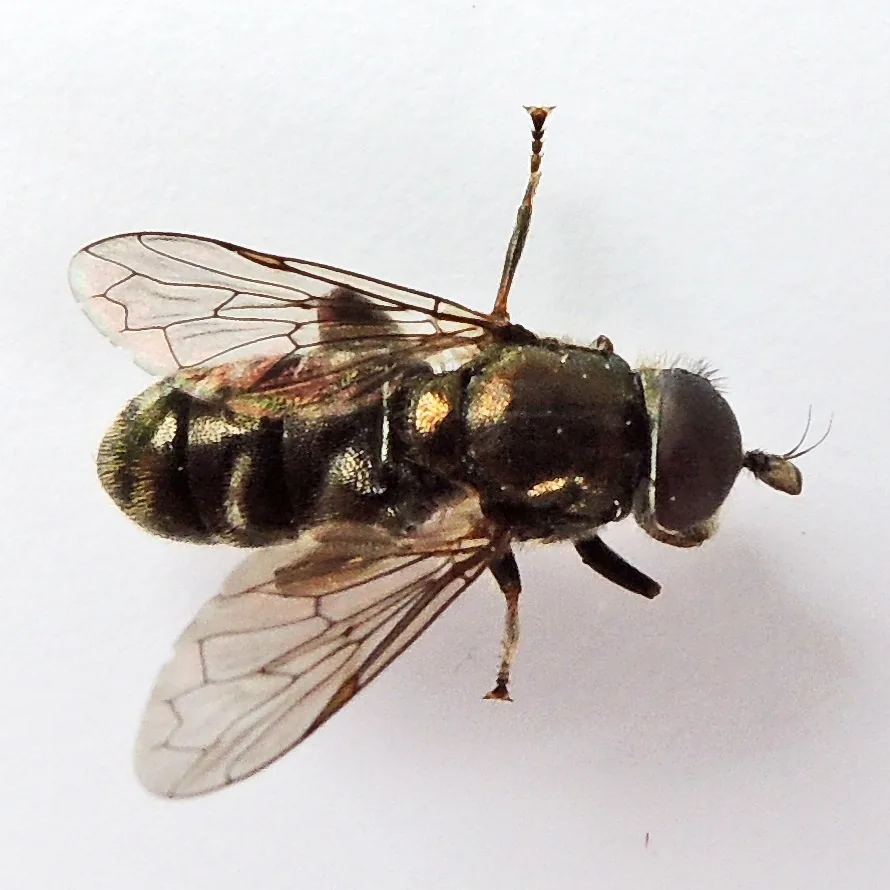
How to identify it
- Adults are stocky, hairy, blackish to dark green flies with pale markings that look like small bumble bees.[1]
- Larvae are plump, wrinkled, dirty white to brownish maggots with a short dark breathing tube at the rear.[1]
- Adults hover around blooming plants on warm, sunny days, feeding on pollen and nectar.[1]
Look-alikes
| Look-alike | How to tell them apart |
|---|---|
| Bumble bees and other beneficials | Adult bulb flies resemble small bumble bees and some beneficial flies.[1] |
Where it lives
Maggots of several fly species infest bulbs of all types.[1]
Biology and life cycle
Eggs are laid in spring or summer near the base of plants and hatch in 5 to 14 days.[1]
Larvae feed in the bulb for 9 to 10 months and pupate in spring; adults live about 2 to 3 weeks.[1]
Damage and signs
Health risk
They feed in bulbs; UC IPM mentions no risk to people.[1]
Control
Prevention
Buy and plant only pest-free bulbs, and handle them carefully to avoid injury.[1]
Sanitation
Remove and destroy infested bulbs and plants as soon as you find them.[1]
Common questions
Sources
- University of California Statewide IPM Program, “Bulb Flies (Pests in Gardens and Landscapes).” ipm.ucanr.edu/PMG/GARDEN/FLOWERS/INVERT/bulbfly.html (accessed 2026-10-06)
- iNaturalist, “Eumerus funeralis taxon page (order and family).” www.inaturalist.org/taxa/465857 (accessed 2026-10-06)