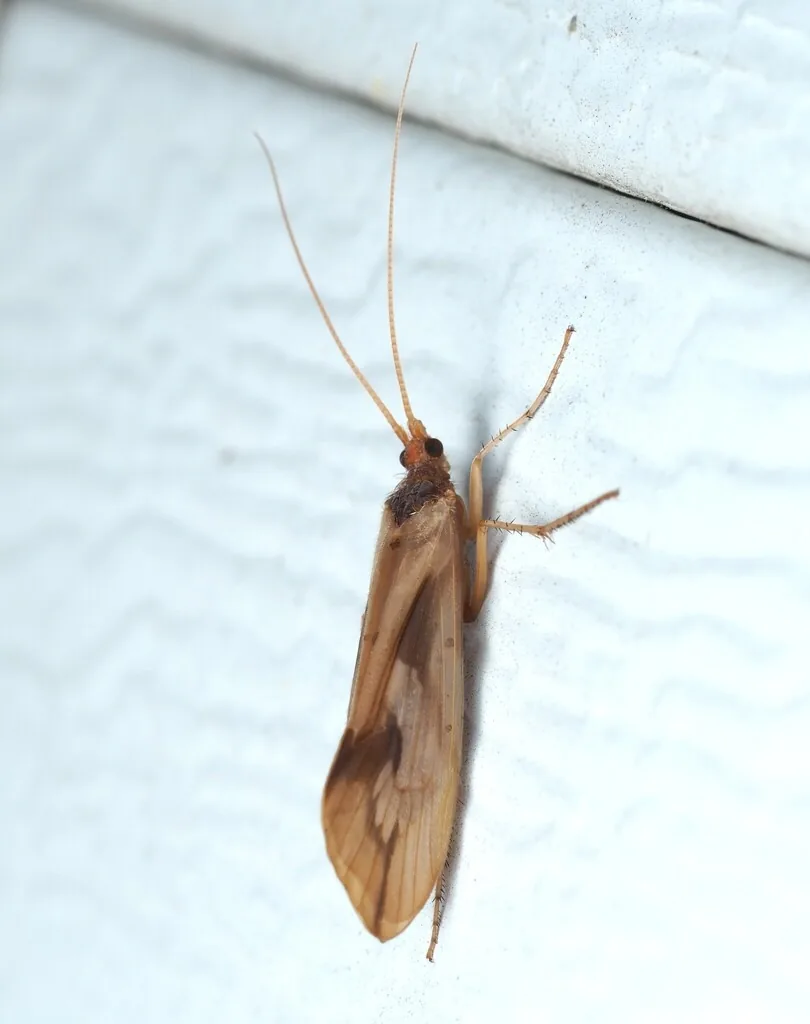
How to identify it
- Adults look like small moths with their wings held tent-like over the back at rest, and long, hair-like antennae.[2]
- Most species are small, usually 1/4 inch or less, and dull colored, though some are brightly colored.[2]
- The tan caddisflies that pile up under lights in river towns are about 1/2 inch long.[1]
Look-alikes
| Look-alike | How to tell them apart |
|---|---|
| Moths | Caddisflies resemble small moths but hold their wings tent-like over the back and have long, hair-like antennae.[2] |
Where it lives
Their larvae hatch and grow in water, so adults are found near rivers, lakes and streams; Iowa State notes big emergences in river communities.[1][2]
Biology and life cycle
Adults are short-lived and spend most of their time mating or laying eggs.[2]
They're especially noticeable at night, swarming around lights and resting on foliage near water.[1][2]
Populations grow when water quality is high, so big swarms are a sign of a healthy river.[1]
Damage and signs
- They cause no damage; the larvae are an important part of the diet of fish.[2]
Health risk
Texas A&M calls them medically harmless.[2]
Control
Prevention
Turn off exterior lights and close blinds or curtains to keep them from swarming around windows, doors and patio lights.[1]
There's no repellent, but mass emergences are temporary and the annoyance passes.[1]
Sanitation
Sweep up piles of dead caddisflies at entrances and under lights and put them in the trash or compost.[1]
Common questions
Sources
- Iowa State University Extension and Outreach, “Caddisflies: Another One of Life's Frustrations (Yard and Garden).” yardandgarden.extension.iastate.edu/article/2012/5-16/caddisflies.html (accessed 2026-10-06)
- Texas A&M AgriLife Extension Service, “Caddisfly (Field Guide to Common Texas Insects).” texasinsects.tamu.edu/caddisfly/ (accessed 2026-10-06)
- iNaturalist, “Trichoptera taxon page (order and family).” www.inaturalist.org/taxa/62164 (accessed 2026-10-06)