How to identify it
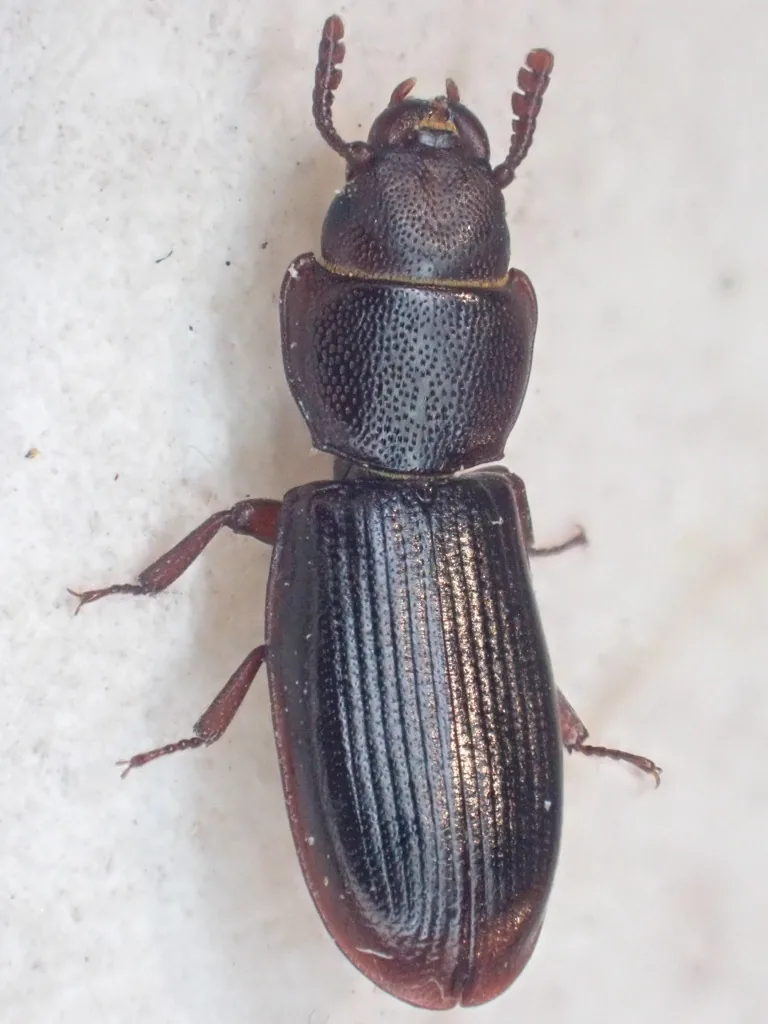
- Adults are shiny black to dark reddish brown, elongate and flattened, and about 1/3 to 0.6 inch long, large enough to spot easily.[1][2][3]
- A clear waist separates the thorax from the wing covers, and the front corners of the thorax project forward toward the head.[1][2]
- Larvae are creamy white to grayish white with a black head, two dark plates just behind the head, and a black plate with two horny points at the tail.[1][2]
- Full-grown larvae are about 0.6 to 1 inch long.[1]
Where it lives
A principal stored-grain pest in Indiana and Kentucky grain storage; it occurs in temperate and tropical regions, with more generations a year in the tropics.[3][1][2]
Biology and life cycle
Females can live a year or more and lay about 1,000 eggs, in batches of 10 to 60 in grain or other food.[1][2]
Larvae usually pass through four stages, and development can take as little as eight weeks; the whole life cycle may take about 70 days.[1][2]
There are usually one or two generations a year in temperate regions and about three in tropical countries.[1][2]
In fall, larvae leave the grain and burrow into woodwork, such as wooden bins or boxcars, to pupate or hibernate.[3][1]
Eggs and pupae die quickly at 0 degrees F, but larvae and adults can survive 15 to 20 degrees F for several weeks.[1]
Damage and signs
- Adults and larvae go from kernel to kernel eating the germ, leaving irregular holes, and also eat endosperm and milled products such as flour and meal.[1][3]
- Besides grain, it feeds on breakfast foods, potatoes, nuts, fruit and other products, and it even eats the larvae of other grain insects.[2]
- Larvae boring into packaged cereal products open a way in for other cereal pests.[3]
Health risk
It contaminates and damages food rather than harming people directly; UC IPM cautions that spraying pesticides on or near food can do more harm than pantry pests.[1][4]
Control
Prevention
Prevention is the most economical and efficient way to manage cadelles in stored grain.[1]
Store dry foods in glass jars or containers with tight-fitting lids rather than plastic bags or paper packages.[4][5]
Sanitation
In a home, find and throw away every infested package, then vacuum shelves and cracks and wash them before restocking.[5][4]
In grain storage, look for larvae in woodwork as well as in the grain, since they bore into wooden surfaces to pupate and overwinter.[3][1]
Pesticides
Insecticides aren't recommended for pantry pests in the home.[4]
When to call a professional
Once cadelles are spread through a grain mass, fumigation is the best remedy; Kentucky Extension points growers to crop-specific insecticide recommendations for stored grain.[1]
Common questions
- What is the large black beetle in my stored grain or flour?
- If it is shiny, flattened and up to about half an inch long with a distinct waist, it may be a cadelle, the largest common stored-grain beetle.[1][2]
- Will freezing kill cadelles?
- Cold works only if it is deep: eggs and pupae die quickly at 0 degrees F, but larvae and adults can survive 15 to 20 degrees F for several weeks.[1]
Sources
- University of Kentucky College of Agriculture, Entomology, “ENTFACT-134: Insect Pests of Stored Grain: Cadelle Beetle (revised March 2026).” entomology.mgcafe.uky.edu/ef134 (accessed 2026-10-06)
- University of Florida, Entomology and Nematology Department, “Cadelle, Tenebroides mauritanicus (stored product pests image gallery).” entnemdept.ufl.edu/projex/gallery/dl/stored_product_pests/text/cadelle.htm (accessed 2026-10-06)
- Purdue University Extension, Department of Entomology, “Principal Stored Grain Insects of Indiana, E-80-W.” extension.entm.purdue.edu/publications/E-80.pdf (accessed 2026-10-06)
- University of California Statewide IPM Program, “Pest Notes: Pantry Pests, Publication 7452.” ipm.ucanr.edu/home-and-landscape/pantry-pests/ (accessed 2026-10-06)
- University of Kentucky College of Agriculture, Entomology, “ENTFACT-612: Stored Product Pests in the Pantry.” entomology.mgcafe.uky.edu/ef612 (accessed 2026-10-06)
- iNaturalist, “Tenebroides mauritanicus taxon page (order and family).” www.inaturalist.org/taxa/232377 (accessed 2026-10-06)