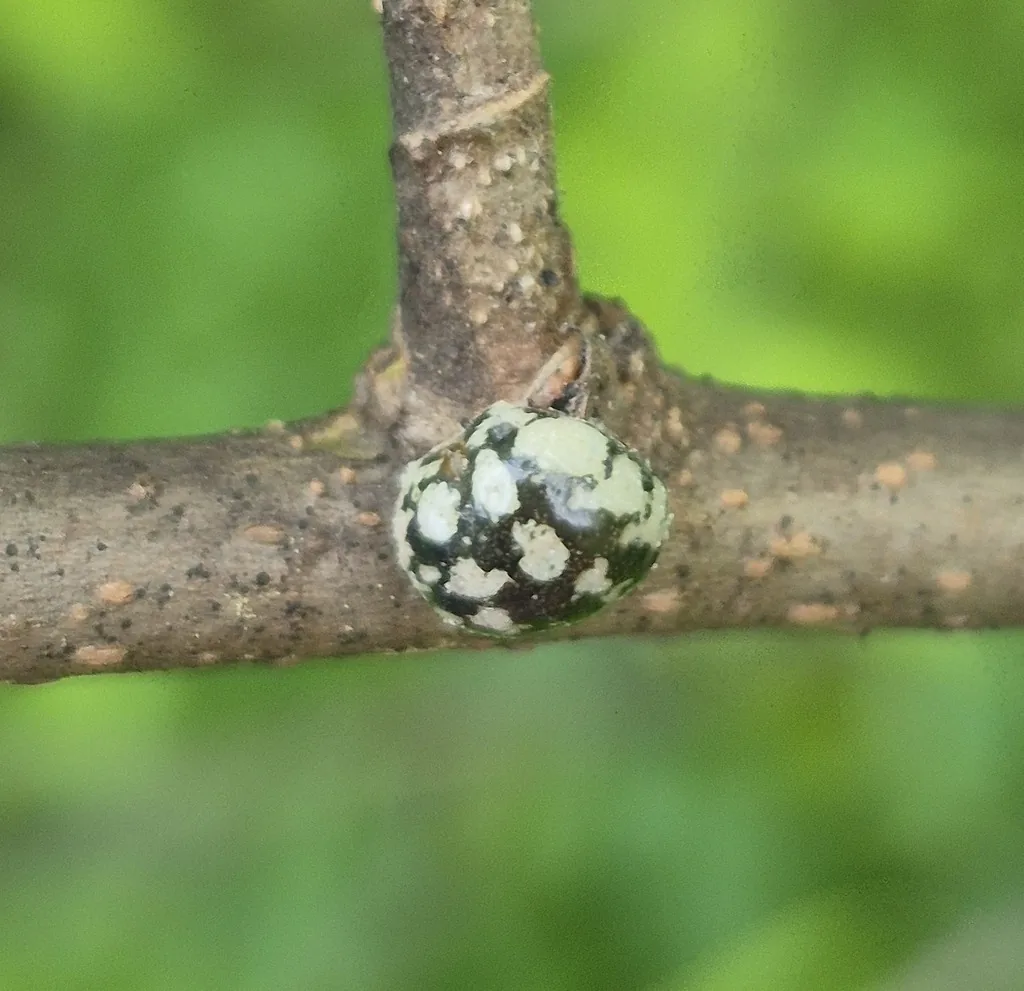
How to identify it
Where it lives
It has a broad host range, including crabapple, elm, honeylocust, maple, oak, dogwood, redbud and stone fruit trees.[1]
Biology and life cycle
It overwinters as crawlers on branches; females swell in spring and lay eggs by mid-May.[1]
Damage and signs
- Feeding causes leaf yellowing and twig dieback, and honeydew draws ants and wasps.[1]
Health risk
It feeds on trees; UK Extension mentions no risk to people.[1]
Control
Traps and physical control
Scrubbing branches with brushes can physically remove the scales, though it may take repeated effort.[1]
Pesticides
Systemic insecticides have had variable results, so control usually targets the crawlers.[1]
Common questions
Sources
- University of Kentucky Entomology (ENTFACT), “The Challenges of Calico Scale Control (ENTFACT-466).” entomology.mgcafe.uky.edu/ef466 (accessed 2026-10-06)
- iNaturalist, “Eulecanium cerasorum taxon page (order and family).” www.inaturalist.org/taxa/882990 (accessed 2026-10-06)