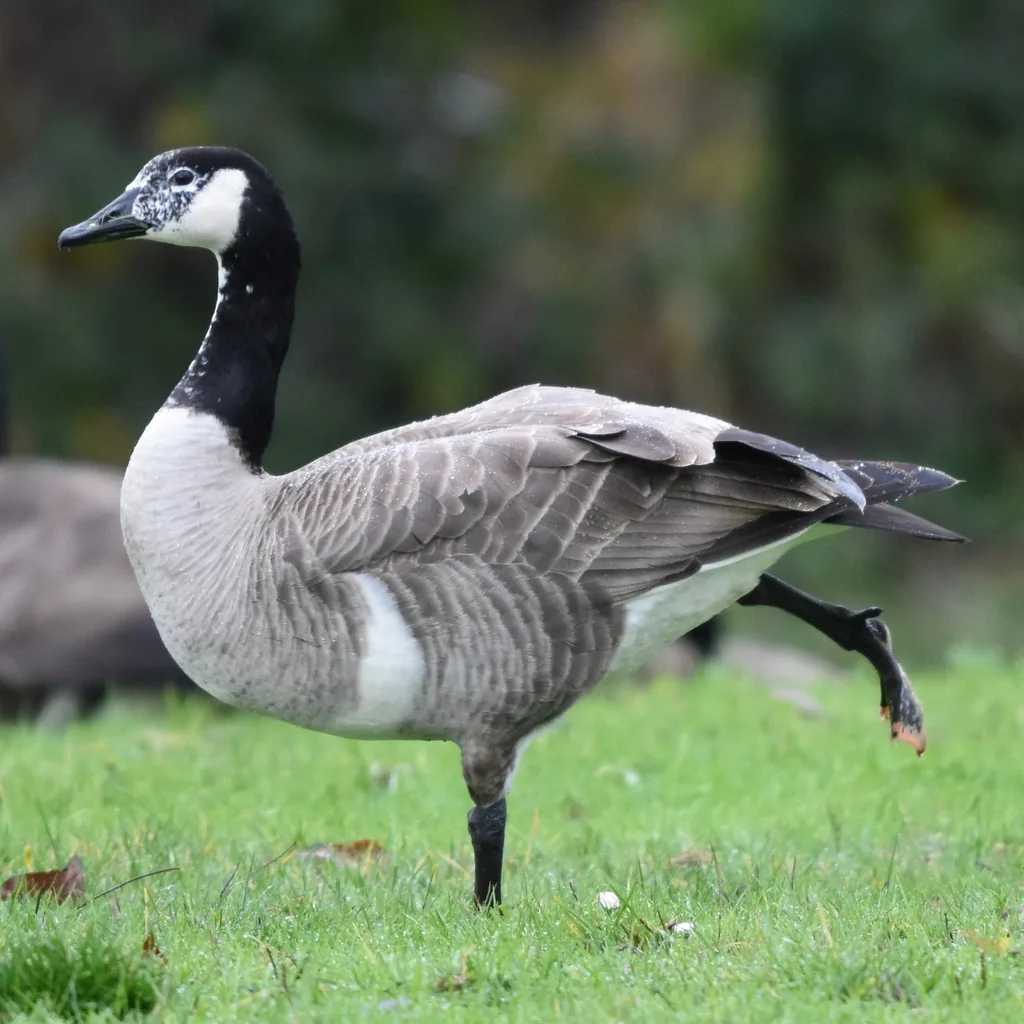
How to identify it
- A large black-and-tan goose with a black head and neck and a big white cheek patch.[1]
- Males and females look alike, though males are slightly larger; adults stand 22 to 48 inches tall and weigh up to 24 pounds.[1]
- Droppings are usually tubular and turn green when the geese are grazing grass.[1]
- Loud honking and V-shaped flight formations are familiar signs of geese.[1]
Where it lives
Canada geese live throughout the United States; migratory flocks nest in the northern Plains, Canada and Alaska, while resident geese stay in other areas all year.[1][2]
Biology and life cycle
Pairs mate for life and return to the same nesting area in late February or March, often as soon as the ice melts.[2][5]
A female lays 5 to 6 eggs in a ground nest near water, usually hidden by vegetation, and islands are favorite spots.[2][5]
Eggs hatch in late April or early May, and the goslings can swim within a day.[2][5]
After nesting, geese molt and can't fly for 4 to 5 weeks, from mid-June through late July.[2][5]
Resident geese in suburbs can live more than 20 years, and one female may produce over 50 young in her lifetime.[2][5]
They graze grasses and other plants, mainly early in the morning and late in the afternoon.[2]
Damage and signs
- Flocks can quickly graze lawns down to bare dirt, especially near ponds by homes, offices and golf courses.[3][5]
- A single goose produces about a pound of droppings a day, fouling walkways, play areas and beaches and adding nutrients to ponds.[5][3]
- Geese defending a nest or young may charge, bite or strike people and pets with their wings.[3][5]
- Geese near roads and airports are a safety hazard.[3][5]
Health risk
Goose droppings can carry germs such as Giardia, Cryptosporidium, Salmonella and E. coli, though few human illnesses have been traced to them. Wash your hands after contact and change shoes before going indoors.[3]
Control
Prevention
Stop feeding geese, which draws more birds than the area can naturally support; this is the first step in any control program.[5][4]
Let grass around ponds grow to its full height of 10 to 14 inches, or replace it with shrubs or ground covers such as ivy, ferns or junipers.[5][4]
Geese prefer Kentucky bluegrass over fescue, and cutting back on fertilizer makes lawns less nutritious to them.[4][5]
Keep them out
A solid fence at least 30 inches tall along the water's edge keeps geese from walking up onto lawns, and works best during the summer molt.[4][5]
Over small ponds, a grid of wires or heavy monofilament 10 to 15 feet apart and 12 to 18 inches above the water keeps geese from landing.[4][5]
Traps and physical control
Mylar tape, flags or eye-spot balloons can scare geese off, especially newly seeded areas, but move them often so geese don't get used to them.[5][4]
Trained dogs chasing geese are among the most effective methods, and geese don't get used to them; don't chase nesting geese or birds that can't fly.[5][4]
Pesticides
EPA-approved repellents with methyl anthranilate or anthraquinone reduce grazing on treated lawns; follow the label, reapply after mowing; repellents are most practical for small lawns.[4][5]
When to call a professional
For bigger problems, USDA Wildlife Services or your state wildlife agency can advise, and capture and removal requires federal and state permits.[5][4]
Timing your efforts
The best time to act is late winter, before nesting begins, or as soon as geese show up where they aren't wanted.[5]
Don't use scare devices on nesting geese or on families during the molt, when the birds can't fly away.[4][5]
Hazing adults without young before the molt can encourage them to move on.[4]
Combine several methods and keep at it; persistence gets the best results.[5]
What doesn't work
Swan decoys, scarecrows, dead-goose decoys and pond fountains or aerators are not recommended for resident geese.[5]
Moving geese elsewhere isn't an option; banded geese have returned to New York from as far away as Maine, South Carolina and Oklahoma.[5]
Poisons are illegal, and no toxicants are registered for Canada geese.[5][4]
Legal status
All Canada geese, including residents, are protected by federal and state laws covering capturing, handling or killing them and disturbing their nests and eggs.[1][5]
Permits are required for most control activities, though New York notes that federal and state permits aren't needed to scare geese as long as they aren't harmed.[1][5]
Treating eggs to stop them hatching requires registering online with the U.S. Fish and Wildlife Service first, and state rules also apply.[5][4]
Check with your state wildlife agency before starting any control method.[4][5]
Common questions
- Why won't the geese leave my pond?
- Short grass, open water and easy sight lines make ideal habitat, and geese return to where they hatched year after year.[4][2][5]
- Can I remove a goose nest?
- Not without following federal rules. Nests and eggs are protected, and egg treatment requires online registration with the U.S. Fish and Wildlife Service first.[5][1]
- Is it legal to chase geese with my dog?
- Yes, no permit is needed to chase geese with a dog, but keep it supervised, follow leash laws, and don't chase geese that are nesting or can't fly.[5][4]
Sources
- Internet Center for Wildlife Damage Management, “Canada Geese: Identification.” icwdm.org/species/birds/canada-geese/ (accessed 2026-10-06). Run by university wildlife damage specialists (maintained at the University of Wisconsin-Stevens Point); species modules are based on Prevention and Control of Wildlife Damage (University of Nebraska Cooperative Extension, 1994).
- Internet Center for Wildlife Damage Management, “Canada Goose Biology.” icwdm.org/species/birds/canada-geese/canada-goose-biology/ (accessed 2026-10-06). Run by university wildlife damage specialists (maintained at the University of Wisconsin-Stevens Point); species modules are based on Prevention and Control of Wildlife Damage (University of Nebraska Cooperative Extension, 1994).
- Internet Center for Wildlife Damage Management, “Canada Goose Damage Identification.” icwdm.org/species/birds/canada-geese/canada-goose-damage-identification/ (accessed 2026-10-06). Run by university wildlife damage specialists (maintained at the University of Wisconsin-Stevens Point); species modules are based on Prevention and Control of Wildlife Damage (University of Nebraska Cooperative Extension, 1994).
- Internet Center for Wildlife Damage Management, “Canada Goose Damage Prevention and Control Methods.” icwdm.org/species/birds/canada-geese/canada-goose-damage-prevention-and-control-methods/ (accessed 2026-10-06). Run by university wildlife damage specialists (maintained at the University of Wisconsin-Stevens Point); species modules are based on Prevention and Control of Wildlife Damage (University of Nebraska Cooperative Extension, 1994).
- New York State Department of Environmental Conservation, “When Geese Become a Problem: Managing Nuisance Canada Geese in New York.” dec.ny.gov/sites/default/files/2025-04/geeseproblem.pdf (accessed 2026-10-06)
- iNaturalist, “Branta canadensis taxon page (order and family).” www.inaturalist.org/taxa/7089 (accessed 2026-10-06)