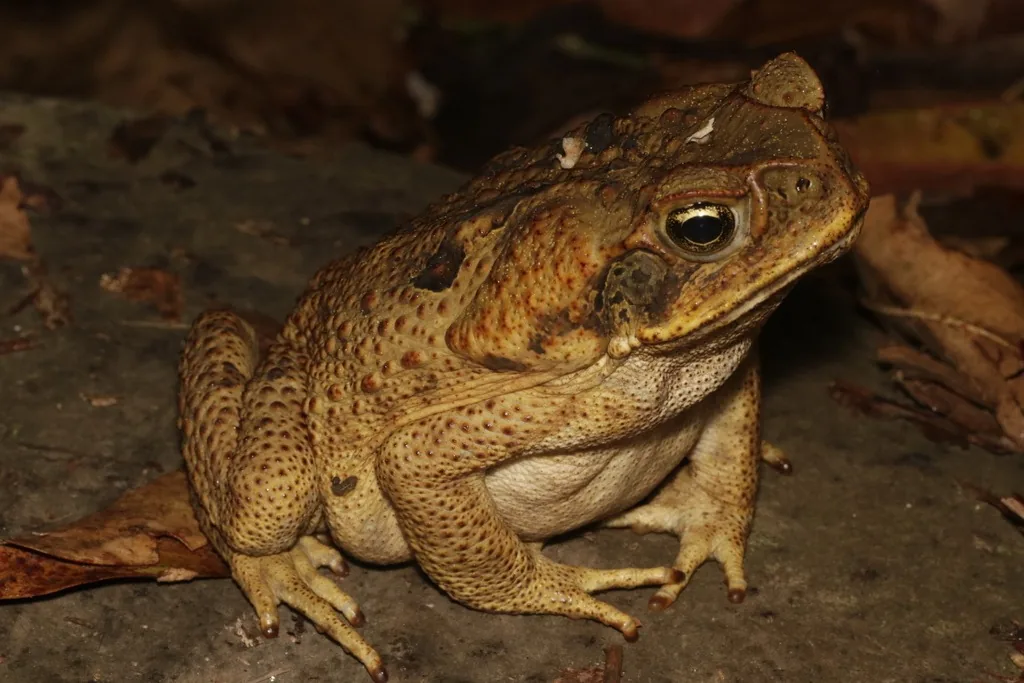
How to identify it
- A heavy, warty ground-dwelling toad, reddish-brown to grayish-brown above with a pale yellow or beige belly.[2]
- Behind each eye sits a very large, roughly triangular poison gland that angles down onto the shoulder and tapers to a point.[1][2]
- Unlike the native southern toad, it has no knobs or crests on top of the head; instead a bony ridge runs around the eyes and over the nose.[1][2]
- UF/IFAS puts most adults at 3 to 6 inches, with some reaching 8 or 9 inches; FWC describes a typical range of 6 to 9 inches.[1][2]
- Females tend to have smoother, mottled brown-and-white backs, while males are rougher and more yellow.[1]
- Newly transformed toadlets are about the size of a raisin and very hard to tell apart from native baby toads.[1]
Look-alikes
| Look-alike | How to tell them apart |
|---|---|
| Southern toad (native) | Rarely over 3 to 4 inches, with two obvious crests on top of the head and small oval shoulder glands that pose no danger to pets.[1][2] |
| Oak toad (native) | Never longer than about 1.5 inches, with a light stripe down the middle of the back and orange undersides to the feet.[1] |
| Eastern spadefoot (native) | Usually under 2 inches, with flattened, hard-to-see glands, often an hourglass pattern and yellow markings, and a digging spade on each hind foot.[1] |
Where it lives
Native from extreme southern Texas through Central and tropical South America. In Florida it is established in central and south Florida, generally south of the I-4 corridor, with a small population near Deland.[1][2]
Biology and life cycle
Cane toads came to Florida as a sugar cane pest-control experiment in the 1930s; today's populations likely trace to pet-importer escapes and releases in the 1950s and 60s.[1][2]
They thrive in yards, golf courses, school grounds, farms and other human-altered places, and are rarely recorded in Florida's natural areas.[1]
Adults hide by day and come out after sunset to hunt; beetles and ants make up most of the diet, but they also eat small animals, garbage and pet food.[1][2]
A female can lay 8,000 to 30,000 eggs in long jelly strings, usually after heavy rain, and tadpoles hatch in about two days.[1]
Every life stage is toxic, from eggs and tadpoles to adults; adults carry the most toxin in their shoulder glands.[1]
Damage and signs
- The main harm is to pets: dogs, especially terriers and other dogs with a strong prey drive, are far more likely than cats to attack them.[1]
- Toxic eggs and tadpoles have been linked to deaths of koi in backyard ponds.[1]
- Dense groups of males can call all night, which can disturb sleep.[1]
- They may compete with native frogs and toads for food and breeding sites, and residents report native southern toads becoming scarce after cane toads move in.[1][2]
Health risk
The toad cannot shoot its toxin, but squeezing the glands releases a milky secretion that can irritate skin and burn the eyes. Wear gloves to handle one and wash your hands afterward.[1][2]
Control
Prevention
Feed pets indoors, bring food and water bowls in at night, and clean up scraps around grills and outdoor tables.[2][1]
Don't leave dogs outside unattended at dawn, dusk or night, when toads are most active, and keep dogs on a short leash on evening walks.[1]
Sanitation
Mow regularly, trim the undersides of shrubs, clear brush and debris piles, and block toad hiding spots under decks, A/C units and compost heaps.[1][2]
Turn off unneeded outdoor lights or switch to motion lights or yellow bug lights, which draw fewer of the insects toads feed on.[1]
Traps and physical control
Remove egg strings and small, solid-black tadpoles from ornamental ponds and poorly chlorinated pools.[1]
Search with a flashlight in the early evening and capture toads with gloves or a plastic bag over your hand, after confirming the identification.[1][2]
In Florida, cane toads may be humanely killed on private property year-round with the landowner's permission; it is illegal to relocate and release them.[2][1]
UF/IFAS describes humane euthanasia as coating the toad's back or belly with benzocaine or lidocaine ointment, or chilling it in a refrigerator for a few hours, and then freezing it for 24 hours.[1]
When to call a professional
If you would rather not handle them, a licensed nuisance wildlife trapper can remove cane toads for you.[2][1]
If your dog or cat bites a cane toad
Warning signs include brick-red or unusually pink gums, drooling or foaming, pawing at the mouth, disorientation and seizures.[1][2]
FWC warns that a pet can die in as little as 15 minutes without proper treatment.[2]
Rinse the mouth with a hose for 10 to 15 minutes, pointing the water forward and out of the mouth, not down the throat.[2][1]
Wipe the gums and tongue with a damp cloth to remove the sticky toxin, then get your pet to a veterinarian right away.[2][1]
Common questions
- How do I know it's a cane toad and not a native toad?
- Look at the head and shoulders: cane toads lack head crests and have very large triangular glands, while native southern toads have obvious crests and small oval glands.[1][2]
- Can I move a cane toad somewhere else?
- No. Releasing them is illegal in Florida, and UF/IFAS notes that relocated toads can find their way back home.[2][1]
- Is it dangerous to touch a cane toad?
- The secretion irritates skin and eyes, so wear latex, rubber or nitrile gloves and wash your hands well after any contact.[2][1]
Sources
- University of Florida IFAS Extension (EDIS), “The Cane or "Bufo" Toad (Rhinella marina) in Florida (EDIS publication UW432).” edis.ifas.ufl.edu/publication/UW432 (accessed 2026-10-06)
- Florida Fish and Wildlife Conservation Commission, “Cane Toad (Rhinella marina) species profile.” myfwc.com/wildlifehabitats/profiles/amphibians/cane-toad/ (accessed 2026-10-06)
- iNaturalist, “Rhinella marina taxon page (order and family).” www.inaturalist.org/taxa/553515 (accessed 2026-10-06)