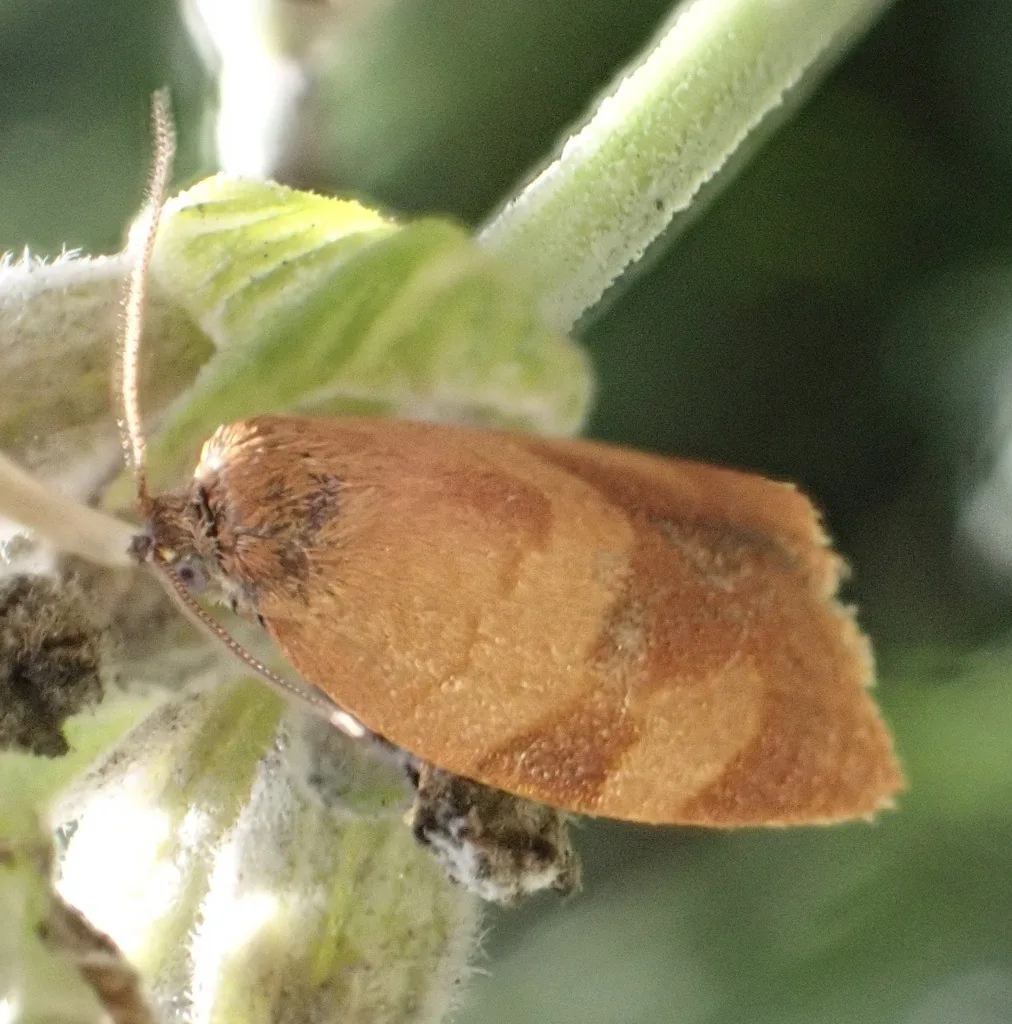
How to identify it
Where it lives
The PNW Insect Management Handbook covers it in Pacific Northwest landscapes; outside the US it's reported to be a serious pest of carnations.[1]
Biology and life cycle
Females lay yellow, flattened eggs in groups of 10 to 200, 500 to 700 in all, which take 5 to 55 days to hatch.[1]
Larvae are active year-round and can spread by ballooning on the wind; pupation takes 10 to 15 days.[1]
Damage and signs
- Larvae roll leaves and tie them with webbing; it attacks many broad-leaved plants but seldom causes serious damage.[1]
Health risk
It feeds on plants; the PNW Insect Management Handbook mentions no risk to people.[1]
Control
Traps and physical control
Hand-pick rolled leaves with larvae or pupae, and clear rolled leaves on the ground or stuck to trunks where leafrollers overwinter.[2]
Biological control
Spiders, parasitic wasps and predators such as the brown lacewing greatly reduce leafroller numbers.[2]
Common questions
- What caterpillar rolls and webs the leaves of my Portuguese laurel?
- Often the carnation tortrix, a leafroller that attacks many broad-leaved plants.[1]
- Why does the caterpillar wriggle backward when I touch its rolled leaf?
- Carnation tortrix larvae are very active when disturbed and often wriggle backward.[1]
Sources
- Pacific Northwest Pest Management Handbooks (OSU, WSU, University of Idaho), “Laurel, Portuguese (Prunus): Carnation tortrix (Insect Management Handbook).” pnwhandbooks.org/insect/hort/landscape/hosts-pests-landscape-plants/laurel-portuguese-prunus-carnation-tortrix (accessed 2026-10-06)
- Pacific Northwest Pest Management Handbooks (OSU, WSU, University of Idaho), “Landscape pests: Leafroller and leaftier (Insect Management Handbook).” pnwhandbooks.org/insect/hort/landscape/common/landscape-leafroller-leaftier (accessed 2026-10-06)
- iNaturalist, “Cacoecimorpha pronubana taxon page (order and family).” www.inaturalist.org/taxa/141743 (accessed 2026-10-06)