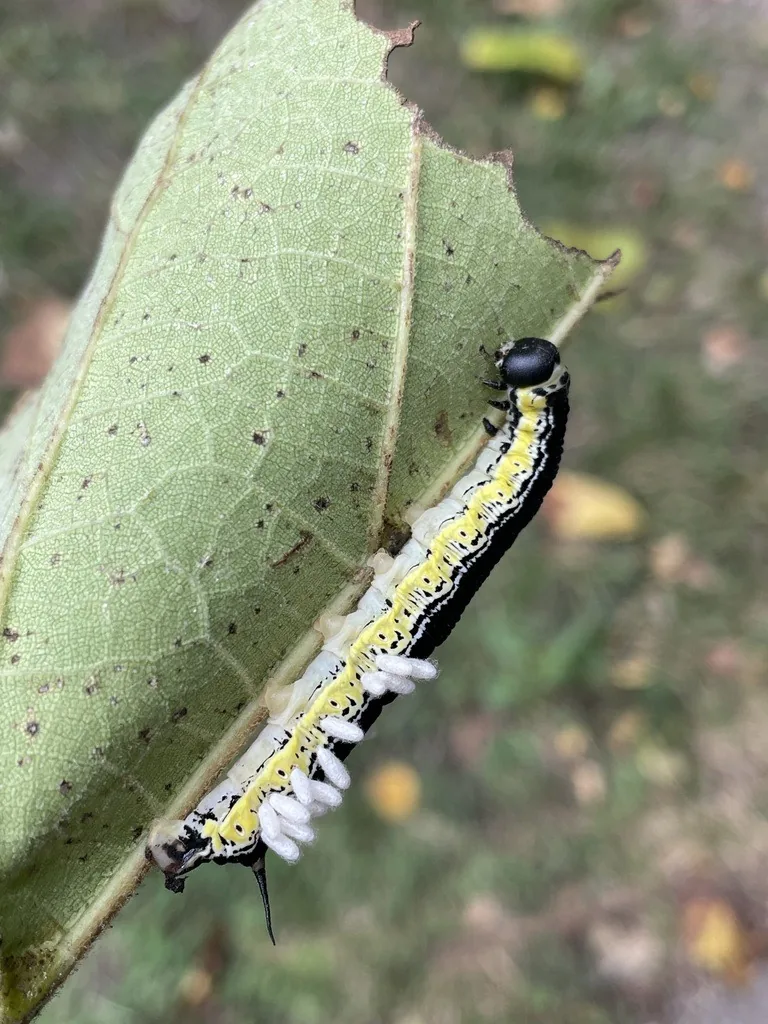
How to identify it
Look-alikes
| Look-alike | How to tell them apart |
|---|---|
| Tomato hornworm | Its similarly colored adult has yellow spots on the abdomen; the catalpa sphinx doesn't.[1] |
Where it lives
Native to the eastern US, it occurs wherever catalpa grows from New Hampshire and Nebraska south to Florida and Texas.[1]
Biology and life cycle
Pupae overwinter in soil; moths fly April to October and lay masses of 100 to 1,000 eggs under leaves.[1]
There's one generation in Pennsylvania and up to five farther south; outbreaks come and go over a few years.[1]
Damage and signs
Health risk
It feeds on plants; Penn State Extension mentions no risk to people.[1]
Control
Prevention
Keep trees healthy with proper water and fertilizer so they tolerate defoliation.[1]
Traps and physical control
Remove egg masses, trim out young groups, or hand-pick caterpillars into soapy water on small trees.[1]
Biological control
Parasitoid wasps, especially Cotesia, often control them; leave caterpillars covered in white cocoons on the tree.[1]
Common questions
Sources
- Penn State Extension, “Catalpa Worm/Catalpa Sphinx Moth.” extension.psu.edu/catalpa-worm-catalpa-sphinx-moth (accessed 2026-10-06)
- iNaturalist, “Ceratomia catalpae taxon page (order and family).” www.inaturalist.org/taxa/143440 (accessed 2026-10-06)