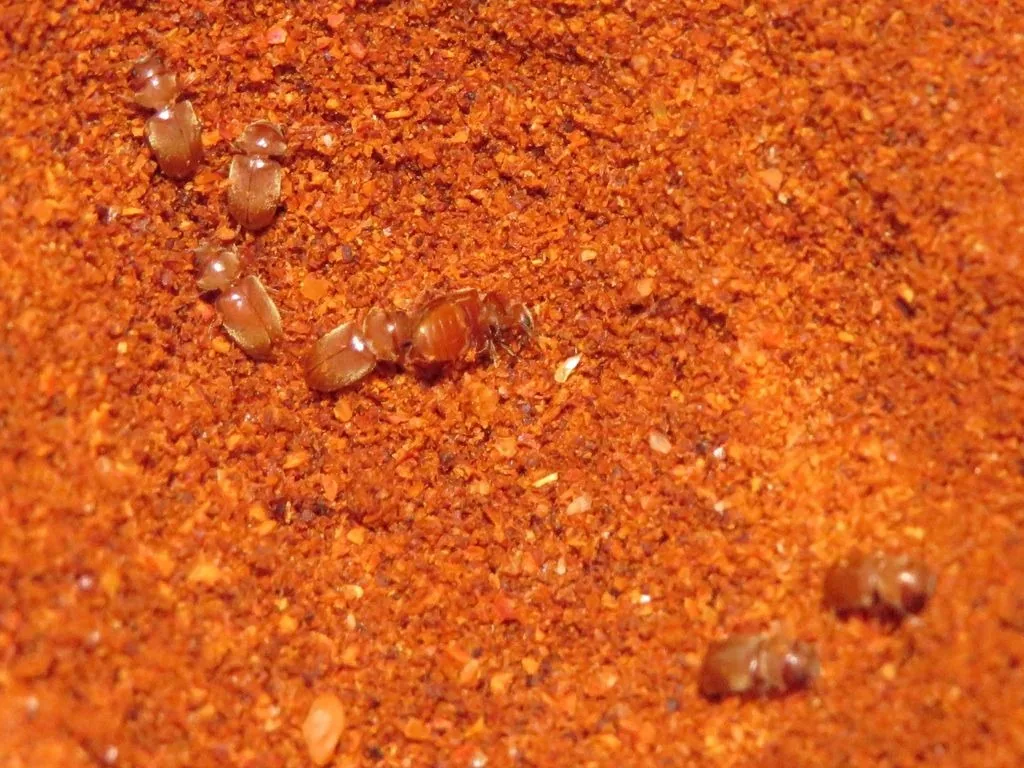
How to identify it
- Adults are about 1/8 inch long, reddish brown and oval, with smooth wing covers coated in fine hairs.[1][3]
- The head is bent sharply down and often hidden from above, giving the beetle a humpbacked look from the side.[3][1]
- The antennae are saw-toothed and the same thickness from base to tip.[1][3]
- When disturbed, adults pull in their legs, tuck their head and lie still.[1]
- Larvae are small creamy to yellowish-white grubs covered with long, fine, yellowish-brown hairs.[2][3]
Look-alikes
| Look-alike | How to tell them apart |
|---|---|
| Drugstore beetle | Nearly identical, but its wing covers have rows of pits that look like lines, and its antennae end in a three-segment club.[1][2] |
| Sawtoothed grain beetle | A slender, flat beetle that neither flies nor comes to lights; cigarette beetles fly and are attracted to light.[4] |
Where it lives
Pan-tropical in origin but found worldwide, especially wherever dried tobacco is stored.[1]
Biology and life cycle
Females lay their eggs in or on the food, and larvae hatch in about six to ten days.[1][3]
Larvae feed for five to ten weeks, then pupate in a cell or cocoon made of food bits.[1][2]
A generation usually takes 40 to 90 days, depending on temperature and food, with five or six overlapping generations in warm climates.[1]
Adults don't feed; most live a few weeks. They are most active at dusk and fly well, especially in late afternoon and on cloudy days above 65 degrees F.[1][3]
Symbiotic yeasts supply B vitamins, letting the beetles live on foods and materials of poor nutritional value.[1]
Damage and signs
- In homes it is most often found in pet food, cereals, nuts, candy, and spices such as chili powder and paprika.[2][4]
- It also attacks flour, dry mixes, dried fruit, cocoa, coffee beans, herbs, rice and hurricane food supplies.[1]
- Non-food targets include dried flowers, potpourri, wreaths, prescription pills, book bindings, furniture stuffing and pinned insect collections.[1][3]
- Larvae and adults contaminate products with frass, cocoons and body parts, and larvae may bore through cardboard boxes looking for a place to pupate.[1]
Health risk
Cigarette beetles contaminate food rather than bite; pantry pests may introduce microbes that rot food, especially in warm, humid storage.[2]
Control
Prevention
Store foods in airtight glass, metal or heavy plastic containers, buy only what you'll use in two to four months, and keep storage areas ventilated.[1][3]
Sanitation
Find the source first: check every food container and stored item, and wrap heavily infested items in plastic and throw them away outside.[1][3]
Look beyond the kitchen at dried flower arrangements, wreaths and bird seed or pet food that mice may have hidden in walls or attics.[3]
Vacuum spilled flour and crumbs from shelves and cracks; Clemson advises against washing cabinets with water, which can leave an attractive pasty residue.[1][3]
Traps and physical control
Small lots can be frozen (7 days at 25 degrees F or 16 days at 36 degrees F) or heated in an oven (one hour at 190 degrees F) to kill all stages.[1]
Pesticides
Insecticides are rarely necessary and should be a last resort; never treat surfaces where food is prepared or stored.[1][3]
Common questions
- Do cigarette beetles only eat tobacco?
- No. Despite the name, they infest a wide range of dried foods, especially pet food, cereals and spices like paprika and chili powder.[2][4]
- Why are tiny beetles flying around my lamp at night?
- Cigarette beetles fly and are attracted to light, and they are most active from dusk through the night.[4][1]
- Will pheromone traps get rid of cigarette beetles?
- Traps mainly catch males and are best for detecting and monitoring beetles; finding and removing the infested item is what solves the problem.[1][2]
Sources
- University of Florida/IFAS Extension (EDIS), “Cigarette Beetle, Lasioderma serricorne (Featured Creatures, EENY/IN384).” ask.ifas.ufl.edu/publication/IN384 (accessed 2026-10-06)
- University of California Statewide IPM Program, “Pest Notes: Pantry Pests, Publication 7452.” ipm.ucanr.edu/home-and-landscape/pantry-pests/ (accessed 2026-10-06)
- Clemson Cooperative Extension, Home & Garden Information Center, “Cigarette Beetles, HGIC 2413.” hgic.clemson.edu/factsheet/cigarette-beetles/ (accessed 2026-10-06)
- University of Kentucky Entomology, “ENTFACT-612: Stored Product Pests in the Pantry.” entomology.mgcafe.uky.edu/ef612 (accessed 2026-10-06)
- iNaturalist, “Lasioderma serricorne taxon page (order and family).” www.inaturalist.org/taxa/47493 (accessed 2026-10-06)