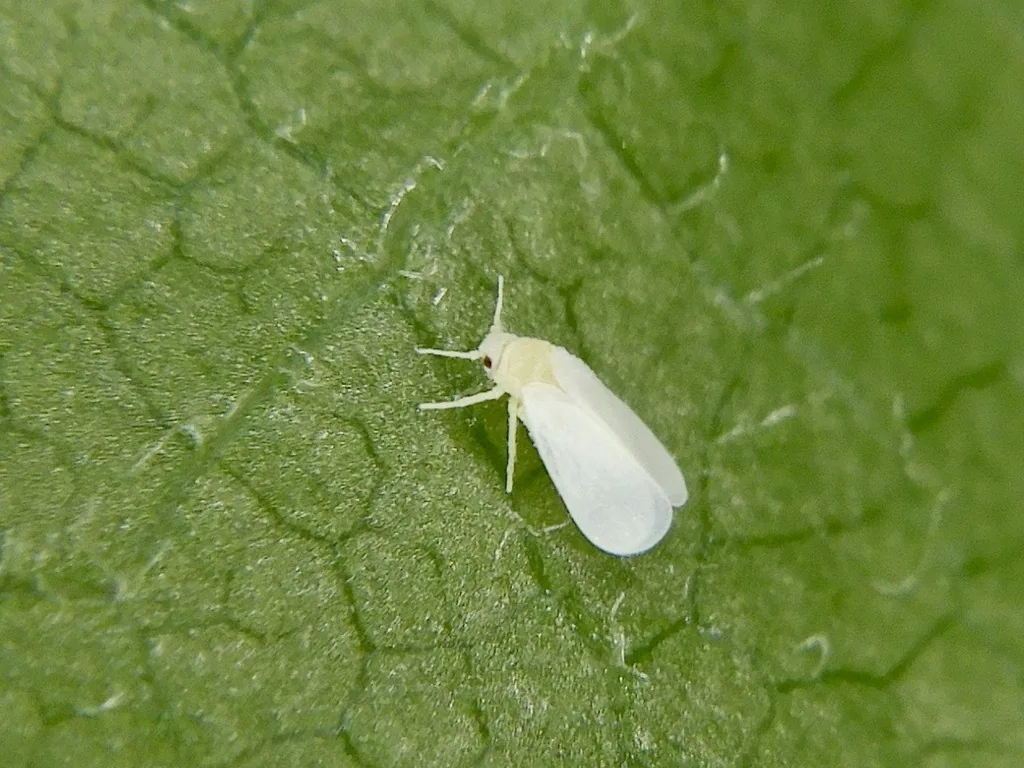
How to identify it
- Adults are tiny, with four white, powdery wings spanning less than 1/8 inch; unlike cloudywinged whitefly, the wings have no dark area in the middle.[1][2]
- Nymphs are flat, oval and scale-like, fastened to the underside of leaves after the first molt; these stages are often more noticeable than the adults.[1][2]
- Eggs are yellow and smooth, partly inserted into the lower leaf surface.[1][2]
Where it lives
Introduced from Asia (India), it is established in many southern states and in California, Colorado, Illinois and Washington, D.C.[1][2]
Biology and life cycle
Each female can lay up to 125 eggs, which hatch in 6 to 21 days into tiny crawlers that settle and lose their legs and antennae after the first molt.[1][2]
Adults emerge from T-shaped splits in the pupal skins; NC State reports three broods a year, with summer broods taking about two months.[1]
Damage and signs
Health risk
Control
Biological control
Lady beetles, lacewing larvae and an introduced tiny wasp, Encarsia lahorensis, attack it, though lady beetles are seldom numerous enough for real control.[1]
Pesticides
Direct sprays to leaf undersides; horticultural oils, applied several times with good timing, work and are gentler on beneficial insects than pyrethroids.[1]
Common questions
- Why are my gardenia leaves covered in black mold?
- Sooty mold growing on honeydew from citrus whiteflies is a common cause.[1]
- What are the flat, oval specks under the leaves?
- Likely citrus whitefly nymphs, which look like tiny scales.[1][2]
- What is the best spray for citrus whitefly?
- Horticultural oil aimed at leaf undersides, repeated as needed.[1]
Sources
- NC State Extension, “Citrus Whitefly.” content.ces.ncsu.edu/citrus-whitefly (accessed 2026-10-15)
- University of Florida IFAS Extension (Featured Creatures), “Citrus Whitefly, Dialeurodes citri (EENY-084).” ask.ifas.ufl.edu/publication/IN241 (accessed 2026-10-15)
- iNaturalist, “Dialeurodes citri taxon page (order and family).” www.inaturalist.org/taxa/370909 (accessed 2026-10-06)