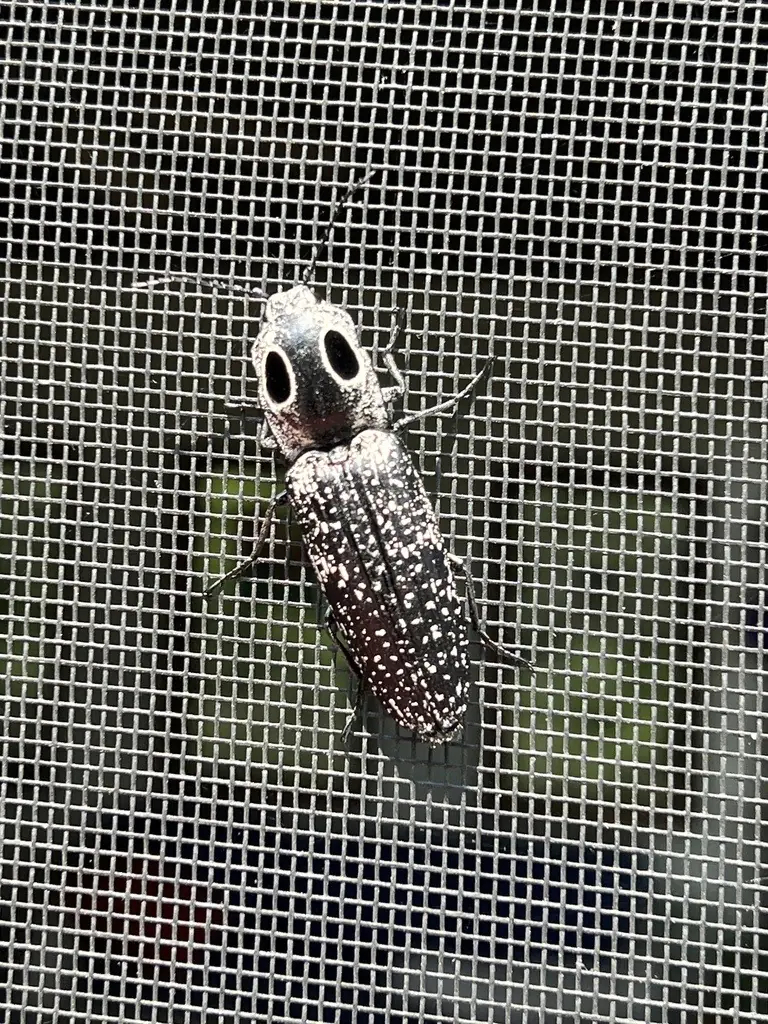
How to identify it
- Adults are long, parallel-sided, somewhat flattened beetles, with backward-pointing points on the rear corners of the shield behind the head.[2]
- Most are fairly small and dull brown to black, with the smaller species about 1/4 inch long; some have reddish or yellowish markings.[2][1]
- Placed on their backs, they snap the front of the body and flip into the air with an audible click.[2][1]
- The eyed click beetle reaches about 1 1/2 inches and has two big oval eyespots on the shield behind its head and mottled gray wing covers.[2]
Look-alikes
| Look-alike | How to tell them apart |
|---|---|
| Mealworms (larvae) | Wireworms resemble mealworms but are hard-bodied, cylindrical and yellowish to brown, living in garden soil rather than stored grain.[1][3] |
| False click beetles | Similar beetles, and some can even click, but they are less common and usually live in wood that is just starting to decay.[2] |
Where it lives
A large, widespread beetle family covered by extension services from Maine to Texas; size, color and life cycle vary by species.[2][1]
Biology and life cycle
Larvae, called wireworms, are slender, hard-bodied and yellowish to brown, about 1/2 to 2 1/2 inches long depending on species, with three pairs of tiny legs just behind the head.[1][2][3]
Common wireworms take three to four years to mature, spending most of that time in the soil, though some species finish in one year.[1][3]
Adults and larvae overwinter in the ground; in spring and summer adults emerge, mate, and females burrow back into the soil to lay eggs near host plants.[2][3]
Adults are generally nocturnal and feed on plants, but they are usually of no economic importance.[1]
Damage and signs
- Wireworms feed on sprouting seeds and seedlings and bore into stems, roots and potato tubers; damage is most common in soil high in organic matter.[3]
- They are serious pests of potatoes, onions, corn, carrots, peas, beans and melons.[1]
- Adult click beetles don't harm older plants and cause no damage indoors.[3][1]
Health risk
Adult click beetles that come indoors are only a nuisance, and as adults they are usually of no economic significance.[1]
Control
Prevention
Reduce soil organic matter where wireworms are a problem, and flooding an area before planting can help lower numbers.[3]
Keep them out
Adults come in through open windows and doors on hot nights, drawn by lights, so keeping those openings closed or screened helps keep them out.[1]
Traps and physical control
In the garden, bury nearly full-grown carrots every 2 1/2 to 3 feet, pull them every 2 to 3 days, and remove the wireworms to trap them.[3]
Common questions
- Why do click beetles click?
- The click is mainly a defense to startle or escape predators, and it also lets the beetle flip itself right side up when it lands on its back.[1]
- Why are click beetles getting into my house?
- They are attracted to lights and often come in through open windows and doors on hot nights.[1]
- What are wireworms?
- They are the larvae of click beetles: hard, slender, yellowish worms that live in soil for several years and tunnel into seeds, roots and potatoes.[3][1]
Sources
- University of Maine Cooperative Extension, “Click Beetles (Home and Garden IPM).” extension.umaine.edu/home-and-garden-ipm/fact-sheets/common-name-listing/click-beetles/ (accessed 2026-10-06)
- Texas A&M AgriLife Extension Service, Department of Entomology, “Click beetle; wireworm (Field Guide to Common Texas Insects).” texasinsects.tamu.edu/click-beetle/ (accessed 2026-10-06)
- University of California Statewide IPM Program, “Wireworms (Home and Landscape: vegetable garden pests).” ipm.ucanr.edu/home-and-landscape/wireworms/ (accessed 2026-10-06)
- iNaturalist, “Alaus oculatus taxon page (order and family).” www.inaturalist.org/taxa/81706 (accessed 2026-10-06)