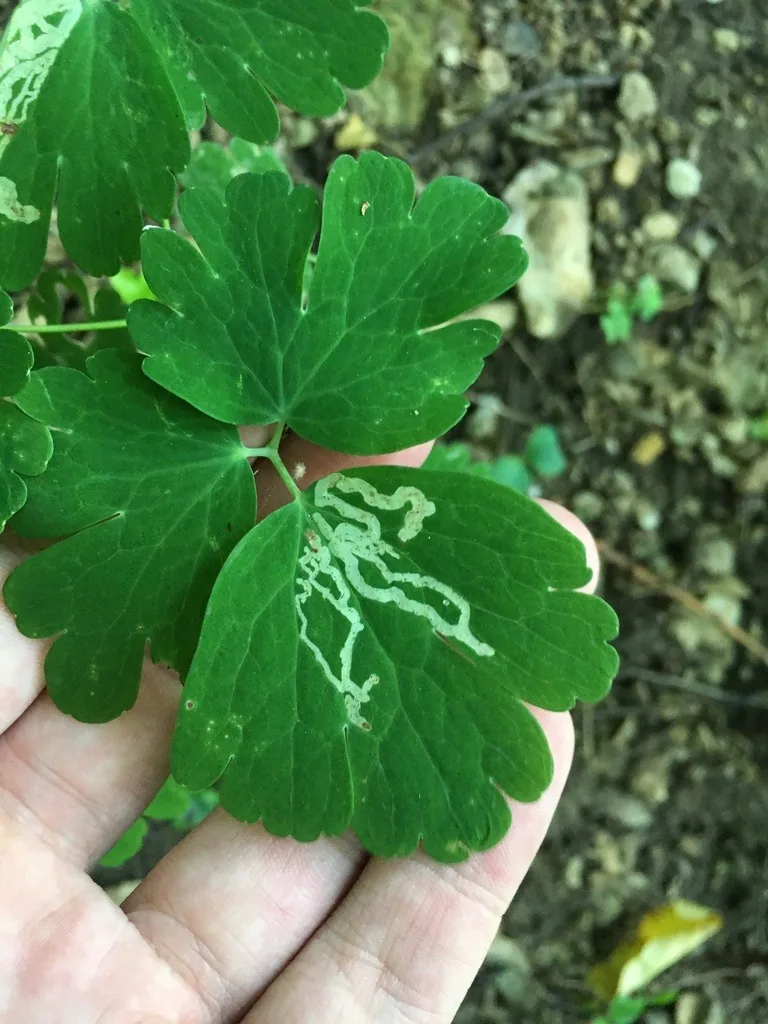
How to identify it
- Mines are light gray to whitish serpentine trails or blotches, most visible on the upper leaf surface, widening as the maggot grows.[1][2]
- Adults are tiny, dark flies, about the size of an eye gnat, that gardeners rarely notice; small punctures in the leaves show where females feed.[1][2]
- When done feeding, the maggot cuts a crescent-shaped hole and pupates in a small, seedlike, shiny brown puparium on the underside of the leaf.[1][2]
Where it lives
Wisconsin notes several species: P. aquilegivora in the Midwest, a blotch-mining species in the East and P. columbinae in the West; NC State reports them as very common in North Carolina gardens.[1][2]
Biology and life cycle
Females lay eggs in the leaves in spring about the time columbines start to flower, and maggots tunnel between the upper and lower leaf surfaces.[1][2]
A new generation of flies emerges about two weeks after pupation; NC State reports up to five generations from May to September, Wisconsin up to three.[1][2]
They overwinter as pupae in the soil or in their puparia.[1][2]
Damage and signs
Health risk
Control
Traps and physical control
Pick off and destroy mined leaves as early as possible, before the maggots pupate.[2]
Biological control
Many tiny parasitic wasps attack leafminers, and populations often collapse without pesticides, though usually too late to prevent the damage.[1][2]
Pesticides
If treating, act when adult punctures first appear; once maggots are inside the leaves, sprays can't reach them. NC State reports good results with an imidacloprid soil drench in early spring.[1][2]
Common questions
- What are the white squiggly lines on my columbine leaves?
- Trails made by columbine leafminer maggots tunneling inside the leaf.[1][2]
- Do columbine leafminers hurt the plant?
- Usually not; the damage is mostly cosmetic.[2]
- How do I get rid of columbine leafminers?
- Pick off mined leaves early, before the maggots pupate; sprays don't reach maggots already inside the leaf.[2]
Sources
- NC State Extension, “Columbine Leafminer.” content.ces.ncsu.edu/columbine-leafminers-1 (accessed 2026-10-15)
- University of Wisconsin-Madison Extension (Wisconsin Horticulture), “Common Columbine Pests: Columbine Leafminer and Columbine Sawfly.” hort.extension.wisc.edu/articles/common-columbine-pests-columbine-leafminer-and-columbine-sawfly/ (accessed 2026-10-15)
- iNaturalist, “Phytomyza aquilegivora taxon page (order and family).” www.inaturalist.org/taxa/499395 (accessed 2026-10-06)