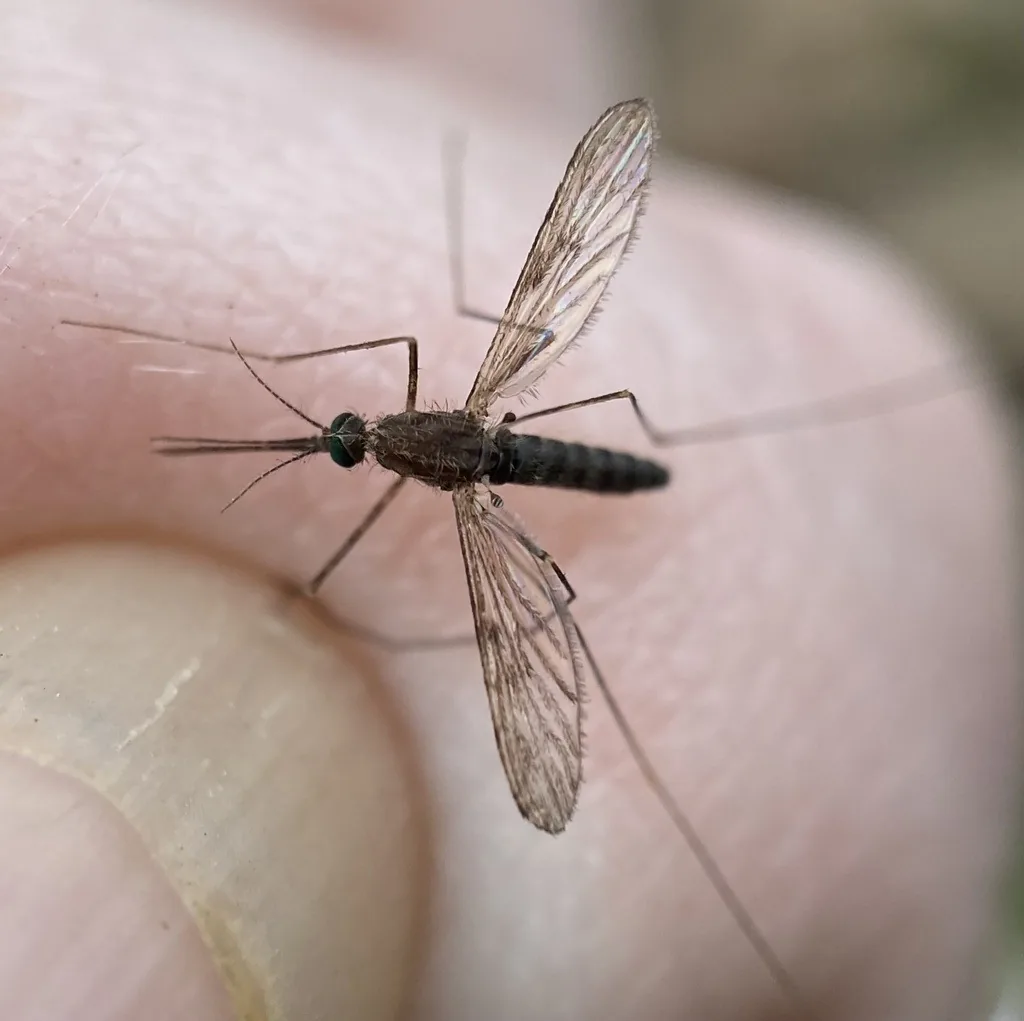
How to identify it
- Adults rest with the abdomen tilted at an angle to the surface, while most other mosquitoes rest parallel to it.[1]
- They're very dark, with dark brown to black hairs, palps about as long as the proboscis and four darker spots of scales on each wing.[1]
- Larvae lie flat at the water surface and have no breathing siphon.[1]
Look-alikes
| Look-alike | How to tell them apart |
|---|---|
| Other mosquitoes | Most mosquitoes hold their bodies parallel to the surface at rest; Anopheles tilt theirs at an angle.[1] |
Where it lives
It lives mainly in eastern North America, from southern Canada through the eastern US into Mexico, and is most abundant in the Southeast.[1]
Biology and life cycle
Females lay eggs one at a time on fresh water with plants, such as streams, ponds and lakes; the eggs have floats and can't survive drying.[1]
Egg, larva and pupa take 5 to 14 days in the water, depending on temperature.[1]
Females feed mostly on large mammals, including people; in colder areas, fertilized females overwinter in barns, tree holes and other dark shelters.[1]
Numbers track water levels in nearby lakes and fields, peaking 14 to 30 days after high water.[1]
Damage and signs
- Besides biting, it can carry dog heartworm and some viruses.[1]
Health risk
Malaria was declared eradicated from the US in the 1950s, but this mosquito can still spread it locally; Palm Beach County, Florida, had eight locally acquired cases in 2003.[1]
Control
Prevention
Wear long sleeves and pants and an EPA-registered repellent such as DEET, picaridin, IR3535 or oil of lemon eucalyptus.[2]
Keep them out
Keep fine-mesh window and door screens in good repair.[2]
Biological control
Bti (Bacillus thuringiensis israelensis) is effective against its larvae.[1]
When to call a professional
Agencies such as the Tennessee Valley Authority and the U.S. Army Corps of Engineers monitor and manage Anopheles populations.[1]
Common questions
- Can mosquitoes still spread malaria in the US?
- Rarely, but this mosquito can transmit it, and local cases still occur occasionally, such as eight in Palm Beach County in 2003.[1]
- How can I tell an Anopheles mosquito?
- It rests with its body tilted at an angle to the surface, and its wings carry four dark spots.[1]
Sources
- University of Florida IFAS Extension (Featured Creatures), “Common Malaria Mosquito, Anopheles quadrimaculatus (EENY-491).” edis.ifas.ufl.edu/publication/IN791 (accessed 2026-10-06)
- University of California Statewide IPM Program, “Pest Notes: Mosquitoes, Publication 7451 (revised April 2020).” ipm.ucanr.edu/legacy_assets/PDF/PESTNOTES/pnmosquitoes.pdf (accessed 2026-10-06)
- iNaturalist, “Anopheles quadrimaculatus taxon page (order and family).” www.inaturalist.org/taxa/1098642 (accessed 2026-10-06)