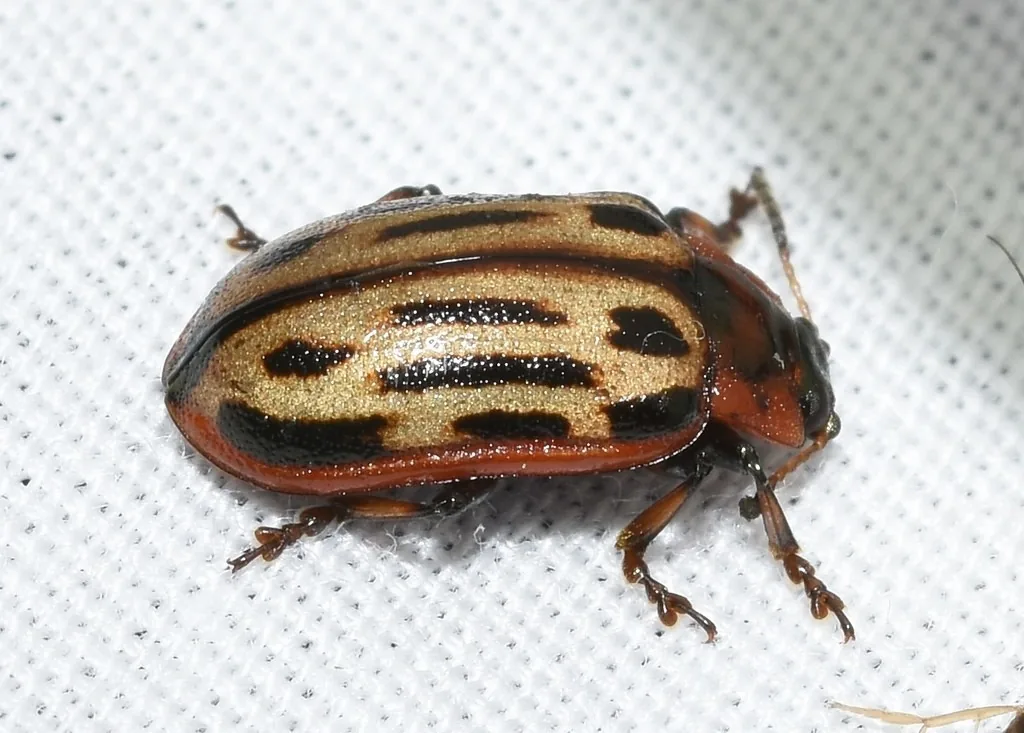
How to identify it
- Adults are about 1/4 inch long, with a black head and thorax edged in yellow or red and yellowish wing covers with broken black stripes.[1]
- Larvae start out black, then turn light to dark brown or gray with white scent glands along the body, growing to 12 mm.[1]
- Eggs are yellow and lemon-shaped, laid in clusters under leaves.[1]
Where it lives
It occurs throughout the United States, including Alaska, wherever cottonwood, poplar and willow grow.[1]
Biology and life cycle
Adults overwinter under bark and in leaf litter and feed on unfolding leaves and tender buds in spring.[1]
Females lay clusters of 25 or more eggs, which hatch in one or two weeks; young larvae feed in groups, skeletonizing leaves.[1]
Disturbed larvae release a pungent droplet from their scent glands, then reabsorb it.[1]
Damage and signs
- It's a very serious defoliator of plantation poplars, aspen, alder and cottonwood; older larvae eat whole leaves except the thick veins.[1]
Health risk
It feeds on plants; UF/IFAS mentions no risk to people.[1]
Control
Prevention
Grow varieties that resist defoliation.[1]
Biological control
Convergent lady beetles eat the eggs, stink bugs attack the adults, and ants, spiders and parasitic wasps also prey on it.[1]
Pesticides
Bt strains 'San Diego' and 'tenebrionis' have been used against it, and neem (azadirachtin) gives good suppression.[1]
Common questions
Sources
- University of Florida IFAS Extension (Featured Creatures), “Cottonwood Leaf Beetle, Chrysomela scripta (EENY-519).” edis.ifas.ufl.edu/publication/IN936 (accessed 2026-10-06)
- iNaturalist, “Chrysomela scripta taxon page (order and family).” www.inaturalist.org/taxa/69192 (accessed 2026-10-06)