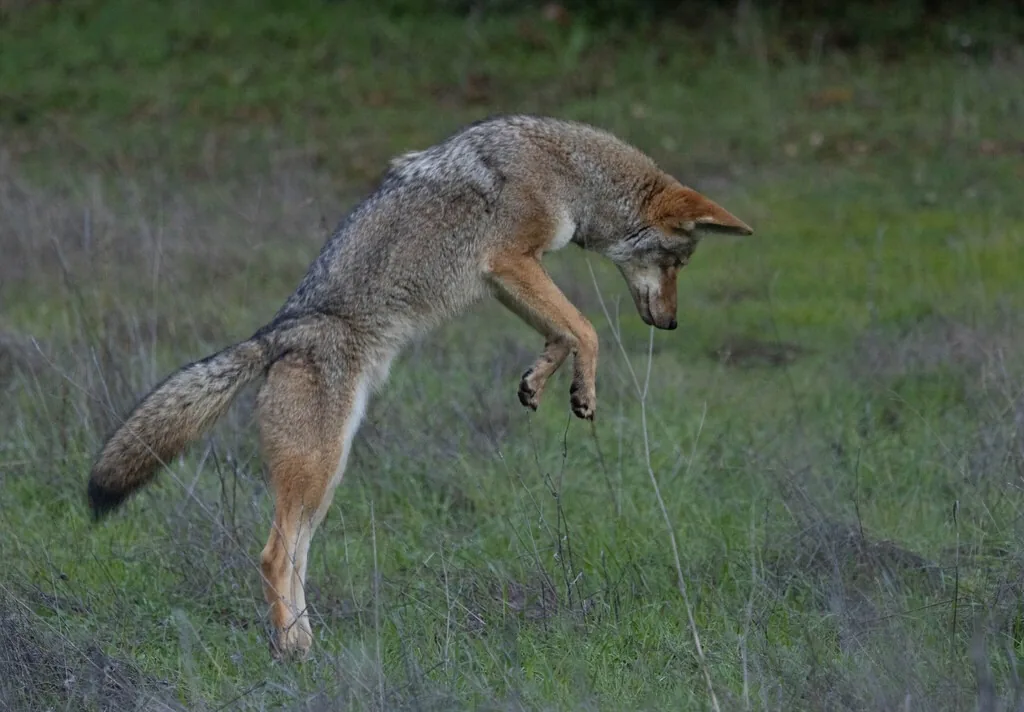
How to identify it
- A coyote looks like a small German shepherd with erect, pointed ears, a long narrow snout and a bushy tail with a black tip.[1][2]
- Fur is usually a blend of rust, brown and gray with a paler belly, though some coyotes are nearly black, reddish or almost white.[1][2]
- Western coyotes usually weigh about 20 to 45 pounds and stand about 18 inches at the shoulder; eastern coyotes run larger, with males averaging about 45 pounds.[1][2]
- Tracks are oval and compact, up to about 3 inches long, with less obvious nail marks than a dog's, and they tend to follow a straight line.[1][2]
- Scats are about the diameter of a cigar, often tapered at one end, and full of hair, bone, feathers or seeds, left along trails and roadsides.[1][2]
Look-alikes
Where it lives
Once most common on the Great Plains, coyotes have spread to every U.S. state and now live almost everywhere in North America, including cities and suburbs.[2][1]
Biology and life cycle
Coyotes breed once a year, mostly in late January and February; litters of usually 4 to 7 pups are born in March and April.[1]
Dens are dug in soil or set in enlarged burrows, hollow logs, rock piles or culverts, usually where people rarely go.[1]
They eat rodents and rabbits when available, plus insects, fruit, berries, birds and carrion; suburban coyotes also take garbage, pet food, cats and small dogs.[1][4]
Coyotes are most active after dusk and before daylight and stay active all year, without hibernating.[1][4]
A family howling together can sound like many animals, but it is usually just a few adults with their pups.[4][2]
Damage and signs
- In suburbs, coyotes kill house cats and small dogs, and groups have attacked even large dogs.[1][4]
- They prey on poultry, sheep, goats and calves, raid gardens and fruit trees, and chew drip irrigation lines.[1]
- Coyotes that are fed or find easy food can grow bold and have bitten people; attacks tend to follow a pattern of rising boldness, starting with more coyotes seen in yards at night.[1]
Health risk
Coyotes can carry rabies; if a coyote bites or scratches you, wash the wound with soap and water and get medical care right away.[1]
Control
Prevention
Never feed coyotes, feed pets indoors or pick up dishes promptly, store pet food securely, and use garbage cans with tight lids.[1][3][4]
Keep cats and small dogs indoors or in enclosed kennels, bring large dogs in after dark, and vaccinate pets against rabies and distemper.[1][3]
Walk dogs on a leash, avoid dawn and dusk and dense brush, and vary your route and timing, since coyotes can learn routines.[1]
Keep them out
Close off crawl spaces under porches, decks and sheds; a deterrent fence is at least 5 1/2 feet tall with a buried wire apron.[1][3]
Sanitation
Pick up fallen fruit, clean up spilled birdseed, fence or contain compost, and prune shrubs up to about 2 feet to remove hiding cover.[1][4]
Traps and physical control
Haze coyotes that come near homes: shout, wave your arms, spray a hose or blow an air horn, and keep it up until the coyote leaves.[1][3]
When to call a professional
Coyotes that have lost their fear of people usually have to be removed by professionals; check state rules first, as legal status varies from predator to protected furbearer.[1][2][4]
If a coyote approaches you or your pet
Stand tall, shout in a deep voice, wave your arms, throw objects and look the coyote in the eye; open a coat to look bigger.[1]
Back away slowly rather than turning and running.[1]
Hazing works only when the whole neighborhood does it consistently and food sources are removed too.[3]
UC IPM advises reporting coyote aggression or attacks to local animal control and the state wildlife agency.[1]
What doesn't work well
Lights, sirens and other scare devices work only briefly, because coyotes quickly get used to them when there is no real threat.[1][3]
No chemical repellents are registered for keeping coyotes away, and relocating problem coyotes is generally illegal without state approval in California.[1]
Removing a few coyotes doesn't lower numbers for long, since others move into open territory.[1]
Common questions
- Is it normal to see a coyote in my neighborhood?
- Yes, coyotes live in many suburbs. Seeing one at night isn't alarming, but coyotes in yards in daylight or approaching people and pets signal growing boldness.[1][4]
- Will a coyote attack my dog?
- Coyotes do take small dogs and cats, especially during pup-rearing season, March through August. Keep small pets inside or supervised and always walk dogs on a leash.[1][3]
- Can I trap and move a coyote?
- Usually not. Rules vary by state, relocation is generally illegal without state approval in California, and moved coyotes are replaced by others.[1][2]
Sources
- University of California Statewide IPM Program, “Pest Notes: Coyote (UC ANR Publication 74135).” ipm.ucanr.edu/home-and-landscape/coyote/ (accessed 2026-10-06)
- Internet Center for Wildlife Damage Management, “Coyotes: Identification.” icwdm.org/species/carnivores/coyotes/ (accessed 2026-10-06)
- Internet Center for Wildlife Damage Management, “Coyote Damage Prevention and Control Methods.” icwdm.org/species/carnivores/coyotes/coyote-damage-prevention-and-control-methods/ (accessed 2026-10-06)
- Massachusetts Division of Fisheries and Wildlife (MassWildlife), “Learn about coyotes.” www.mass.gov/info-details/learn-about-coyotes (accessed 2026-10-06)
- iNaturalist, “Canis latrans taxon page (order and family).” www.inaturalist.org/taxa/42051 (accessed 2026-10-06)